Home / Journal / Technical research
One photo, many surfaces: why single-image 3D is an ill-posed problem
A small experiment shows that a convex shape, its concave twin and a half-depth relief can produce the same shaded image, and what single-image 3D has to add to break the tie.
A photograph is a projection. The camera keeps the direction of every ray and throws away its length. Anyone who wants a full 3D scene from one frame, as I do in SMART ONE, has to put that missing dimension back. In this article I show, with a small experiment you can rerun, why that is harder than it looks. It also explains why every depth value recovered from a single image should carry an uncertainty label.
The physics in one line
For a matte (Lambertian) surface, the brightness of a pixel depends on three things: the surface reflectance ρ (albedo), the surface normal n and the light direction s:
I = ρ · max(0, n · s)
Berthold Horn turned this relation into the classic shape-from-shading problem: recover the surface from its shading (Horn, 1970). Barrow and Tenenbaum (1978) described the broader task as recovering intrinsic images: reflectance, orientation, distance and illumination, all from one picture. The catch is that one equation per pixel has to explain several unknowns per pixel.
The experiment
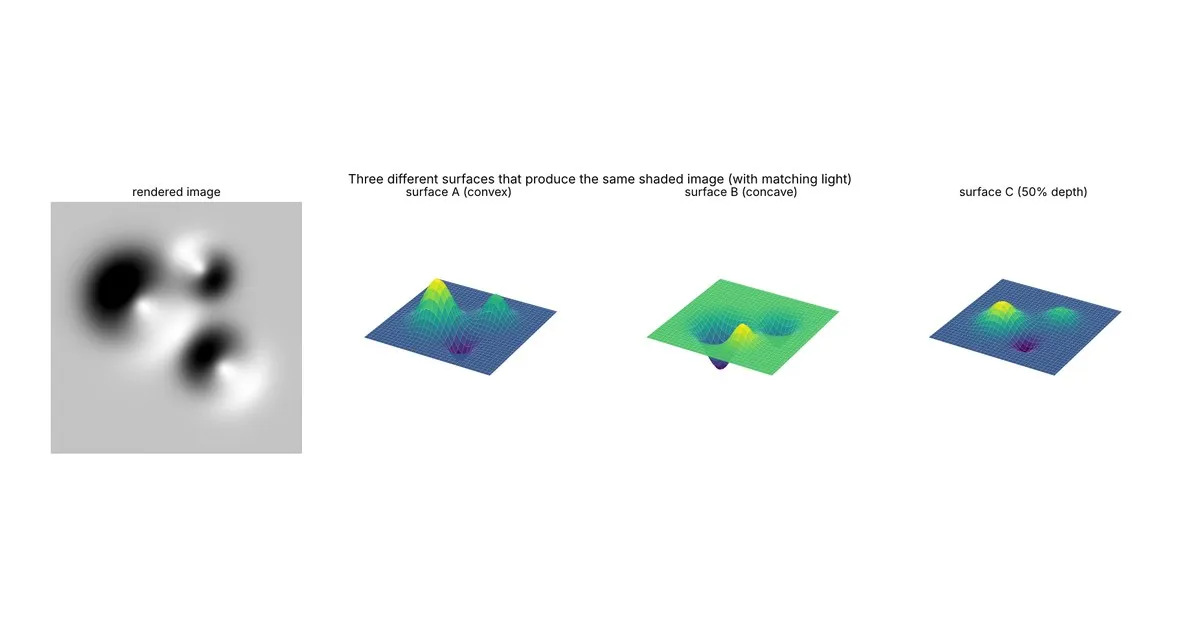
I built a synthetic surface, 512 × 512 samples, with two bumps and one dip. I rendered it with a single directional light and compared it with three alternative surfaces.
- Convex ↔ concave. Flip the depth (z → −z) and mirror the light horizontally.
- Bas-relief, 50% depth. Scale the depth by λ = 0.5, change the light accordingly and let the albedo vary across the surface. This is the generalized bas-relief family described by Belhumeur, Kriegman and Yuille (1999).
- Bas-relief with constant albedo. The same flattened surface, but with uniform albedo, after matching overall exposure.
Results
| Comparison (8-bit display scale) | Difference to the original image |
|---|---|
| Convex vs concave, light mirrored | 0.0 grey levels (identical) |
| 50% depth, light and albedo adjusted | below 10⁻¹³ grey levels (identical within floating point) |
| 50% depth, light adjusted, albedo constant | mean 17.2 grey levels, 99th percentile 83.5 |
The first two rows are the uncomfortable part. A convex shape and its concave twin produce exactly the same image. A surface half as deep produces exactly the same image too, as long as the albedo is allowed to vary. In this scene it has to vary by up to 57% from place to place. Shading alone does not tell you whether a face is a face or a mask seen from behind. It does not tell you whether a relief is deep or shallow either.
The third row shows the way out. If we assume something extra (here: the paint is uniform), the ambiguity breaks and the wrong surface becomes visible in the pixels. Every practical single-image method works this way. It adds information that is not in the photo.
Where the missing information comes from
- Assumptions about materials and light. Uniform albedo, a single distant light, no interreflections. These assumptions are cheap, but they are fragile in real rooms.
- Shadows and occlusion. Cast shadows tie the light direction to the geometry. Belhumeur et al. show that even shadows are preserved under the bas-relief transform, so they constrain less than one might hope.
- Learned priors. Networks such as MiDaS (Ranftl et al., 2022) and Depth Anything (Yang et al., 2024) learn from millions of images what scenes usually look like. Their output is a statistically likely answer, not a measurement.
- More views. As soon as there are two or more images, geometry becomes measurable. VGGT (Wang et al., 2025) infers cameras, depth and point maps from one, a few or hundreds of views in a single forward pass.
What this means for my work
SMART ONE builds a depth map, layers, materials and lighting from one frame. This experiment is the reason every SMART ONE output carries its source and status: measured, inferred from a prior or uncertain. My light-based reconstruction research tries to add physical constraints beyond the shading term, such as shadows, light falloff and inter-reflection, so that fewer of the remaining degrees of freedom are left to guesswork. The bas-relief result sets an honest bar for that work. A single-image method can be judged only by what it adds to the photo, never by how convincing its result looks.
If you are just starting
- A photo stores directions, not distances. Depth from one image is always partly a guess.
- When a tool gives you depth from one photo, ask what it assumed about light and materials.
- Shoot more than one view whenever you can: two photos turn guessing into measuring.
Reproduce it
The full experiment is about 40 lines of Python (NumPy and Matplotlib):
import numpy as np
n = 512; y, x = np.mgrid[-1:1:n*1j, -1:1:n*1j]
z = (0.6*np.exp(-((x+.3)**2+(y+.2)**2)/.08) + 0.35*np.exp(-((x-.35)**2+(y-.3)**2)/.05)
     - 0.25*np.exp(-((x-.2)**2+(y+.45)**2)/.03))
def render(z, s, albedo=1.0):
    zy, zx = np.gradient(z, 2/(n-1)); b = np.stack([-zx, -zy, np.ones_like(z)])
    nb = np.linalg.norm(b, axis=0)
    return np.clip(albedo*(b[0]*s[0] + b[1]*s[1] + b[2]*s[2])/nb, 0, None), nb
s = np.array([0.5, 0.4, 0.77]); s /= np.linalg.norm(s)
I0, nb0 = render(z, s)
Ia, _ = render(-z, np.array([-s[0], -s[1], s[2]]))          # concave twin
lam = 0.5; sb = np.array([s[0]/lam, s[1]/lam, s[2]])          # bas-relief light
_, nbb = render(lam*z, sb); Ib, _ = render(lam*z, sb, albedo=nbb/nb0)
k = 255/I0.max()
print(np.abs(I0-Ia).max()*k, np.abs(I0-Ib).max()*k)           # 0.0 and ~1e-13
References
- Barrow, H. G., & Tenenbaum, J. M. (1978). Recovering intrinsic scene characteristics from images. In A. Hanson & E. Riseman (Eds.), Computer Vision Systems (pp. 3–26). Academic Press.
- Belhumeur, P. N., Kriegman, D. J., & Yuille, A. L. (1999). The bas-relief ambiguity. International Journal of Computer Vision, 35(1), 33–44.
- Horn, B. K. P. (1970). Shape from shading: A method for obtaining the shape of a smooth opaque object from one view (MIT AI Technical Report 232).
- Ranftl, R., Lasinger, K., Hafner, D., Schindler, K., & Koltun, V. (2022). Towards robust monocular depth estimation: Mixing datasets for zero-shot cross-dataset transfer. IEEE TPAMI, 44(3), 1623–1637.
- Wang, J., Chen, M., Karaev, N., Vedaldi, A., Rupprecht, C., & Novotny, D. (2025). VGGT: Visual Geometry Grounded Transformer. CVPR 2025, 5294–5306.
- Yang, L., Kang, B., Huang, Z., Xu, X., Feng, J., & Zhao, H. (2024). Depth Anything: Unleashing the power of large-scale unlabeled data. CVPR 2024.
SEMEN KLENOV · Research notes on visual data. Drafted with AI assistance; experiment code and numbers checked by the author.