The struggle for attention: man as an imperfect program
Is every choice really free? How the brain's built-in settings are used by news, advertising, cinema and algorithms, and what a single question, why, can change.
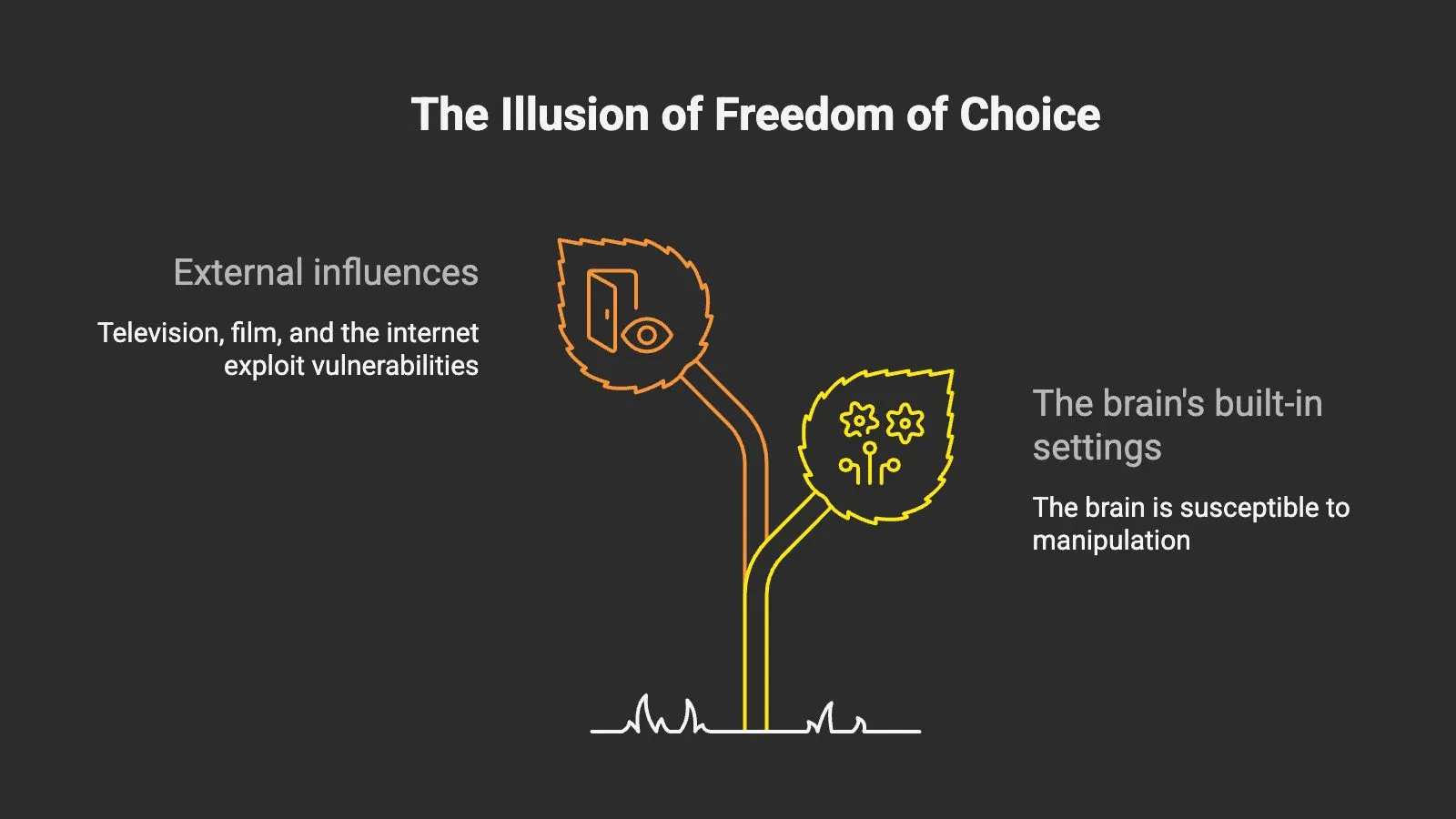
Are you sure that every choice you make is really free? Imagine for a second: millions of thoughts and decisions pass through your mind in a day, and it seems that all of them are the fruit of your own independent self. Yet we often act as if by a pre-written script, without noticing the invisible external threads that reach us from a television or a smartphone screen. Could it be that freedom of choice is an illusion, and our thoughts are steered by someone else?
This article develops that provocative idea. We will try to see what really drives us, what the brain’s built-in settings control, and how outside influences from television, cinema and the internet use those settings the way software uses vulnerabilities.
Man as a system
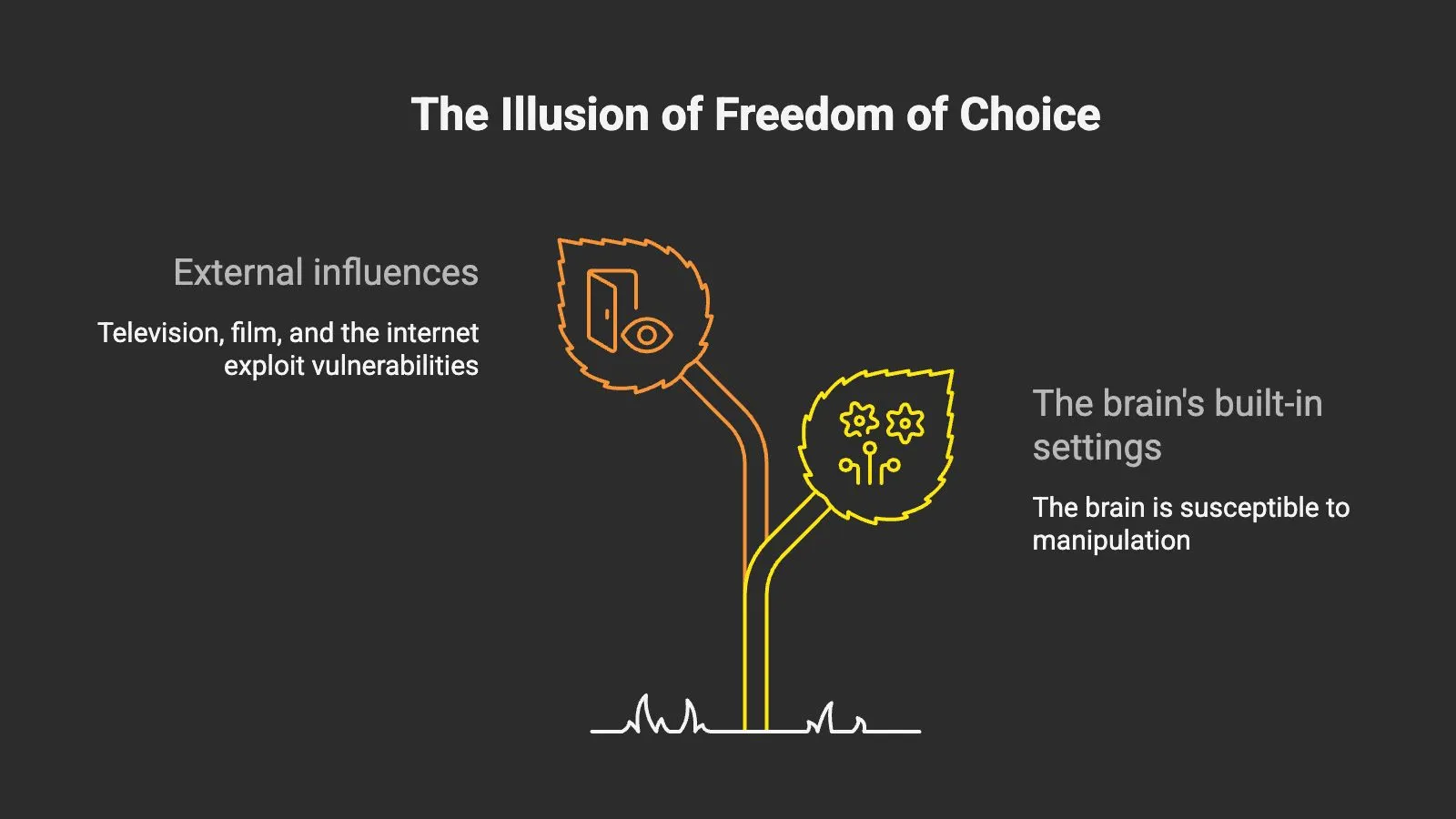
To understand why we are easy to program, recall how the mind is built. Over millions of years of evolution the brain became a very frugal manager of energy. Its firmware is tuned to save: each time we meet a new situation, it is easier for the brain to apply a template or a familiar scenario than to process all the information again. That is why we look at the world through simplified schemes. The brain does not look for truth. It looks to save energy.
Try to remember how you learned about events in another country. Most likely not by studying every source, but through the most noticeable news, catching on vivid details. The brain made a choice for you about what is important and what is not. This is how the attention filter works. It does not select information consciously. Like an embedded banner, it highlights the loudest and most emotionally intense pieces of reality and leaves the rest in shadow.
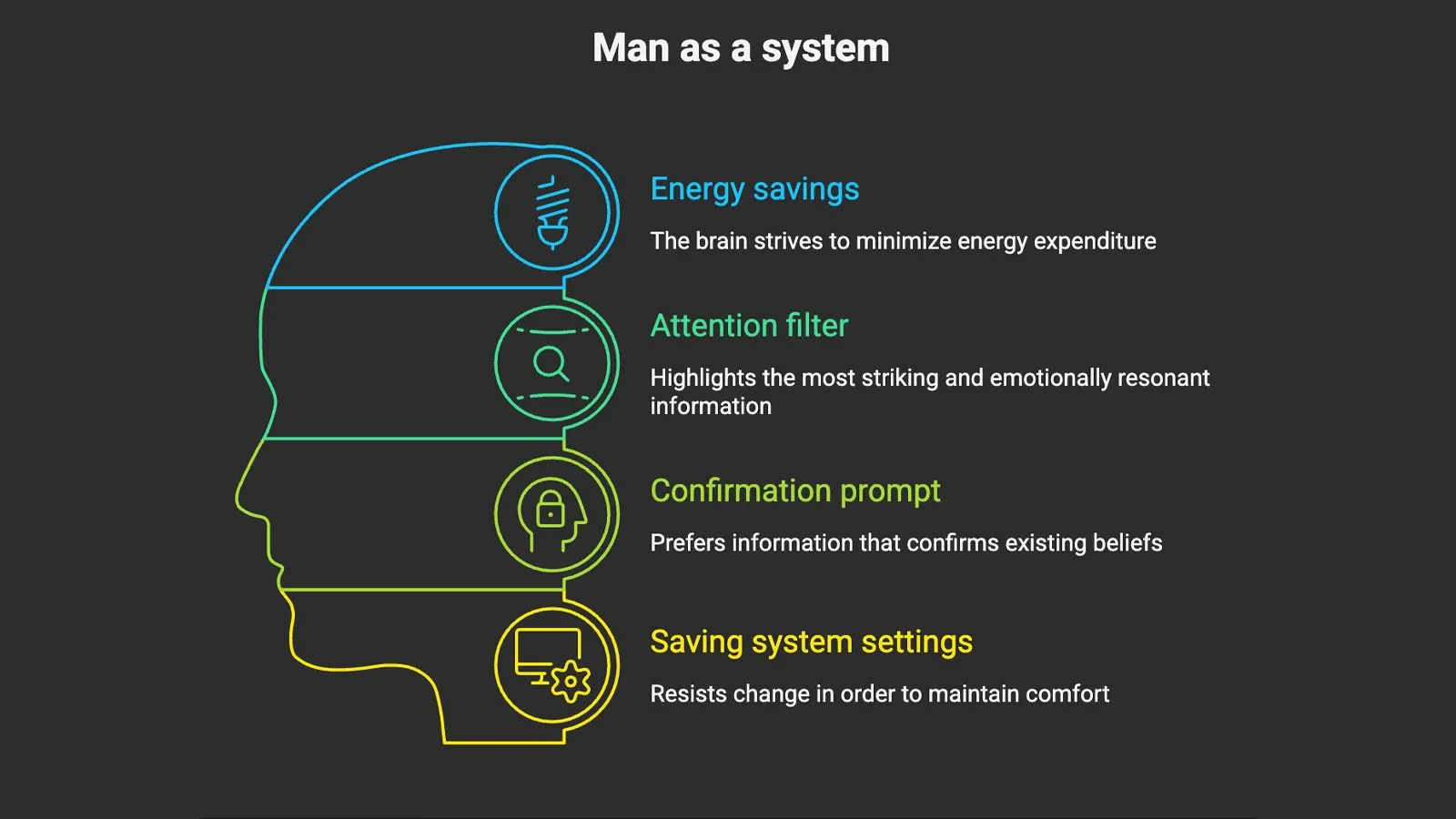
This effect is called confirmation bias. The brain works as a filter: it lets through what we like and blocks what makes us doubt ourselves.
Example: “always late”. Imagine you are convinced that your new colleague is unreliable and lazy because he was fifteen minutes late on his first day. Every time he is a couple of minutes late, or leaves work on time, the brain ticks a box: “I was right.” Meanwhile consciousness ignores the days when he arrived before everyone else or stayed late.
Revising an opinion about a person or a phenomenon is a heavy energy load for the brain. It requires you to:
- Admit that the old scheme was wrong.
- Build a new logical chain.
- Keep checking it.
It is easier to call an exception an accident than to change the rule itself. We protect our comfort by living in a cosy world of old settings, even if it stopped matching reality long ago. This is not a trick of the brain but its natural feature: when new information breaks the familiar picture of the world, the brain prefers to discard it rather than rebuild. This is how it “saves the system settings”, even when they are out of date.
Behavioural patterns
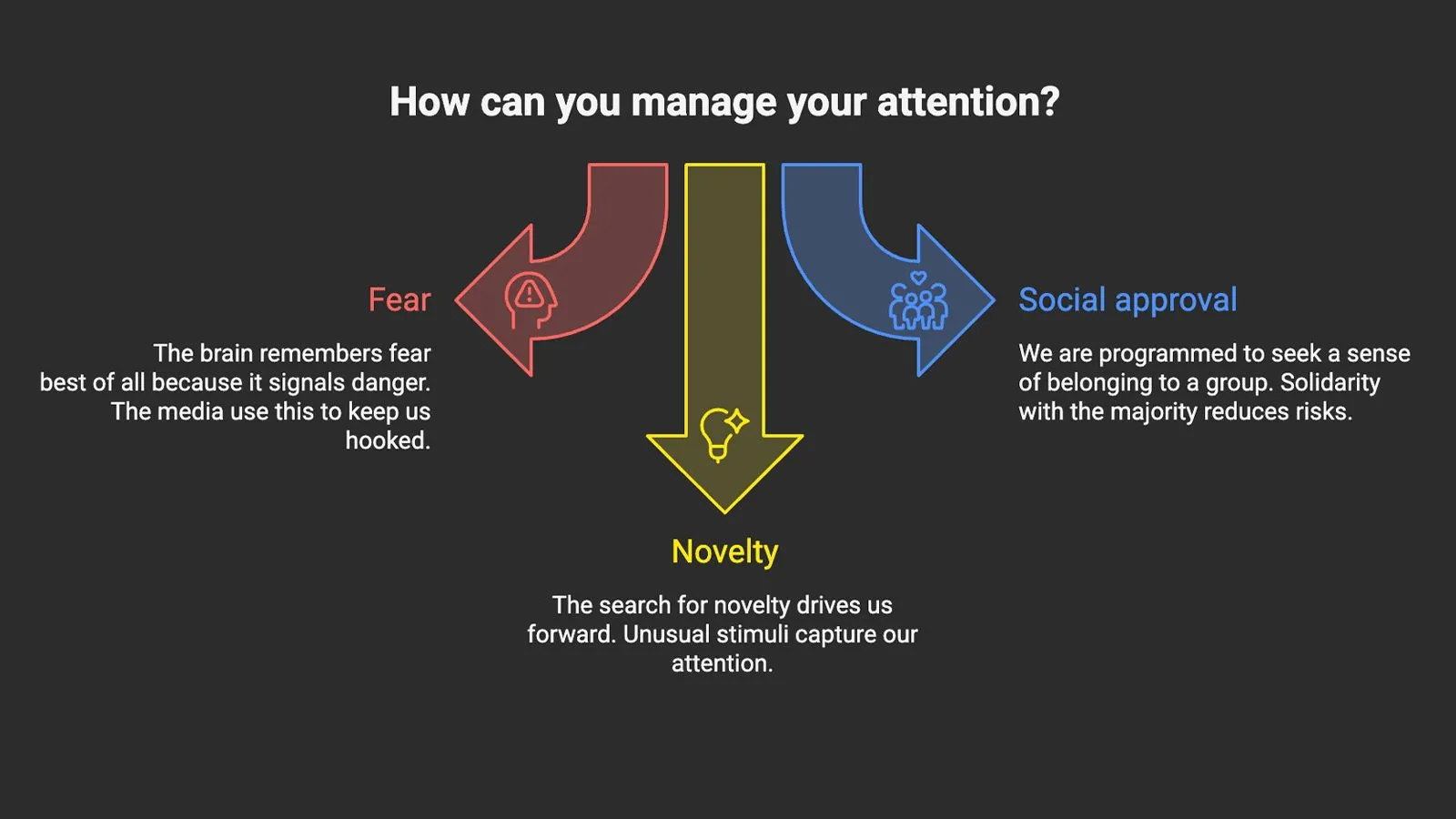
Alongside these basic settings we get a system of cognitive filters. They are biologically determined mechanisms that set the priorities of perception: where to look first and what to keep in memory. Fear, the need for social approval and the pull of novelty are fundamental survival patterns.
Fear and negative bias. Fear works as the strongest signal. The brain remembers it best because fear marks a possible danger. When you meet alarming news, the brain instantly mobilises its attention. In evolution, remembering threats was crucial: those who ignored danger did not leave offspring. That is why dramatic headlines and incidents in the media gather so much attention. They work like an emergency alert from nature itself: the brain’s safety system decides that ignoring such a signal is risky. Media and social-network algorithms use this to produce an endless stream of content that exploits our anxiety in order to keep us engaged.
Social proof. On a biological level we are programmed to seek belonging to a group. When we see success stories or mass trends, the brain produces a dopamine response: we want to take part in the “right” behaviour so as not to remain isolated. Solidarity with the majority is an ancient way to reduce risk. As a result, whatever is widely approved quietly becomes our own internal standard. Stories about prize-winning heroes or trends that “everyone is talking about” give a pleasant feeling of “I am like them too” and encourage us to follow the crowd.
The pull of novelty. If fear and the group keep us safe, the search for novelty keeps us moving. Scientists call it exploratory behaviour. Our brain is a prediction machine, and any new or non-standard stimulus is treated as a possible source of a resource or of important information. Anything unusual stands out on the radar of perception, because the brain directs extra energy to analysing an unknown object. We reach for the new because useful opportunities may be hidden there. Advertisers use this mechanism on purpose, with visual pattern breaks and unexpected twists. We literally cannot look away until the brain has classified the new object and worked out how to deal with it.
So the vulnerability of perception is not a mistake but an inheritance. It was vital for our ancestors to notice the slightest movement in the bushes or a change in the mood of a fellow tribesman, without wasting time on thousands of neutral phenomena. Speed of reaction mattered more than depth of analysis.
In the modern world, though, these mechanisms have turned into control interfaces. Once we understand which buttons are being pressed by fear, novelty or a thirst for approval, it becomes clear that our attention is not always the result of a conscious choice. It is a resource run by ancient programs, and in the age of information noise they increasingly work against their owner and make us open to outside manipulation.
Media and management
Modern media, from television to social networks, have turned the exploitation of our biological vulnerabilities into an automated process. A news feed or a recommendation feed is no longer a random set of data. It is a personalised mosaic in which every element is calibrated to your reactions. The system does not just offer content: it predicts which stimulus will keep you online longer.
The first level of influence is the field of basic instincts. The main task of news content is to create a powerful emotional hook, so the media lean on anxiety and uncertainty. The brain classifies negative information as critical for survival. The effect is cumulative: regular consumption of alarming content makes a person more suspicious and subconsciously more aggressive. Fear here is not just an emotion but an effective tool for holding an audience for the messages that follow.
If news works with the instinct of self-preservation, films and series turn to subtler settings: the need to belong and the search for identity. We tend to unite around shared ideas, values and images of the future. In a single media mechanism, cinema is the final stage in assembling a worldview:
- News creates a background of urgency and danger and unsettles the psyche.
- Advertising offers a quick relief from the discomfort and forms new consumer and behavioural habits.
- Films and series finish the process by offering role models and meanings a person will want to identify with.
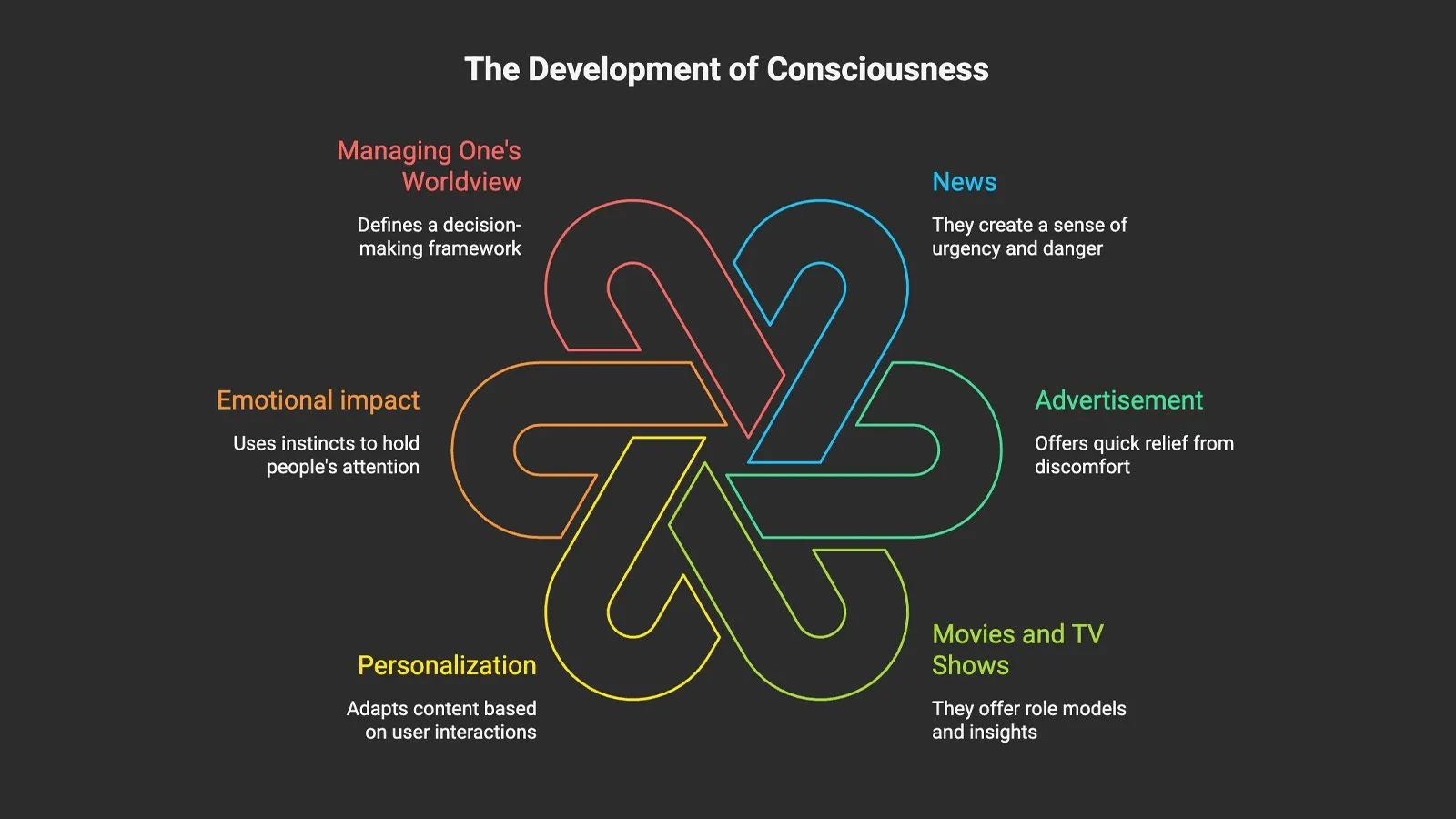
This creates a closed system for predicting reality: a person is not just sold a product or an idea but is given a coordinate system in which they will make decisions later. Every time content causes a sharp emotional outburst, whether anger, delight or anxiety, ask yourself: “Why am I being shown this?” Almost always the answer is an attempt to keep your attention inside someone else’s coordinate system and to impose a ready-made model of behaviour, passed off as your own choice.
Counteraction
The most influential manipulators today are algorithms. If you have read this far, the algorithm has already understood that you are interested in the topic, and tomorrow it will offer you something similar. These programs follow a simple rule: show exactly what has already received your attention. Our perception is filtered not only by the brain but by the machine. Modern technology has made the influence almost invisible. That fine-tuning gives enormous power: a person is shown only the reality that suits them, and an opinion forms gradually, without their knowledge.
But there is a way out. The first and easiest step is to start asking “Why?”. The more we control what we see, the less the algorithms control us. It is important to learn to notice patterns, and the easiest way to understand the mechanics of influence is to observe yourself.
We are imperfect, but it is our humanity, the ability to reflect and the wish to look for the truth, that gives us a chance to govern ourselves and not be governed in a single direction.
Conclusion
Human beings are unique creatures, but inside each of us there is a whole code library of cognitive patterns. A person is vulnerable, and that vulnerability has long been used for manipulation. Freedom of choice has not disappeared entirely, though. It lives in our attention and our self-interest. When you start to notice outside influences, you are no longer a puppet. Even the small question “why?” makes the brain process information more consciously.
They are constantly trying to reprogram us, but the ability to resist remains inside each person. It is awareness that gives a chance to break the vicious circle of automatic reactions. The more questions we ask, and the more persistently we look for answers, the closer we come to real freedom.