Home / Journal / Technical research
A team of models: routing creative work between AI agents
The research on LLM routing and cascades, the architecture of my SAM system, and real numbers from my queue: 10 of 107 agent answers went into active work.
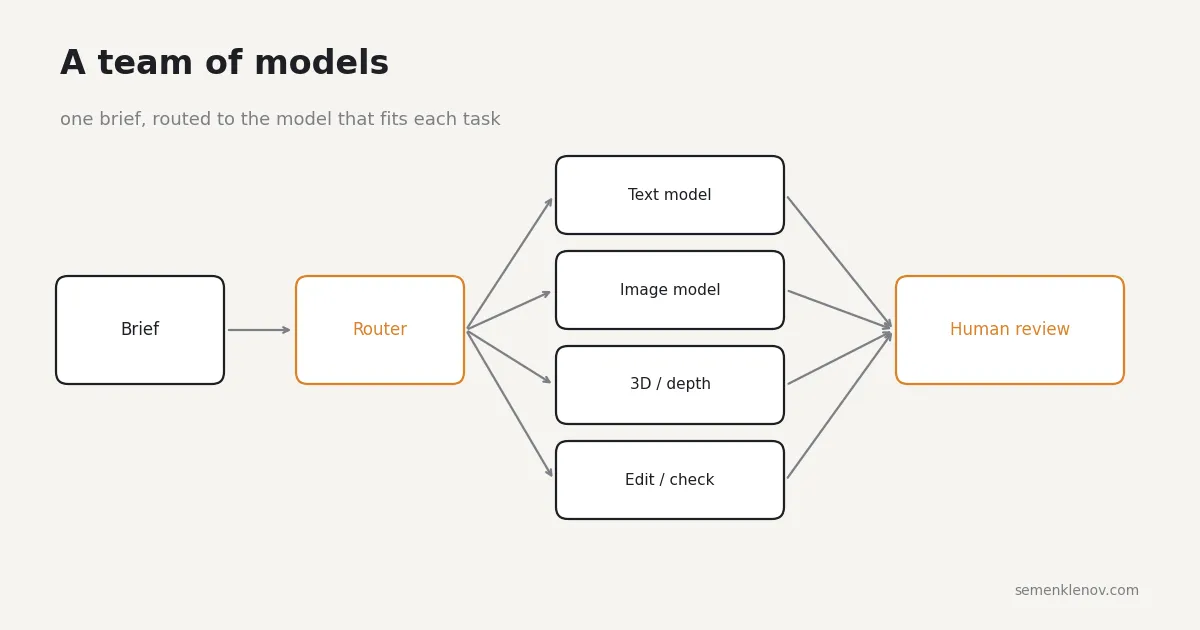
For the past weeks I have been running my projects with a small “team” of AI models instead of a single assistant. SAM, my control system, takes a task from my phone, decides which model should do it, queues it and collects the answer in my Obsidian notes. In this article I cover the research behind routing between models and the architecture I chose. It ends with the first hard numbers from my own queue, which turned out to be about planning more than about models.
Why route at all
Large language models differ by orders of magnitude in price and capability. Sending everything to the strongest model is expensive. Sending everything to the cheapest one is unreliable. Research now treats this as an optimisation problem.
- FrugalGPT (Chen, Zaharia & Zou, 2023) describes three cost strategies: prompt adaptation, LLM approximation and LLM cascades. In a cascade, a cheap model answers first and a stronger one is called only when the answer looks unreliable. The authors report matching the best single model with up to 98% lower cost on their benchmarks.
- RouteLLM (Ong et al., 2025) instead trains a router that decides before answering whether a query needs the strong or the weak model. It learns this from human preference data, and each query goes to exactly one model.
- AutoGen (Wu et al., 2023) is a framework in which several agents, each with a role, talk to each other to solve a task. It is useful when a task needs planning, coding and checking by different “specialists”.
The common idea: capability is a budget. Spend the expensive model on the hard parts and let cheaper ones do the rest.
The SAM architecture
- Interface. I send a task from my iPhone, by text or voice.
- Lead. A strong model (Claude) reads the task, splits it and writes sub-tasks into a queue. Each sub-task names its project, agent, priority and expected time.
- Workers. Command-line and API agents (Gemini, DeepSeek, Kimi, GPT) take tasks from the queue. A small local model is used only when I ask for it explicitly.
- Storage. Every task, answer and decision is a Markdown file in my Obsidian vault, linked to its project, so nothing lives only inside a chat.
- Ledger. Calls and remaining credits are logged, so cost is visible per project.
- Review. A worker’s answer stays “under review” until the lead or I accept it.
Two design rules came from practice. First, agents talk to each other through code (CLI and APIs), not by reading screens in a browser; it is cheaper and far more reliable. Second, the system must run from the phone without approvals on the laptop. Otherwise it does not get used.
First numbers from my own queue
On 25 November 2026 I reviewed every answer that had piled up in the queue: 107 results across 11 projects, written mostly by Gemini and DeepSeek working without internet access.
| Outcome | Results | Share |
|---|---|---|
| Accepted into active work | 10 | 9% |
| Closed: the decision had already been made elsewhere | 40 | 37% |
| Archived: the project was frozen in the meantime | 57 | 53% |
Only one in eleven answers went into active work. The main reason was not quality. More than half of the answers belonged to projects I froze when I reset my priorities. Over a third were overtaken by decisions I made faster in a live session. Some answers were also built on outdated assumptions, because the workers had no internet and no fresh context.
The lesson is uncomfortable but useful. In a multi-agent system, the router that matters most is the one that decides which tasks exist at all, not which model answers them. Cheap models made 107 drafts at low cost, and most of that work was wasted because the tasks were chosen before the priorities were. I now limit worker tasks to the projects in my active plan and give offline workers explicit, current facts. I also treat every offline answer as a draft whose facts must be checked before use.
What this means for my work
SAM is the infrastructure behind my other projects: research notes, the SMART ONE campaign, the book and the website. It also lets me run my own small experiments on how to work with AI, such as the queue numbers above. Next, I will measure acceptance rate and cost per accepted result per agent, now that the queue is restricted to active projects. I will publish those numbers too.
If you are just starting
- Use a strong AI model to plan and check, and cheaper ones for drafts and routine work.
- Keep every AI answer in files you own, linked to the project. Chats get lost.
- Decide what you need before you ask. Most wasted AI output answers questions nobody needed.
References
- Chen, L., Zaharia, M., & Zou, J. (2023). FrugalGPT: How to use large language models while reducing cost and improving performance. arXiv:2305.05176.
- Ong, I., Almahairi, A., Wu, V., Chiang, W.-L., Wu, T., Gonzalez, J. E., Kadous, M. W., & Stoica, I. (2025). RouteLLM: Learning to route LLMs with preference data. ICLR 2025. arXiv:2406.18665.
- Wu, Q., et al. (2023). AutoGen: Enabling next-gen LLM applications via multi-agent conversation. arXiv:2308.08155.
SEMEN KLENOV · Research notes on AI systems. Drafted with AI assistance; queue data from the author’s own system.