Home / Journal / Cinematography
History of Cinema: Lumière, Soviet Cinematography and European Movements
From the Lumière screening of 1895 and Méliès to Soviet cameramen, Toland, German Expressionism, Italian Neorealism and the French New Wave.
Cinematography is a craft with a lineage of named people: directors and the cameramen who made their images. This article traces the main lines, from the first public screening, through early Russian and Soviet cinema and the classical era, to the great European movements.
Key points
- The first commercial public screening of projected motion pictures took place on December 28, 1895, at the Grand Café in Paris, given by the Lumière brothers.
- Georges Méliès turned cinema into narrative fantasy, with in-camera and optical effects that remain part of the toolkit.
- Soviet cinema produced lasting director-cinematographer partnerships, and Sergei Urusevsky’s mobile camera changed how the camera could behave.
- Gregg Toland’s deep-focus work on Citizen Kane (1941) is a classic example of lens, lighting and set design working together.
- European movements, from German Expressionism to the New Wave, each tied a visual method to a worldview.
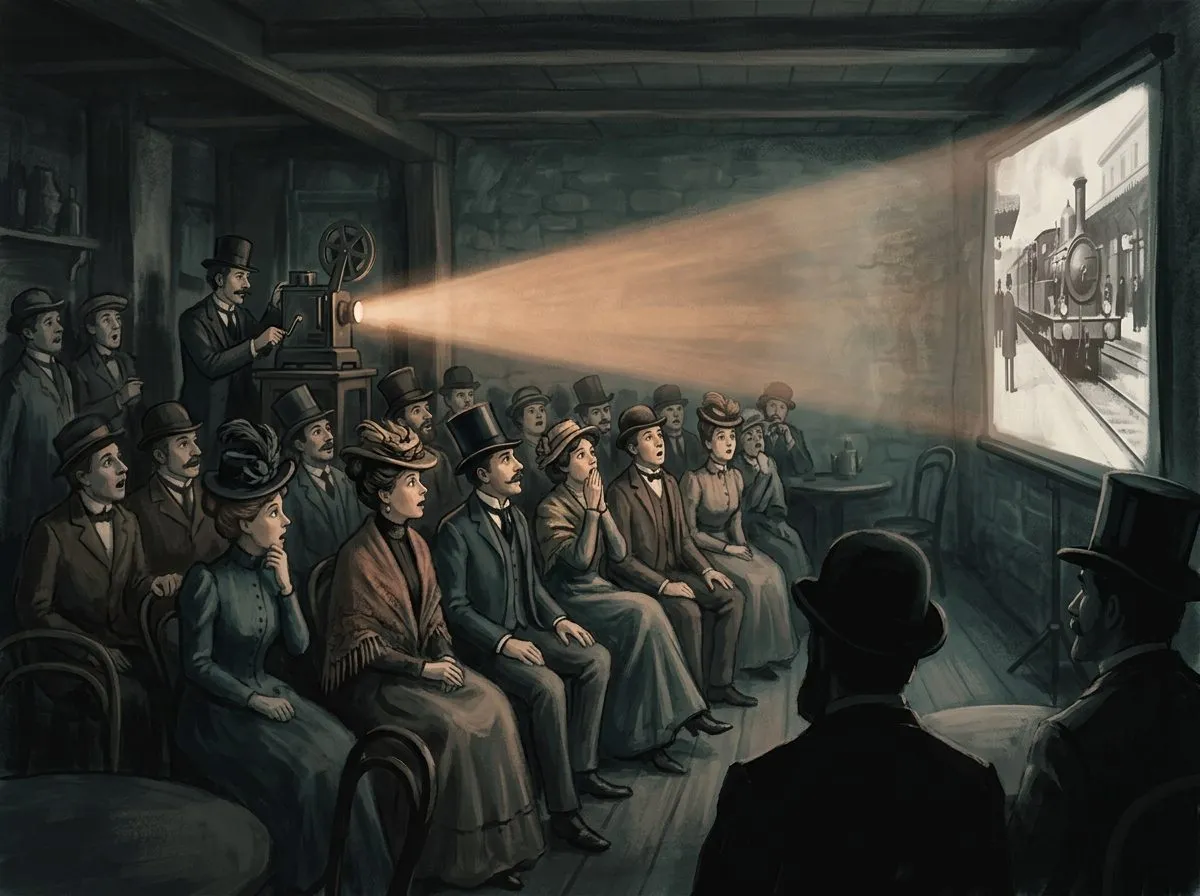
The first public film screening, 1895
The birth of cinema
The Lumière screening of 1895 is the conventional starting date of public cinema. Soon afterwards Georges Méliès built a professional film studio and pioneered narrative fantasy together with dissolves, double exposures, split-screen mattes, time-lapse, over- and undercranking, stop-motion substitution and expressive theatrical lighting. In Russia, Alfred Fedetsky shot early documentary footage in 1896, including a train leaving Kharkiv station and public festivities on Red Square, and in 1908 Alexander Drankov produced the first Russian narrative short, Stenka Razin, photographed by Nikolai Kozlovsky in six tableau scenes; October 28 is marked as the birthday of Russian narrative cinema.
Soviet cinematography
After 1917, early Soviet cinema joined propaganda, social realism and formal experiment, and gave rise to partnerships between directors and cameramen:
- Sergei Eisenstein and Eduard Tisse
- Vsevolod Pudovkin and Anatoly Golovnya
- Alexander Dovzhenko and Danylo Demutsky
- Grigori Kozintsev, Leonid Trauberg and Andrei Moskvin
- Dziga Vertov and Mikhail Kaufman
Eisenstein drew on German Expressionism and Baroque art, bringing high-contrast light and dynamic framing into montage. Socialist Realism shaped the work of cameramen such as Yuri Ekelchik and Mark Magidson, and the tradition culminated in Sergei Urusevsky, who with director Mikhail Kalatozov made The Cranes Are Flying (1957), Letter Never Sent (1960) and I Am Cuba (1964). His camera moved with the actors as an emotional participant, using wide lenses close to the body, long mobile tracking and expressive shifts of light.
The handbook also groups later Soviet cinematography into regional schools. The Moscow school (Vadim Yusov, Georgy Rerberg, Pavel Lebeshev) is described as graphic and precise, with clean perspective and controlled values. The Leningrad school (Valery Fedosov, Dmitry Dolinin) favours soft painterly texture, rich half-tones and aerial perspective. The Ukrainian school (Yuri Ilyenko, Vilen Kalyuta) is poetic and colourful with energetic handheld work, and the Georgian school (Levan Paatashvili, Archil Akhvlediani) combines expressive light, high tonal contrast and rich cultural portraiture. Georgy Rerberg, who shot Andrei Tarkovsky’s Mirror, was known for psychological realism and naturalistic, painterly values.
The classic era
D. W. Griffith helped establish the grammar of continuity editing: wide masters, reverse angles, close-ups and cross-cutting, in collaboration with cinematographer Billy Bitzer and actress Lillian Gish, in The Birth of a Nation (1915) and Intolerance (1916). In 1912 Mack Sennett founded Keystone Studios, where Charlie Chaplin began. The Jazz Singer (1927) opened the sound era, followed in France by René Clair’s Under the Roofs of Paris (1930). The Golden Age of Hollywood was dominated by the major studios: 20th Century Fox, Paramount, Warner Bros., MGM and Columbia.
Gregg Toland tailored a visual style to each script and pioneered deep-focus cinematography, coated lenses and ceilinged sets on Orson Welles’s Citizen Kane (1941). His credits include The Grapes of Wrath, Dead End, The Little Foxes and The Best Years of Our Lives.
European film movements
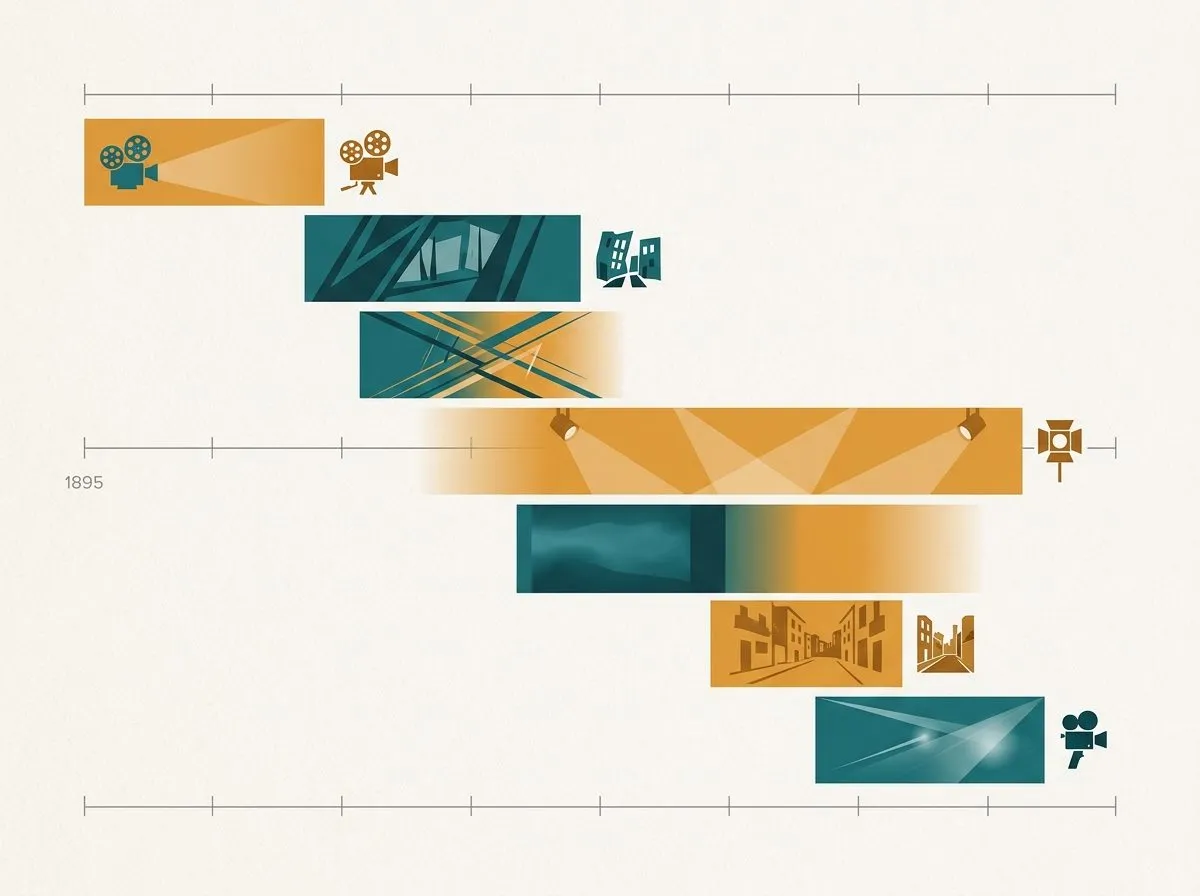
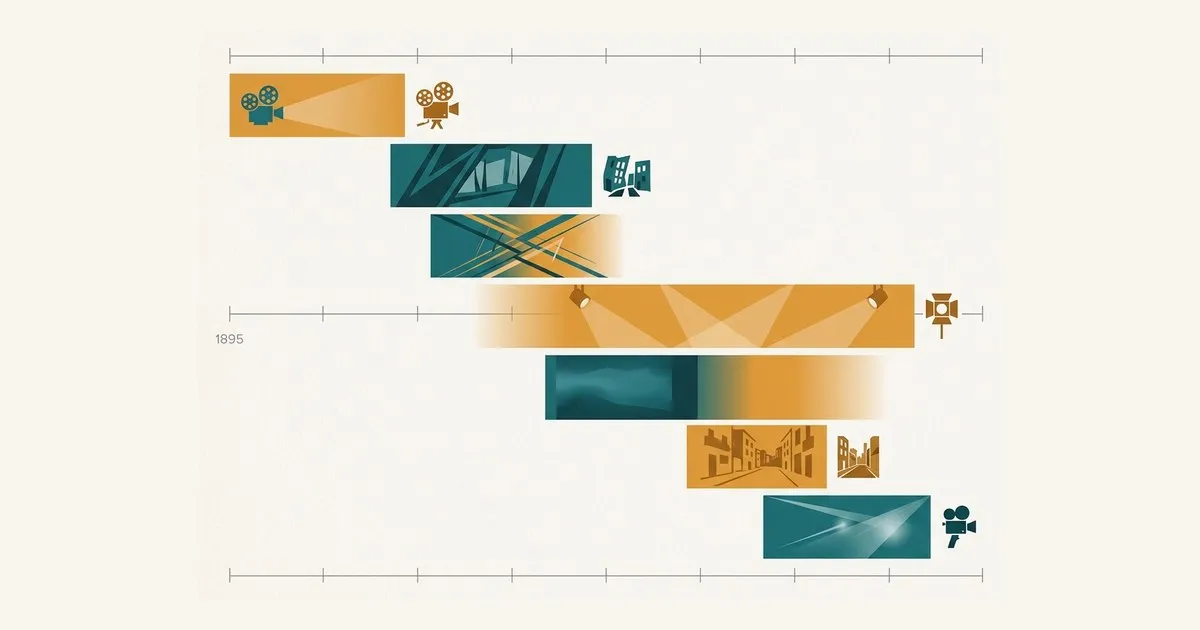
Timeline of film movements
- French avant-garde (impressionist cinema). Louis Delluc and Abel Gance explored cinema as visual music, with rapid rhythm, superimposition and expressive camera movement.
- German Expressionism (1919 and the 1920s). A rejection of naturalism, with distorted sets, stark shadows and psychological staging: The Cabinet of Dr. Caligari (1920), directed by Robert Wiene and shot by Willy Hameister.
- Italian Neorealism. Real locations, non-professional actors, natural light and working-class stories: Rome, Open City (1945, Rossellini, shot by Ubaldo Arata) and Bicycle Thieves (1948, De Sica, shot by Carlo Montuori).
- French Poetic Realism. Real working-class settings with poetic, moody light: Marcel Carné’s Port of Shadows (1938, shot by Eugen Schüfftan) and Le Jour se lève (1939, shot by Philippe Agostini).
- French New Wave (late 1950s and the 1960s). Location shooting, handheld cameras, natural light, improvised staging and jump cuts: Truffaut’s The 400 Blows (1959, Henri Decaë), Godard’s Breathless (1960, Raoul Coutard) and Resnais’s Hiroshima Mon Amour (1959, Sacha Vierny). Colour works such as The Umbrellas of Cherbourg (1964) and A Man and a Woman (1966) extended its influence.
Quick answers
When did public cinema begin? With the Lumière brothers’ paid screening in Paris on December 28, 1895.
Why is Gregg Toland remembered? For deep-focus photography, with coated lenses and ceilinged sets, on Citizen Kane.
What links Neorealism and the New Wave? Both left the studio for real locations and natural light, though with different politics and methods.
Read next
- History of Photography: From the Camera Obscura to the Rolleiflex
- Art Movements, Genre and Narrative: Visual Culture for Cinematographers
- Advice for the Cinematographer: Craft, Discipline and the Viewer’s Eye
Related on this site
- Ultimatum: working with light as a drama of space
- One light, two worlds: physical units from the film set to the render engine
This article is part of the free handbook Technical Foundation. Filmmaking: The Cinematographer’s Handbook by Semen Klenov, an independent researcher of light and visual perception. Cite the handbook as: Klenov, S. (2026). Technical Foundation. Filmmaking: The Cinematographer’s Handbook. Zenodo. https://doi.org/10.5281/zenodo.24326083.