Home / Journal / Technical research
One light, two worlds: physical units from the film set to the render engine
Lux, candela, stops and mireds: the few relations that let a lit set and its digital double be matched by calculation, not guesswork.
On a film set, a gaffer talks in lux, stops and kelvin. In a render engine, a lighting artist often types “intensity 10” and adjusts by eye. Both are trying to control the same thing: light arriving at a surface and then at a sensor. My book Technical Foundation. Filmmaking starts from the physics of light for this reason. If both sides use the same units, a lit set and its digital double can be matched by calculation instead of guesswork. In this article I gather the few relations that do most of the work.
Four units that matter
| Quantity | Unit | What it describes | Where you meet it |
|---|---|---|---|
| Luminous flux | lumen (lm) | Total visible light a source emits | Lamp datasheets, LED panels |
| Luminous intensity | candela (cd) | Light per unit solid angle in one direction | Spot and fresnel photometry |
| Illuminance | lux (lx = lm/m²) | Light arriving at a surface | Incident light meter, set planning |
| Luminance | cd/m² (nit) | Light leaving a surface toward the viewer | Monitors, HDR, what the camera “sees” |
These are photometric units, weighted by human vision. Renderers work internally with radiometric quantities (watts, radiance), which describe energy without that weighting. Converting between the two is well defined for a given spectrum.
The inverse-square law, in stops
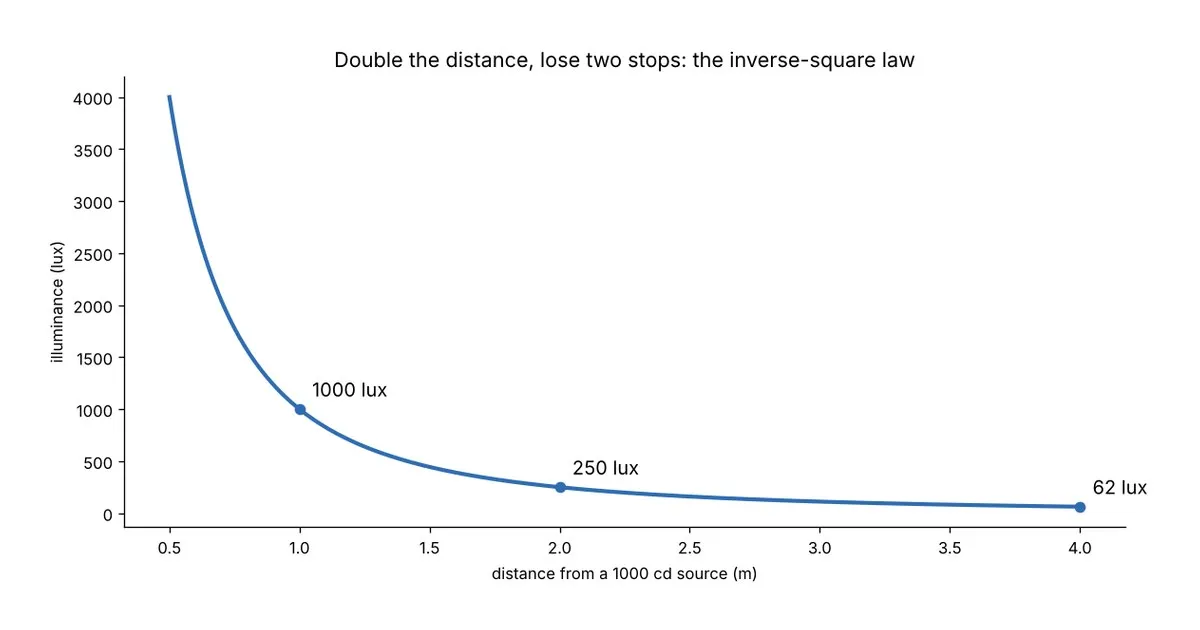
For a small source, illuminance falls with the square of the distance: E = I / d². For a 1000 cd source:
| Distance | Illuminance | Change vs 1 m |
|---|---|---|
| 0.5 m | 4000 lx | +2 stops |
| 1 m | 1000 lx | 0 |
| 1.41 m | 503 lx | −1 stop |
| 2 m | 250 lx | −2 stops |
| 2.83 m | 125 lx | −3 stops |
| 4 m | 62.5 lx | −4 stops |
Rule: every ×1.41 in distance costs one stop. Every doubling costs two. This is why moving a key light back is the cheapest way to make a falloff gentler across a scene. It is also why a lamp that looks right in a small studio can look flat in a big one. The law holds for point-like sources. Large soft sources and lenses (fresnels, reflectors) deviate from it near the source.
Colour temperature, in mireds
Kelvin numbers are not linear for the eye. Gel and white-balance shifts add up correctly in mireds: mired = 1,000,000 / K.
| Shift | Mired change |
|---|---|
| 5600 K daylight → 3200 K tungsten | +133.9 |
| 6500 K → 5600 K | +24.7 |
| 3200 K → 2700 K | +57.9 |
The same 500 K step is a small shift at the daylight end and a much larger one at the tungsten end. For a digital double, the light colour should be set from the measured mired value, not adjusted until it “looks warm”.
Where the render engine comes in
Physically based renderers solve, approximately, the rendering equation (Kajiya, 1986). It balances the light leaving each point against the light arriving from everywhere else. Physically Based Rendering (Pharr, Jakob & Humphreys, 2023) is the standard reference for how this is implemented. Two practical consequences:
- Lights in physical units. Modern engines let you set lights in real units; Unreal Engine, for example, offers candela and lumen units for point and spot lights. If the set was metered, the digital light can start from the measured value.
- Measured environment light. Debevec and Malik (1997) showed how to recover high-dynamic-range radiance maps from a bracket of photographs. Debevec (1998) used such maps to light synthetic objects so that they sit convincingly in real scenes. This is the basis of the HDRI workflow every VFX artist uses today.
What this means for my work
The book collects this physics for filmmakers: optics, electricity on set, lighting technology and the history of the image. My research projects take the same physics in the other direction. SMART ONE estimates the lighting of a scene from a single photo and builds an HDRI and a photon simulation of how light moves through a room. My light-based reconstruction work tries to use the behaviour of light, falloff and shadows included, as a constraint on geometry. The common thread is simple: light is measurable, so the decisions we make with it can be measurable too.
If you are just starting
- Learn three numbers by heart: double distance = minus 2 stops, ×1.41 distance = minus 1 stop, mired = 1,000,000 / K.
- Buy or borrow an incident light meter once. It teaches light faster than any tutorial.
- In 3D, start a scene with physical light units and real-world sizes before you adjust by eye.
References
- Debevec, P. E., & Malik, J. (1997). Recovering high dynamic range radiance maps from photographs. Proceedings of SIGGRAPH 97, 369–378.
- Debevec, P. (1998). Rendering synthetic objects into real scenes: Bridging traditional and image-based graphics with global illumination and high dynamic range photography. Proceedings of SIGGRAPH 98, 189–198.
- Kajiya, J. T. (1986). The rendering equation. Computer Graphics (Proceedings of SIGGRAPH 86), 20(4), 143–150.
- Klenov, S. (2026). Technical Foundation. Filmmaking: The Cinematographer’s Handbook (v1.1). Zenodo. https://doi.org/10.5281/zenodo.24325834
- Pharr, M., Jakob, W., & Humphreys, G. (2023). Physically Based Rendering: From Theory to Implementation (4th ed.). MIT Press.
SEMEN KLENOV · Research notes on light and 3D graphics. Drafted with AI assistance; calculations checked by the author.