Home / Journal / Technical research
Your phone as a measuring instrument: what LiDAR can and cannot do
Peer-reviewed numbers for smartphone LiDAR (±1 cm on small objects, 5 m range) and the test protocol I will run on my iPhone 16 Pro before trusting it.
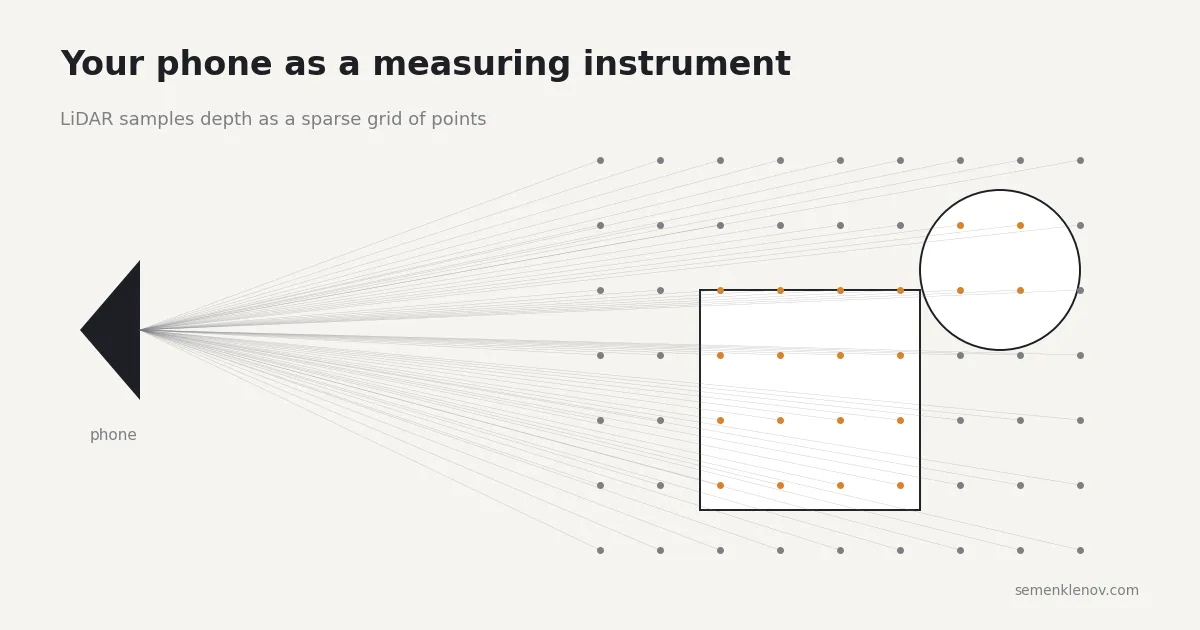
Since 2020, Pro iPhones and iPads have carried a small LiDAR sensor. I use mine to capture rooms, objects and travel locations for 3D work and for SMART ONE. The open question is how far a phone can be trusted as a measuring instrument, and not just as a scanner that makes nice-looking models. In this article I summarise the best peer-reviewed answer I know of. It also sets out the test protocol I will run on my own device, before I quote any number from it.
What the research says
Luetzenburg, Kroon and Bjørk (2021) tested the LiDAR of the iPhone 12 Pro and iPad Pro 2020 in the lab and on a coastal cliff in Denmark, and compared it with a structure-from-motion multi-view stereo (SfM MVS) survey. Their main numbers:
| Measure | Result |
|---|---|
| Small objects, side length above 10 cm | absolute accuracy ± 1 cm, precision about 1 cm |
| Detection limit | objects around 5 cm; precision drops below 10 cm |
| Maximum range | up to 5 m |
| Point density | 7,225 points/m² at 25 cm, falling to 150 points/m² at 250 cm |
| Cliff models up to 130 × 15 × 10 m | absolute accuracy ± 10 cm |
| Whole cliff vs SfM MVS | about 80% of points within 15 cm, 92% within 30 cm |
The authors conclude that the devices are cost-effective tools for close-range work. They also state clearly that accuracy and precision do not yet reach the standard of SfM MVS. They list the limits:
- short range;
- export of the raw points is restricted, so apps sample points from a mesh;
- weaker returns on vegetation;
- error growing with distance;
- only five repeat scans per object in their precision test.
What this means in practice
- Good for: rooms, furniture, props, building details within a few metres, quick reference geometry for 3D scenes.
- Poor for: distant facades, fine details below about 5 cm, anything where centimetre accuracy matters at more than a couple of metres.
- Always remember: the app’s mesh is already a smoothed interpretation. It is not the raw measurement.
My protocol for the iPhone 16 Pro
The study used a 2020 device. Newer phones may behave differently, and I have not measured mine yet. Before I use LiDAR depth as evidence in SMART ONE, or for the VR capture of my university campus that I am planning, I will run this test and publish the numbers in a follow-up note.
- Targets. Three boxes with measured edges (about 5, 10 and 30 cm), plus one 1 m reference bar. Measured with a calliper and a steel tape.
- Distances. 0.5, 1, 2 and 4 m from the target.
- Repeats. 10 scans per distance, a fresh scan each time, same app and settings, logged.
- Surfaces. Matte card, wood, glossy plastic, plant leaves.
- Measures. Edge length error, and RMS distance to the box planes after fitting, reported in millimetres.
- Reporting. All raw files, the scripts and a table of mean, standard deviation and worst case per distance and surface, including the failed scans.
The point of the protocol is that I will publish the number with its conditions, and not a single headline figure.
What this means for my work
SMART ONE treats depth from a single photo as an inference with uncertainty. LiDAR depth, by contrast, is a measurement, but only inside its range and accuracy envelope. In a SMART ONE report, a LiDAR distance should therefore come with its distance band and expected error, and outside 5 m it should not appear as a measurement at all. The study above gives the first version of that envelope; my own test will replace it with numbers for my device.
If you are just starting
- Phone LiDAR is great within about 5 m and for objects larger than about 10 cm.
- Always scan a reference object of known size in the same capture, so you can check scale.
- Repeat a scan several times before you trust a measurement. One scan is an anecdote.
References
- Luetzenburg, G., Kroon, A., & Bjørk, A. A. (2021). Evaluation of the Apple iPhone 12 Pro LiDAR for an application in geosciences. Scientific Reports, 11, 22221. https://doi.org/10.1038/s41598-021-01763-9
SEMEN KLENOV · Research notes on visual data. Drafted with AI assistance; reviewed by the author. Results of the protocol will be published separately.