Home / Journal / Technical research
Rules instead of data: the science behind procedural buildings
From shape grammars to CGA shape: why I build my Houdini building generator from rules, and how grammar steps map onto a node graph.
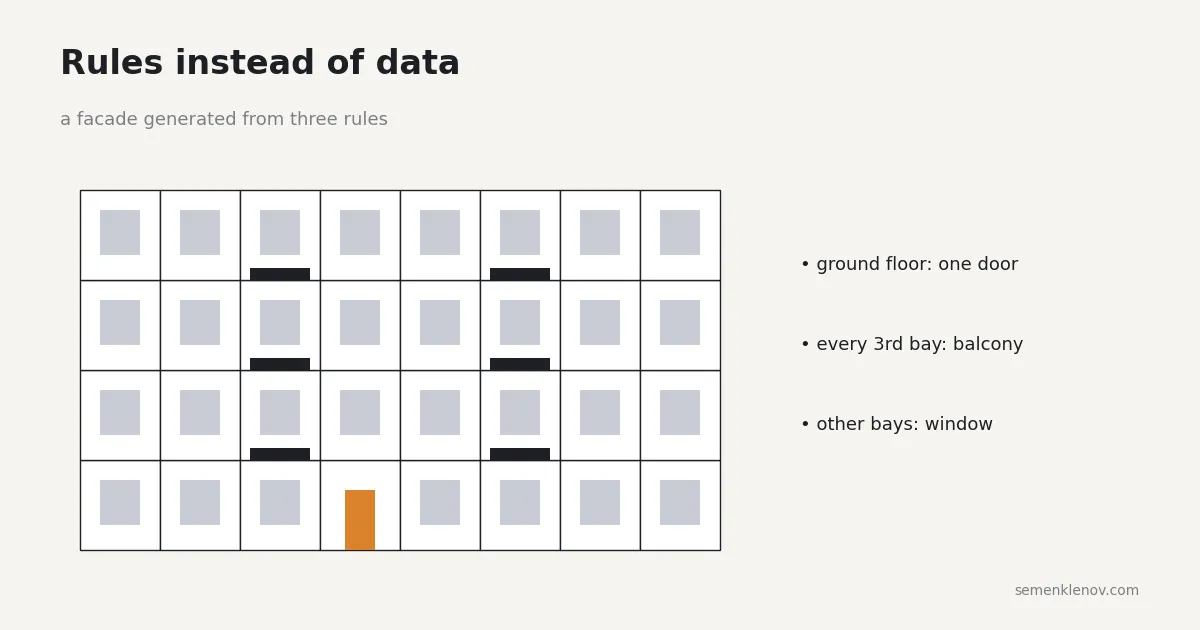
Today a building for a game or a film set can be generated in two very different ways. One is to learn from data: show a model thousands of buildings and let it produce new ones. The other is to write rules: describe how a facade splits into floors, floors into bays, bays into windows, and let the rules produce endless variations. I am building a procedural building generator in Houdini, and I chose rules. In this article I explain the science behind that choice and where it came from.
Fifty years of shape grammars
Shape grammars (Stiny & Gips, 1972) introduced the idea that a design can be generated the way a sentence is generated by a grammar. Rules replace one shape with others, step by step.
Procedural cities (Parish & Müller, 2001) applied grammar ideas, through L-systems, to whole street networks and building lots. A city could be described by a few rules and parameters instead of being modelled block by block.
Split grammars (Wonka et al., 2003, “Instant Architecture”) made the facade the central object. A rule splits a rectangle into smaller rectangles, floors into tiles, with constraints that keep the result architecturally plausible.
CGA shape (Müller et al., 2006) became the best-known formulation: start from a building mass, extrude it, split it into faces, floors, tiles and windows, and use occlusion queries so that windows do not appear where another wing blocks the wall. This line of work led directly to commercial tools for city generation.
Rules vs data: an honest comparison
| Rule-based (grammar) | Learned (data-driven) | |
|---|---|---|
| Control | Every parameter is named and editable | Steered by prompts or examples; fine control is hard |
| Repeatability | Same seed and rules give the same building | Often not exactly repeatable |
| Production fit | Clean topology, UVs, LODs, real dimensions | Often needs retopology and cleanup |
| Variety | Limited by the rules you write | Very large, including surprising forms |
| Cost to start | High: rules take expert time | Low, if a trained model exists |
| Data rights | No training data needed | Depends on how the training data was collected |
For a production pipeline, the left column wins. A game level needs buildings with real door heights, clean collision meshes and LODs. These properties are easy to guarantee with rules and hard to guarantee with generation. The right column wins for exploration and concept art. A sensible pipeline uses both: learned tools for ideas, rules for the asset that ships.
How a grammar maps onto Houdini
Houdini is a natural host for split grammars, because each rule becomes a node and each parameter becomes a slider:
- Mass. A footprint curve is extruded, and the roof type is chosen by a parameter.
- Floors. Split the walls along height by floor-height rules, with a different ground floor.
- Bays. Split each floor into bays of target width. The remainder is spread to corners.
- Elements. Each tile gets a window, door or blank wall from a weighted, seeded choice.
- Detail. Ledges, frames and sills are instanced from a small kit of modular assets.
- Outputs. UVs, material IDs and LODs are produced by the same graph.
The same graph produces a whole street when it is fed many footprints. The seed makes every building reproducible.
What this means for my work
My Houdini building generator is at an early stage. I am learning Houdini while I build it, and I will publish its progress honestly, step by step. The goal is a fully procedural building: geometry, materials and all channels connected and driven by rules. The grammar view gives the project a clear structure to test against: every feature must be a rule with named parameters, and every result must be reproducible from a seed. The same principle runs through my other work. In SMART ONE, I prefer explicit, inspectable steps to black boxes wherever the task allows it.
If you are just starting
- Start procedural work with a tiny rule set: one box, split into floors, then windows.
- Name every parameter. If you cannot name it, you cannot control it later.
- Use a seed for every random choice, so a result you like can always be rebuilt.
References
- Müller, P., Wonka, P., Haegler, S., Ulmer, A., & Van Gool, L. (2006). Procedural modeling of buildings. ACM Transactions on Graphics, 25(3), 614–623.
- Parish, Y. I. H., & Müller, P. (2001). Procedural modeling of cities. Proceedings of SIGGRAPH 2001, 301–308.
- Stiny, G., & Gips, J. (1972). Shape grammars and the generative specification of painting and sculpture. In Information Processing 71 (pp. 1460–1465). North-Holland.
- Wonka, P., Wimmer, M., Sillion, F., & Ribarsky, W. (2003). Instant architecture. ACM Transactions on Graphics, 22(3), 669–677.
SEMEN KLENOV · Research notes on 3D graphics. Drafted with AI assistance; reviewed by the author.