Home / Journal / Technical research
How to check an image: a beginner's method for visual evidence
No single tool says 'real or fake'. A four-level method: provenance, file traces, scene physics and content, with what each can and cannot prove.
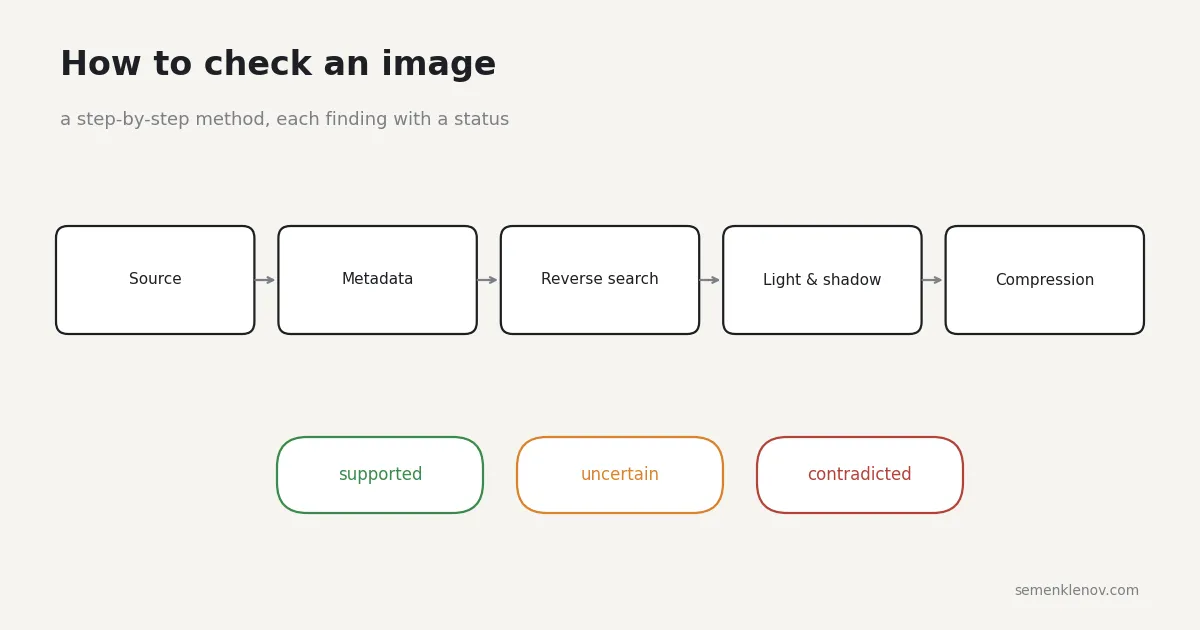
“Is this photo real?” is probably the most common question about images today. My honest answer is that no single tool can say that. There is, however, a clear method for finding out what a picture can and cannot support. I build SMART ONE around this method, and in this article I explain it step by step for beginners: designers, journalists, students and anyone who works with images.
First, change the question
“Real or fake” has too few answers. A better set of questions:
- Where did the file come from? (provenance)
- What happened to the file? (processing history)
- Is the scene physically consistent? (light, shadows, geometry)
- Does the content match the claim? (place, date, event)
Each question has its own methods, and each method has its own limits.
Level 1: provenance and context
- Metadata (EXIF). Camera model, lens, date, sometimes GPS. It is easy to read and also easy to edit or strip, so treat it as a hint, not proof.
- Content Credentials (C2PA). A signed record of origin and edits, when the camera or software supports it. Check it at contentcredentials.org/verify. A missing credential means “unverified”, not “fake”.
- Reverse image search. Search the image on several engines to find older copies, the original source or the uncropped version. This simple step often answers the question in minutes.
Level 2: traces in the file
- Compression history. Saving a JPEG twice leaves periodic gaps in its DCT statistics. My own test showed about 41% empty histogram bins after a double save, against 0.1% after a single one. But messengers recompress every photo, so this proves nothing about the content.
- Sensor noise. Every sensor has a faint, unique noise pattern. With reference photos from the same camera it can link an image to a device (Lukáš, Fridrich & Goljan, 2006), and missing patches of that pattern can reveal pasted regions.
- Traces of generators. Images from AI models leave statistical fingerprints, often visible in the frequency spectrum. Research shows that detectors trained on one generator often fail on another, especially after compression and resizing, as on social networks (Corvi et al., 2023). Use such detectors as one signal among several.
Level 3: physics of the scene
This level is my favourite, because the physics of light is hard to fake perfectly.
- Shadows. Every cast shadow points back toward its light source. Kee, O’Brien and Farid (2013) turned this into a geometric test: draw wedge-shaped constraints from shadows to the objects that cast them. If no common position for the light exists, the shadows cannot all be real.
- Lighting direction. Shading on faces and objects should agree with one lighting environment.
- Perspective and reflections. Parallel lines must meet at shared vanishing points, and reflections must follow mirror geometry.
Level 4: content against the claim
- Place: compare landmarks, signs and terrain with maps and street-level imagery.
- Time: check shadow length and direction against the claimed time of day, and weather against archives.
- Event: compare with other independent photos of the same moment.
How to write the conclusion
The most valuable habit is to write down evidence in three columns:
| Supported by evidence | Contradicted by evidence | Not determined |
|---|---|---|
| e.g. location matches street view | e.g. shadow directions disagree | e.g. whether the photo was cropped |
Avoid single-word verdicts. “Shadows on the left and right persons are inconsistent with a single light source” is useful. “Fake” is not.
What this means for my work
SMART ONE organises visual evidence in exactly this way: provenance, measured file properties and scene physics are shown separately, each with its status. It is not a validated manipulation detector, and it says so. Its goal is to help a person reason about an image more carefully, not to replace that reasoning.
If you are just starting
- Always do a reverse image search first. It is free and often decisive.
- Keep the original file. A screenshot destroys most of the evidence.
- Learn to trace one shadow back to its light. It is the best training for your eye.
- Write “not determined” when you do not know. It is a professional answer.
References
- C2PA. (2025). Content Credentials: C2PA Technical Specification, version 2.2. https://spec.c2pa.org/
- Corvi, R., Cozzolino, D., Zingarini, G., Poggi, G., Nagano, K., & Verdoliva, L. (2023). On the detection of synthetic images generated by diffusion models. IEEE ICASSP 2023. https://doi.org/10.1109/ICASSP49357.2023.10095167
- Kee, E., O’Brien, J. F., & Farid, H. (2013). Exposing photo manipulation with inconsistent shadows. ACM Transactions on Graphics, 32(3), 28. https://doi.org/10.1145/2487228.2487236
- Lukáš, J., Fridrich, J., & Goljan, M. (2006). Digital camera identification from sensor pattern noise. IEEE Transactions on Information Forensics and Security, 1(2), 205–214.
SEMEN KLENOV · Visual science for beginners. Drafted with AI assistance; reviewed by the author.