Home / Journal / Cinematography
History of Photography: From the Camera Obscura to the Rolleiflex
A timeline of photographic invention: camera obscura, Niépce, Daguerre, Talbot, collodion, gelatin plates, roll film, Kodak, Leica, Rolleiflex.
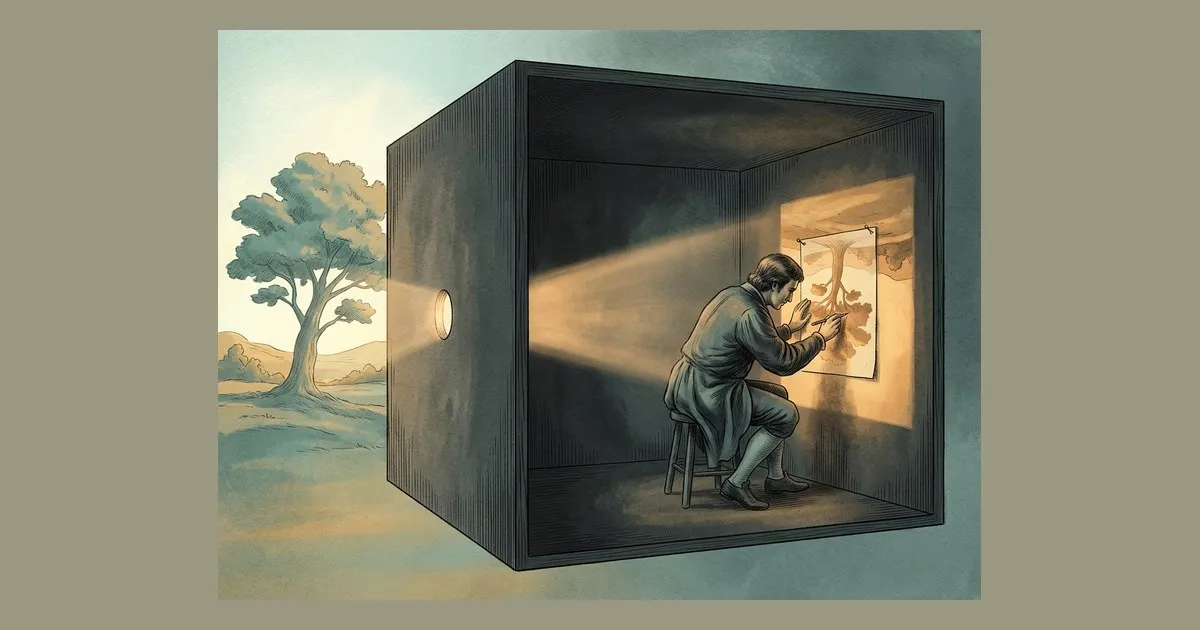
Photography means “writing with light”, from the Greek phos (light) and grapho (to write or draw). Every cinematographer works inside a tradition that began with a dark room and a hole in the wall. This article follows the main inventions in order.
Key points
- The camera obscura projected an inverted image long before anyone could fix it. The first permanent photograph was made by Joseph Nicéphore Niépce in 1826.
- Daguerre’s silver-plate process (1839) and Talbot’s paper negative (announced the same year) gave two lines of development: the unique image and the reproducible negative.
- Gelatin dry plates in the 1870s, and flexible roll film in 1888, freed photography from the wet-plate darkroom.
- Leica brought 35 mm film cut from the cinema into a compact still camera; the Rolleiflex (1929) became a photojournalist’s standard.
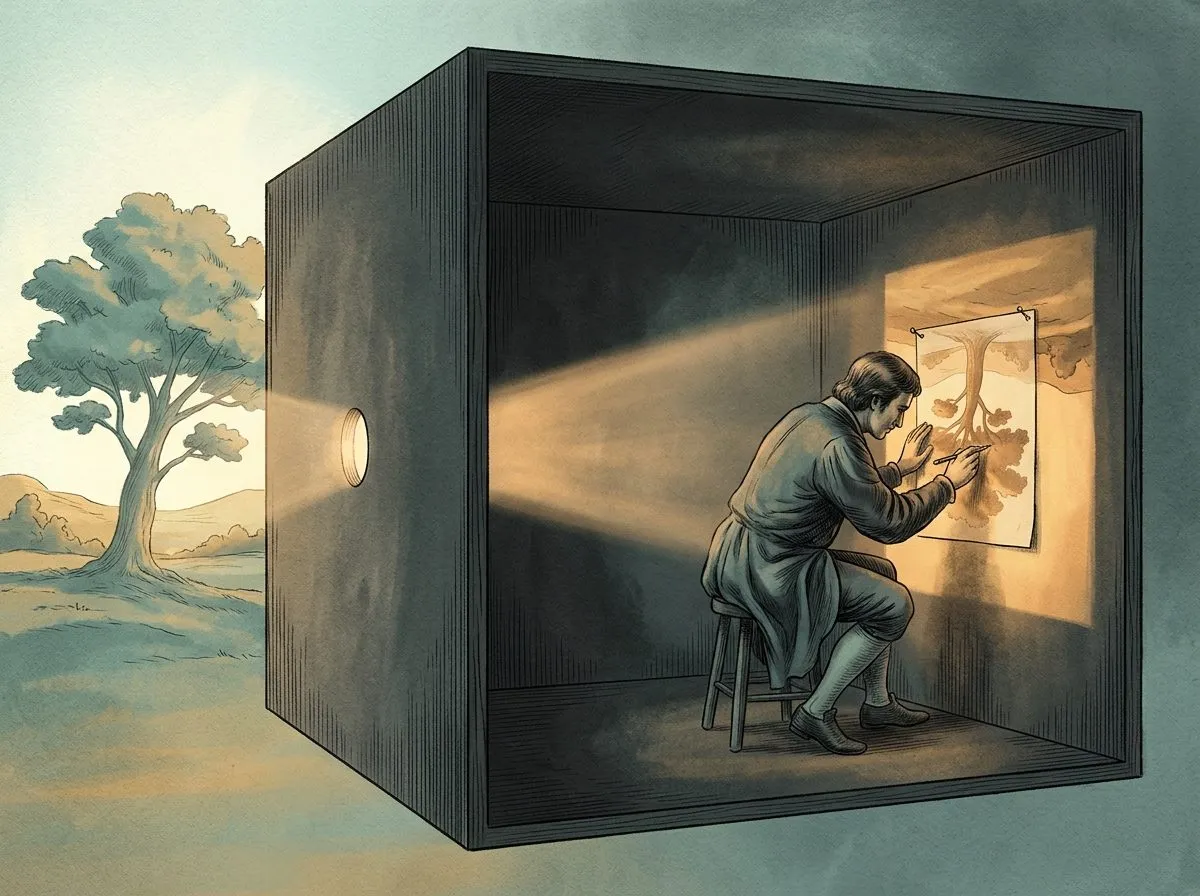
The camera obscura
From camera obscura to the first photograph
The camera obscura is a dark chamber with a small aperture that projects an inverted image of the outside world on the opposite surface. Astronomers used it in the Middle Ages to observe the sun, and artists used it to trace views. Simple lenses of polished rock crystal were known in antiquity. In the 16th century the Italian polymath Girolamo Cardano added a convex lens to the aperture, and later designs used an internal mirror to project an upright image onto ground glass for tracing.
In 1826 Niépce made View from the Window at Le Gras on a pewter plate coated with bitumen of Judea. The exposure took hours of sunlight, and the bitumen was dissolved afterwards in lavender oil, leaving a direct positive image on metal.
Daguerreotype, calotype and the language of photography
- Daguerreotype (1839). Louis Daguerre perfected a practical process on polished silver-plated copper, sensitized with iodine vapour. The result was a unique, highly detailed image.
- Calotype. William Henry Fox Talbot developed the first negative-positive paper process, so that many positives could be printed from one paper negative.
- Sir John Herschel introduced sodium thiosulfate (“hypo”) as a fixing agent and coined the terms negative, positive and photography.
- Ambrotype. An underexposed wet-collodion negative on glass, backed with black velvet or lacquer so that it reads as a positive.
Timeline of improvements
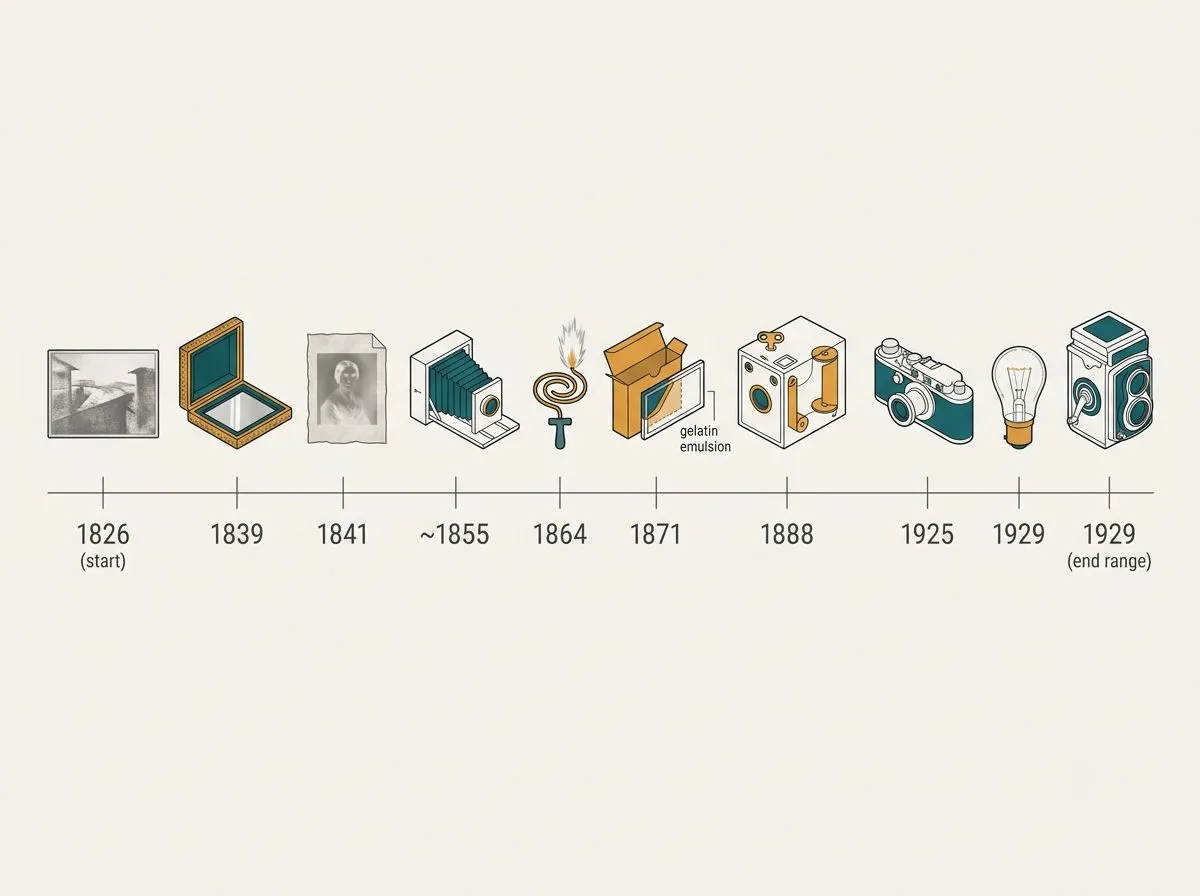
Timeline of photographic inventions
| Year | Development |
|---|---|
| 1847 | Sergei Levitsky introduces accordion-style leather bellows, making field cameras collapsible and portable |
| 1850 | Blanquart-Evrard’s albumen paper, the dominant printing medium for the rest of the century |
| 1854 | Disdéri patents the carte-de-visite: a multi-lens camera makes several small portraits on one negative, so portraits become affordable |
| 1859 | Bunsen and Roscoe show that burning magnesium gives intense light, the first practical artificial flash |
| 1864 | Sayce and Bolton develop the dry collodion plate |
| 1871 | Richard Leach Maddox’s gelatin silver bromide emulsion launches the modern dry-plate era |
| 1888 | John Carbutt makes flexible transparent celluloid film; George Eastman patents the Kodak box camera pre-loaded with a 100-exposure roll (“You press the button, we do the rest”) |
| 1892 | Jules Carpentier builds an early precision twin-lens reflex |
| 1914 | Oskar Barnack builds the Ur-Leica at Leitz, adapting 35 mm motion-picture film to a compact still camera; the Leica reaches the market in the mid-1920s |
| 1925 | Paul Vierkötter patents the electric flashbulb: magnesium-aluminium foil sealed in oxygen-filled glass, ending open-powder smoke and fire hazards |
| 1929 | Franke & Heidecke introduce the Rolleiflex, a medium-format twin-lens reflex on 120 roll film |
Why it matters on set
Almost every idea in a modern camera appears somewhere on this list: the lens and ground glass, the shutter, the negative-positive principle, the fixed and developed silver image, roll film, the reflex viewfinder and artificial light. The film camera described elsewhere in this handbook is the direct descendant of Barnack’s decision to borrow cinema film for stills, just as cinema itself had borrowed from still photography.
Quick answers
Who made the first permanent photograph? Joseph Nicéphore Niépce, in 1826.
What was the difference between Daguerre’s and Talbot’s processes? Daguerre produced a single positive image on metal. Talbot produced a paper negative from which many prints could be made.
What did Eastman change? He made photography simple: a pre-loaded camera on flexible roll film that the maker developed and reloaded.
Read next
- History of Cinema: Lumière, Soviet Cinematography and European Movements
- How a Still Camera Works: Shutters, Lens Mounts, Meters and Viewfinders
- Photographic Film: Structure, the Characteristic Curve and Processing
Related on this site
- A digital photo is not reality: what your camera really records
- Analogue vs digital: sampling, bits and aliasing explained with two experiments
This article is part of the free handbook Technical Foundation. Filmmaking: The Cinematographer’s Handbook by Semen Klenov, an independent researcher of light and visual perception. Cite the handbook as: Klenov, S. (2026). Technical Foundation. Filmmaking: The Cinematographer’s Handbook. Zenodo. https://doi.org/10.5281/zenodo.24326083.