Home / Journal / Technical research
A digital photo is not reality: what your camera really records
A sensor records one colour per pixel; the rest is reconstructed. My Bayer-mosaic experiment shows false colours appearing in pure grey stripes, and five more ways a photo differs from the world.
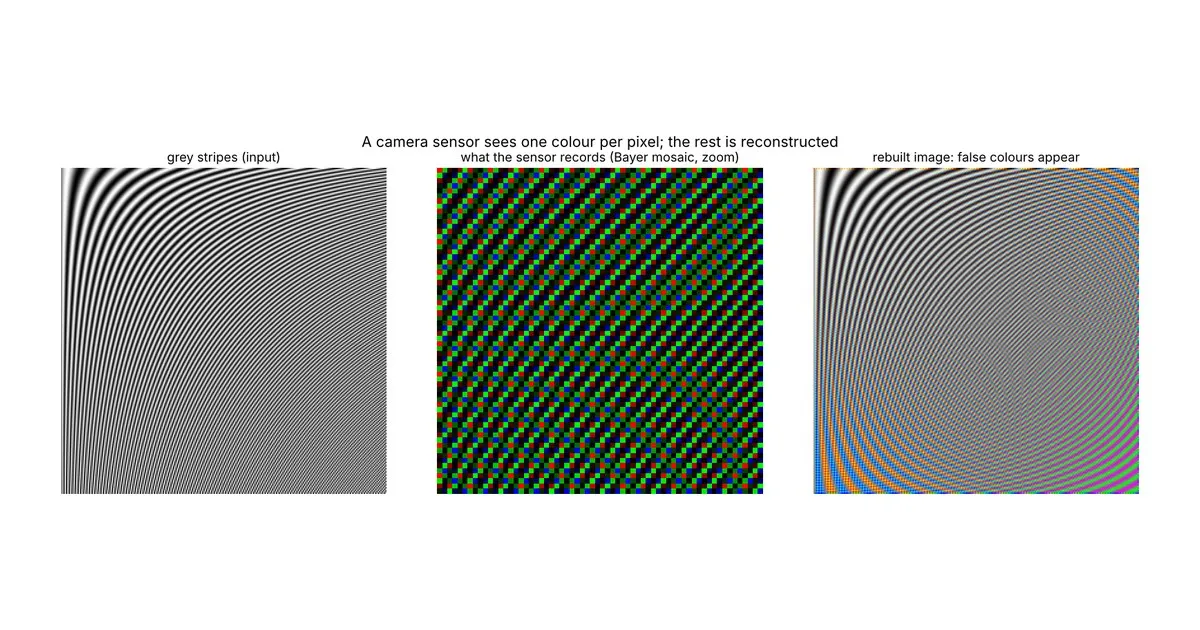
Most people believe a photo is a record of reality. My work in filming, lighting and 3D has taught me the opposite: a digital image is a reconstruction, built from a small part of the light that reached the sensor. This is the first thing I would explain to anyone entering photography, film, 3D or visual research. In this article I show it with a simple experiment.
What the sensor actually catches
A camera sensor is a grid of photosites that count photons. A photosite has no idea about colour. To get colour, almost every consumer camera covers the sensor with a mosaic of tiny filters, the Bayer pattern (Bayer, 1976): in every 2 × 2 block there are two green, one red and one blue filter. Green gets double space because our eyes are most sensitive to it.
So each pixel records one colour channel out of three. The other two-thirds of the colour data are invented by an algorithm called demosaicing, which guesses missing values from neighbours. Good cameras use clever demosaicing (Malvar, He & Cutler, 2004); phones add machine learning on top.
The experiment
I reduced full-colour images to a Bayer mosaic, exactly as a sensor would see them, and rebuilt them with simple bilinear demosaicing.
| Test | Result |
|---|---|
| Colour samples kept by the sensor | 33.3% of the full RGB data |
| Rebuilt photos (coffee, cat, rocket), PSNR vs original | 29.4, 34.2 and 29.9 dB |
| Fine grey stripes, rebuilt | false colours up to 0.67 on a 0–1 scale |
The real photos come back looking fine at a glance, because smooth areas are easy to guess. The stripes are the honest test. The input is pure grey, yet the rebuilt image is full of orange, blue and green bands (see the cover). Nothing in the scene was coloured. The colours were created by the reconstruction. This is the moiré you see on striped shirts and brick walls in photos.
Five more ways a photo differs from the world
- Dynamic range. A sunny scene can span far more brightness than a sensor holds. Highlights clip to white, shadows sink into noise, and HDR merging and tone mapping decide what you see.
- Tone curve. The camera bends linear light into a pleasing curve. Brightness in a JPEG is not proportional to real light.
- Colour science. White balance and the camera’s colour profile are choices made by the manufacturer and by you.
- Noise reduction and sharpening. These remove real detail together with the noise and add edge contrast that was never there.
- Compression. JPEG and video codecs throw away what the eye is least likely to miss, at the cost of detail you might need later.
A phone adds one more layer: computational photography that merges several frames and enhances faces, sky and text. A modern phone photo is closer to an interpretation than to a measurement.
How to tell what is real in an image
- Shoot RAW when the image matters. It keeps the sensor data before most of these decisions are made.
- Look at fine repetitive patterns at 100% zoom: false colours show where reconstruction guessed.
- Learn your camera’s dynamic range by bracketing a scene and seeing where detail dies.
- For research or evidence, write down the full chain: device, settings, software, exports.
What this means for my work
SMART ONE is built on this idea. It treats a photo as a reconstruction with a history, and it reports what is measured and what is inferred. My book Technical Foundation. Filmmaking covers the physics behind it: light, optics and recording on film and digital.
If you are just starting
- Never say “the camera captured reality”. Say “the camera recorded and processed light”.
- Learn to read a histogram before you learn any filter.
- Try the stripes test with your own phone: photograph a fine pattern and zoom in.
Reproduce it
import numpy as np
from scipy.ndimage import convolve
from skimage import data, img_as_float
def mosaic(im):  # RGGB: keep one colour per pixel
    m = np.zeros_like(im); m[0::2, 0::2, 0] = im[0::2, 0::2, 0]
    m[0::2, 1::2, 1] = im[0::2, 1::2, 1]; m[1::2, 0::2, 1] = im[1::2, 0::2, 1]; m[1::2, 1::2, 2] = im[1::2, 1::2, 2]
    return m
def demosaic(m):  # bilinear interpolation
    kG = np.array([[0, 1, 0], [1, 4, 1], [0, 1, 0]])/4; kRB = np.array([[1, 2, 1], [2, 4, 2], [1, 2, 1]])/4
    return np.stack([convolve(m[..., 0], kRB), convolve(m[..., 1], kG), convolve(m[..., 2], kRB)], -1).clip(0, 1)
yy, xx = np.mgrid[0:256, 0:256]
stripes = (0.5 + 0.5*np.sin(2*np.pi*xx*(0.05 + 0.4*yy/256)))[..., None].repeat(3, -1)
out = demosaic(mosaic(stripes)); print(np.abs(out - out.mean(-1, keepdims=True)).max())  # false colour
References
- Bayer, B. E. (1976). Color imaging array. US Patent 3,971,065.
- Klenov, S. (2026). Technical Foundation. Filmmaking: The Cinematographer’s Handbook (v1.1). Zenodo. https://doi.org/10.5281/zenodo.24325834
- Malvar, H. S., He, L.-W., & Cutler, R. (2004). High-quality linear interpolation for demosaicing of Bayer-patterned color images. ICASSP 2004.
SEMEN KLENOV · Visual science for beginners. Drafted with AI assistance; experiment code and numbers checked by the author.