Home / Journal / Cinematography
How a Still Camera Works: Shutters, Lens Mounts, Meters and Viewfinders
The parts of a still camera and how they work together: shutter types, SLR and rangefinder viewfinders, lens mounts, flange distance, zoom lenses and metering.
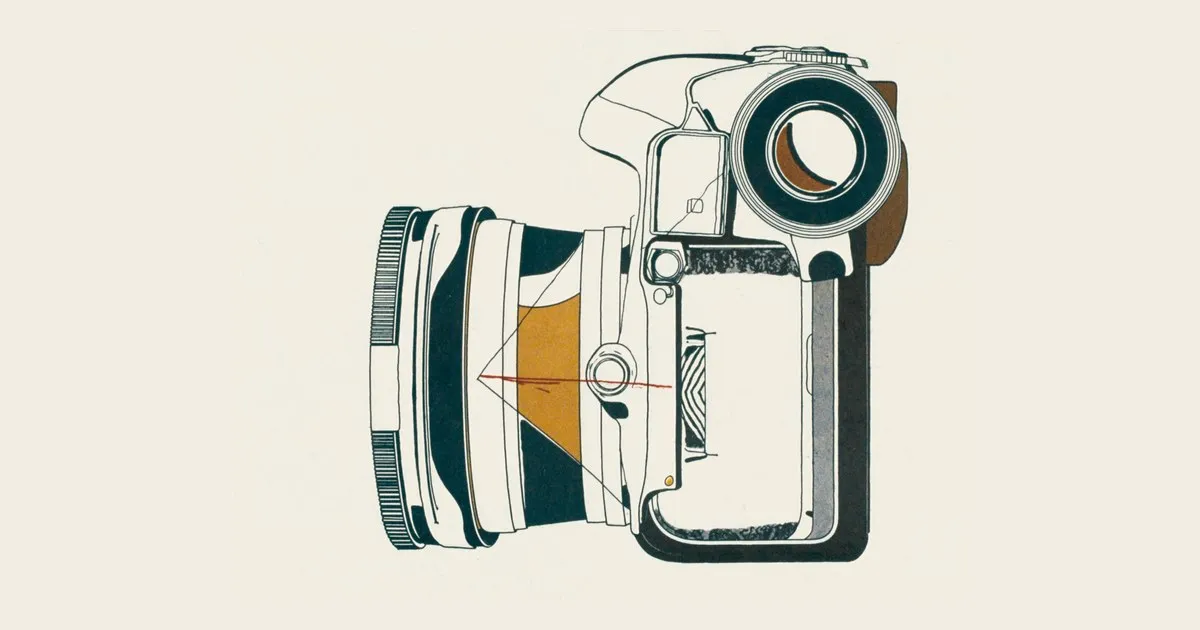
A still camera is a light-tight box that holds a lens at a precise distance from a film or sensor, with a shutter and an aperture to control how much light arrives and for how long. This article explains how the parts fit together and why small mechanical tolerances matter so much.
Key points
- The shutter controls the time of exposure and the aperture controls the amount of light. Together they set exposure.
- A focal-plane shutter sits just in front of the sensor; a leaf shutter sits inside the lens and allows flash synchronization at all speeds up to 1/2000 s.
- The flange focal distance, from mount to sensor, must be kept within ±0.02 mm for accurate focus marks and infinity focus.
- A normal lens has a focal length about equal to the format diagonal, with an angle of view of about 45°–55°. Wide-angle lenses are shorter and telephotos longer.
- An SLR shows exactly what the taking lens sees; a rangefinder has a separate window and suffers parallax at close range.
The camera body and lens
The rigid body holds the lens and sensor in exact alignment. The focus mechanism moves the lens elements forward and back to put the image in focus on the sensor plane. Key lens specifications are focal length, maximum aperture, T-stop, angle of coverage, and resolving power with MTF contrast. Lens coatings cut reflection to under 1% per surface. The circular image field must cover the whole sensor without vignetting or loss of resolution at the corners.
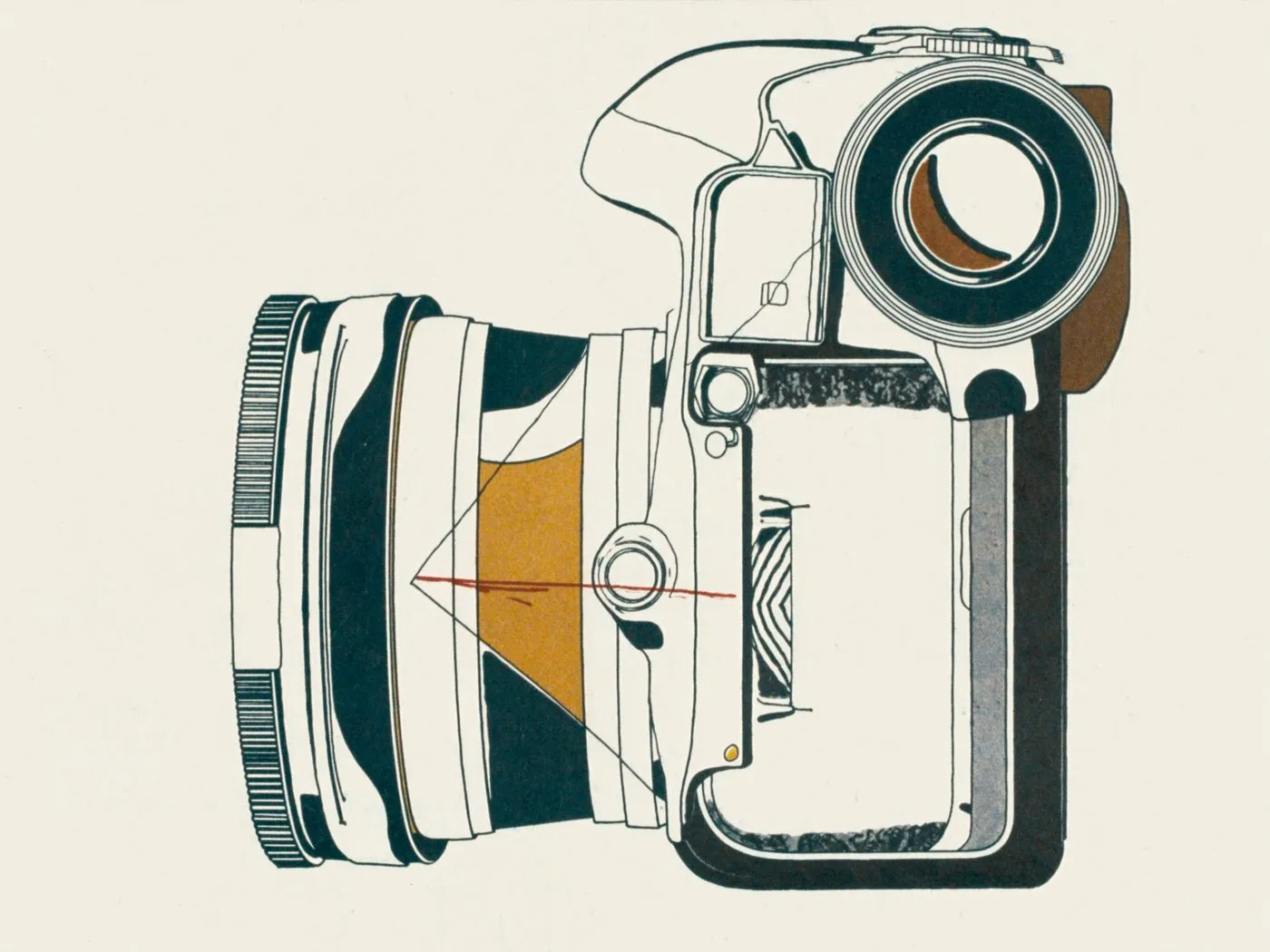
Cutaway of a single-lens reflex camera
Optical theory describes a thick lens by its cardinal points: the principal planes and points, where the ray geometry is referenced, and the front and rear focal points. On manual lenses, depth-of-field marks on the barrel show the sharp zone for each aperture.
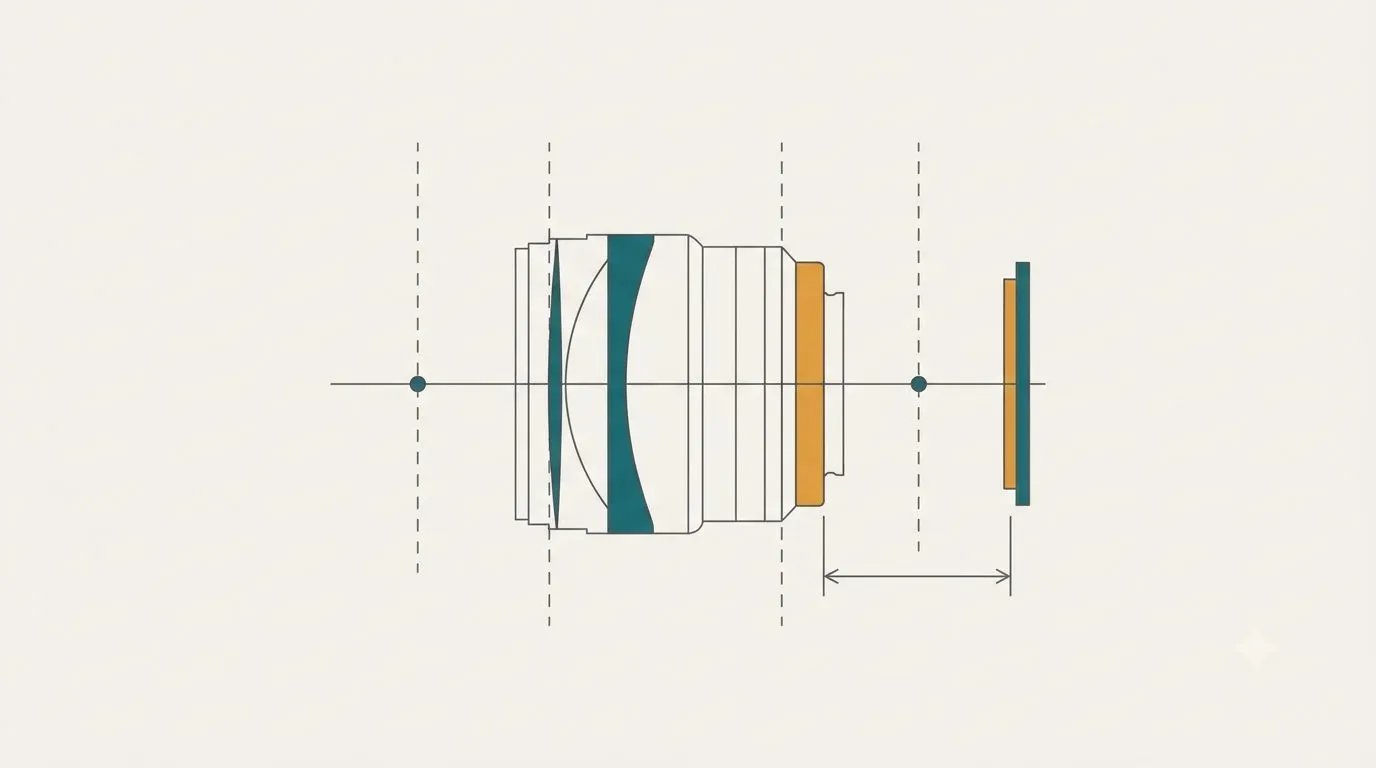
Cardinal points of an optical system
Mounts and lens categories
Lenses attach by a thread (M42) or a bayonet (PL, LPL, EF, E-mount). Bayonets lock the lens securely and allow quick, repeatable lens changes on set. Because the lens is focused for a given distance to the sensor, the flange distance must be held to a tolerance of ±0.02 mm.
By focal length, lenses fall into three categories. A normal lens renders natural perspective. A wide-angle lens has a broad field and exaggerates perspective and distance. A telephoto lens has a narrow field and compresses perceived depth. Zoom lenses change focal length continuously and, in parfocal designs, hold focus throughout. A higher zoom ratio means more elements, so advanced multi-layer coatings become essential to control flare and keep contrast.
The iris is a set of overlapping curved blades. Cinema lenses typically have a manual, clickless iris for smooth exposure changes. Photographic lenses may have a click-stop or an auto-stop spring iris.
Shutters
- The focal-plane shutter is a pair of metal blades moving horizontally or vertically in front of the sensor. A fast subject that moves across the slit during travel can be subtly distorted.
- The leaf shutter is made of overlapping leaves inside the lens between groups, and it synchronizes with flash at all speeds up to 1/2000 s.
- The rotary disc shutter is a spinning mirrored disc in motion picture cameras, synchronized with the film pulldown.
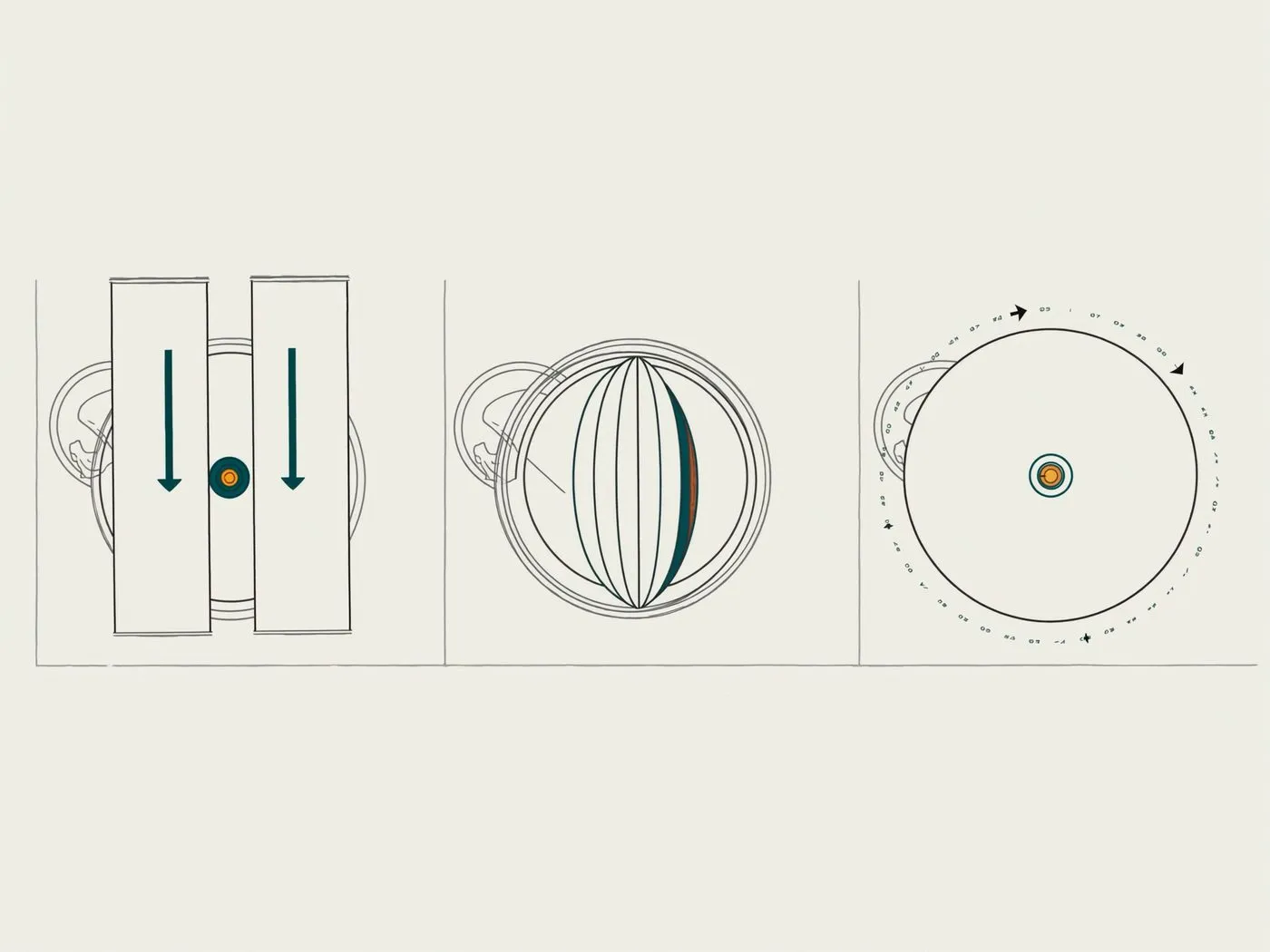
Focal-plane, leaf and rotary shutters
Metering and viewfinders
Through-the-lens (TTL) meters judge exposure with centre-weighted, evaluative or spot patterns. In a single-lens reflex a 45° mirror sends light up through a focusing screen and a pentaprism to the eyepiece, so the finder shows exactly the framing of the taking lens, without parallax. A rangefinder has a separate optical window, which causes parallax at close distances. Other camera formats are fixed-lens compacts, twin-lens reflexes and large-format view cameras.
Quick answers
Why is flash synchronization easier with a leaf shutter? The leaves open fully at any speed, so the flash can fire while the whole frame is exposed.
What does a rangefinder not show well? Close subjects, because its window sits to one side of the lens.
Why is the flange distance so strict? If it is off, the focus scale and infinity setting no longer match what is sharp on the sensor.
Read next
- How a Film Camera Works: Pulldown Claw, Rotary Shutter and Film Gate
- Lenses, Focal Length, Aperture and Depth of Field Explained for Filmmakers
- Exposure: The Zone System, Light Meters, Gray Cards and Lighting Ratios
Related on this site
- The Virtual Camera: a practical CGI guide
- A digital photo is not reality: what your camera really records
This article is part of the free handbook Technical Foundation. Filmmaking: The Cinematographer’s Handbook by Semen Klenov, an independent researcher of light and visual perception. Cite the handbook as: Klenov, S. (2026). Technical Foundation. Filmmaking: The Cinematographer’s Handbook. Zenodo. https://doi.org/10.5281/zenodo.24326083.