Home / Journal / Cinematography
Exposure: The Zone System, Light Meters, Gray Cards and Lighting Ratios
How exposure is measured and placed: the ten-zone scale, middle gray, incident and spot meters, the gray card, bracketing and the 3:1 key-to-fill ratio.
Exposure is how much light reaches the film or sensor during the shutter interval. Getting it right means placing the important tones where the recording medium can hold them. This article explains the Zone System, the two ways to meter light and the lighting ratio a cinematographer sets with the gaffer.
Key points
- Exposure is the light on the emulsion or sensor over the duration of the shutter opening at the chosen aperture.
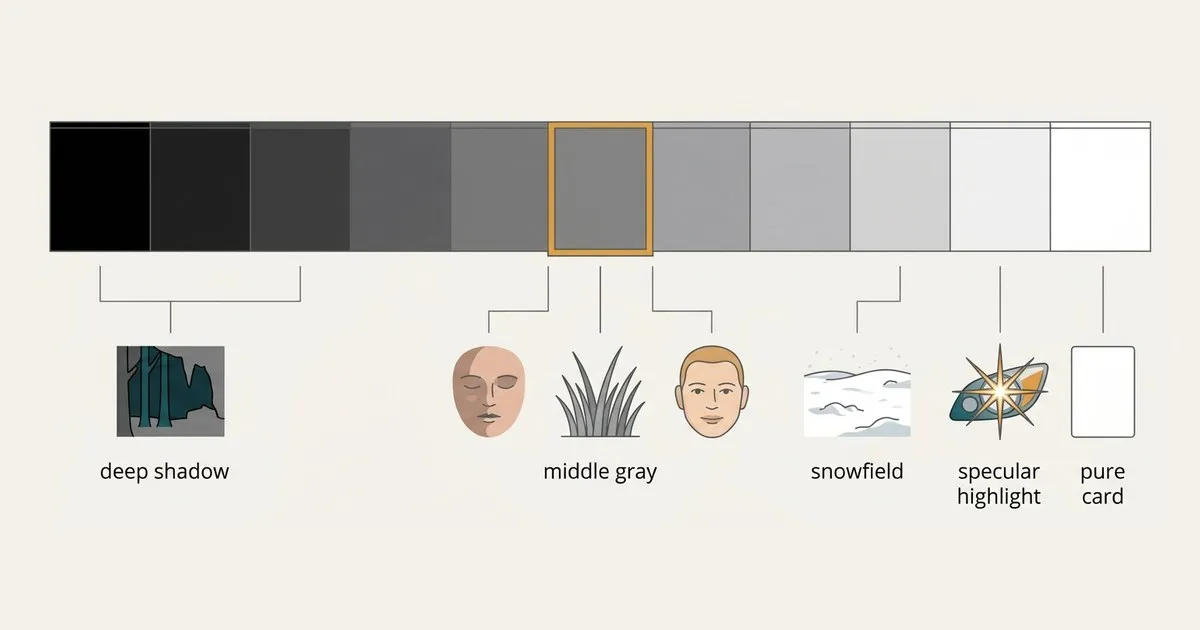
- The Zone System maps a scene into ten zones, each one stop (a factor of two in light) from the next. Zone V is middle gray, about 18% reflectance.
- Most meters are calibrated to 18% reflectance, so they assume the scene averages out to middle gray.
- An incident meter measures light falling on the subject and a spot meter measures light reflected from a small area, usually a 1° angle.
- To keep detail in both shadows and highlights, the key-to-fill ratio should generally not exceed 3:1.
The Zone System
The goal of exposure is to reproduce the tonal range of the subject without distortion. The Zone System, associated with Ansel Adams, turns this into a method. If one reference tone is placed correctly, every other tone falls into its place relative to it. Changing the exposure moves all densities along the characteristic curve together, but the relationships between them stay the same. So the question is always: which tone matters most in this shot, and where should it sit?
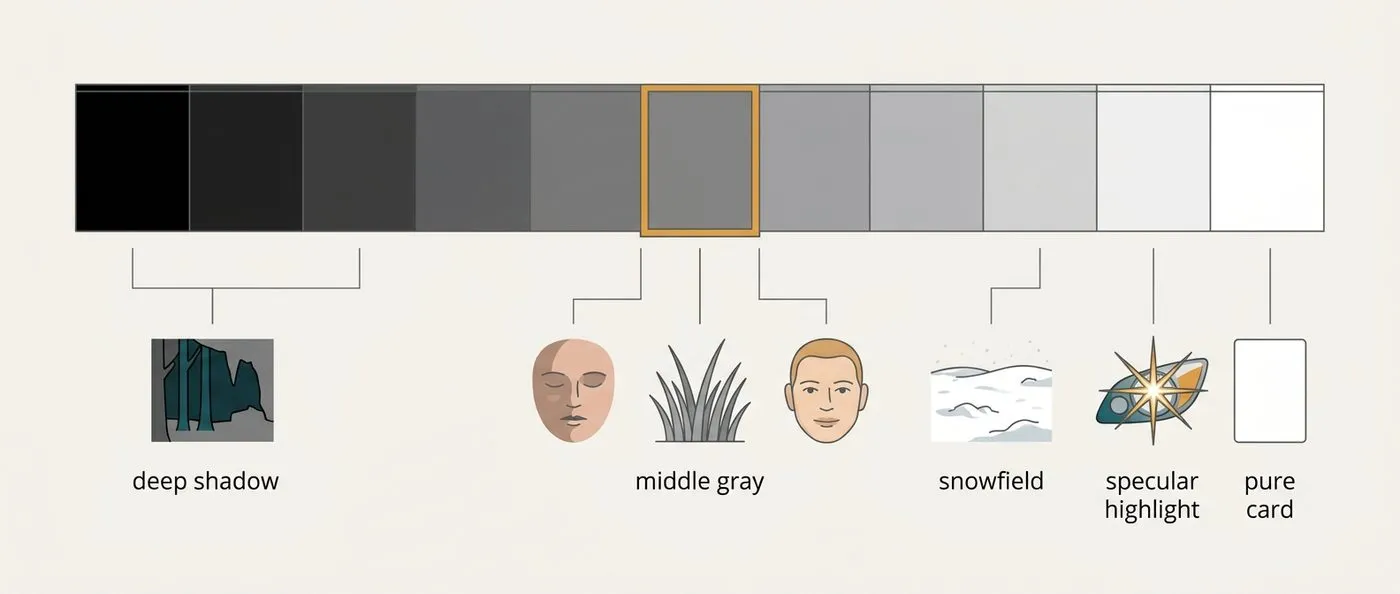
Ansel Adams’ Zone System
The ten zones run from pure black, with no detail, through deepest textured black, the first trace of shadow detail and dark gray, to Zone V, standard middle gray of 18–20% reflectance. Above it come average light gray (light skin in shade, clean stone), fair skin in bright light, blue sky and a sunlit stone wall, then delicate textured highlights, near-white and pure specular white without detail.
Measuring light
Three things can be measured:
- Quantity, the illuminance on the set or at a point, in lux or foot-candles.
- Ratio, the contrast between lit and shadow areas.
- Quality, the colour temperature of the source in kelvin.
The lighting ratio is the total illuminance on the subject (key plus fill) divided by the fill alone. To measure key plus fill, switch on all the front and three-quarter fixtures and leave the rim and backlights off, since they do not affect frontal exposure. To measure fill alone, switch the key off.
The incident light falling on a subject is always greater than the light it reflects. Metering the incident light gives accurate colours whatever the tonal range of the frame. An incident meter (or flash meter for strobes) measures light falling on the scene. A spot meter reads reflected luminance from a narrow field of 1°–3°. A colour meter evaluates colour temperature.
Exposure meters
An exposure meter finds the shutter-aperture combination for a scene. Classically it is a photocell connected to a microammeter whose needle deflection gives the exposure value. A reflected-light meter integrates all the light from its window into one average, and works on the assumption that real scenes average to 18% reflectance. TTL meters sit inside the camera and read light through the lens.
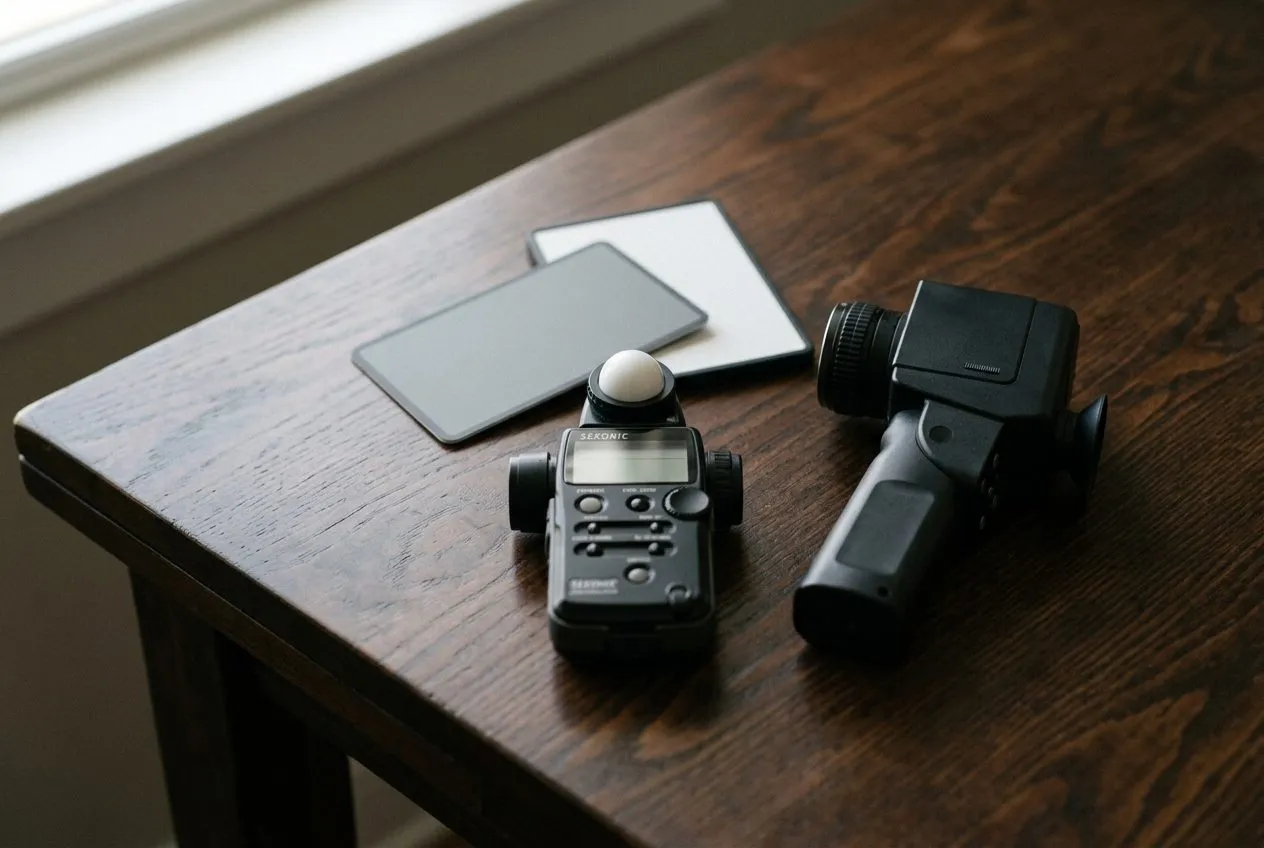
Incident meter, spot meter and gray card
- Bracketing exposes consecutive frames at incremental exposure value steps, typically ±1 EV, when no meter is available or the scene is complex.
- A gray card has an 18% gray side and a 90% white side. Exposing from the white side needs five times more exposure, a little over two stops, to match the middle-gray calibration.
- A flash meter is built to measure the brief discharge of strobes.
Quick answers
Why use an incident meter? It reads the light on the subject, so a very dark or very bright subject does not fool it.
Why is a spot meter useful? It lets you read one particular tone, such as a face or a window, and place it exactly.
What does a 3:1 ratio mean? The key plus fill is three times as bright as the fill alone, which means the key by itself is twice the fill, one stop brighter.
Read next
- Photometry for Filmmakers: Lumens, Lux, Candela and Inverse-Square Law
- Photographic Film: Structure, the Characteristic Curve and Processing
- Key Light Principles: Hard vs Soft, High-Key vs Low-Key Lighting
Related on this site
- One light, two worlds: physical units from the film set to the render engine
- How to check an image: a beginner’s method for visual evidence
This article is part of the free handbook Technical Foundation. Filmmaking: The Cinematographer’s Handbook by Semen Klenov, an independent researcher of light and visual perception. Cite the handbook as: Klenov, S. (2026). Technical Foundation. Filmmaking: The Cinematographer’s Handbook. Zenodo. https://doi.org/10.5281/zenodo.24326083.