Home / Journal / Cinematography
Photometry for Filmmakers: Lumens, Lux, Candela and Inverse-Square Law
Luminous flux, intensity, illuminance and luminance explained for the set, with the inverse-square law, reciprocity and the Sunny 16 rule.
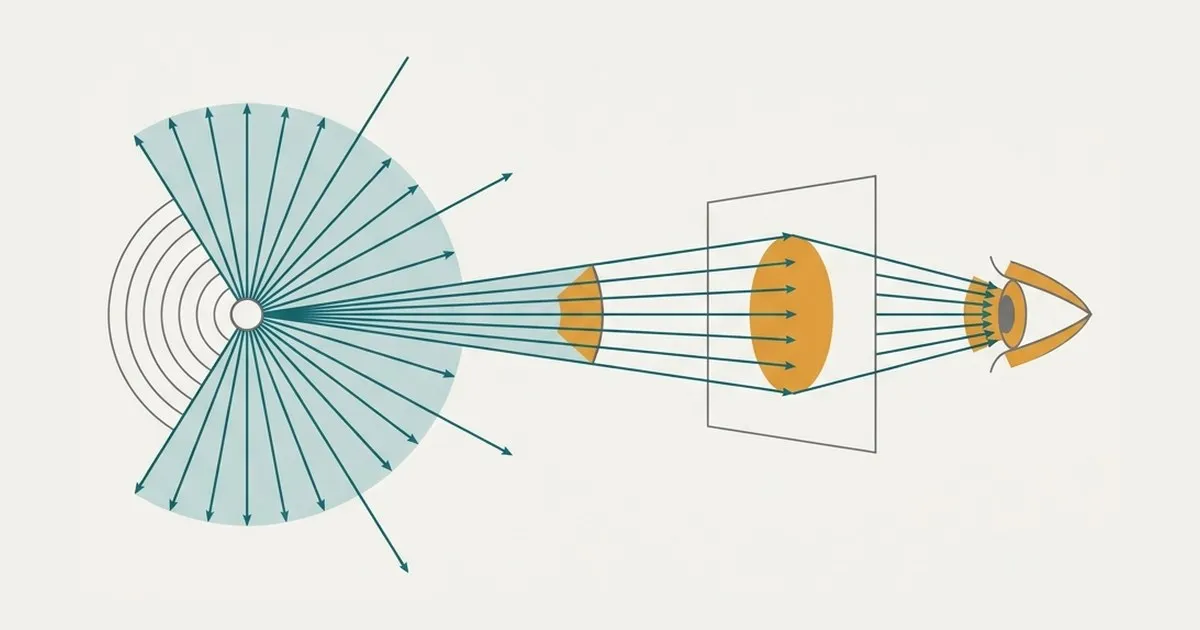
Photometry measures light the way the eye sees it. Its units, lumens, candelas, lux and nits, are the vocabulary of every exposure calculation and every lighting plan. This article defines each unit in plain terms and ends with the three rules a camera department uses daily: the inverse-square law, reciprocity and Sunny 16.
Key points
- Luminous flux (lumen, lm) is the total light emitted by a source, weighted by the sensitivity of the eye.
- Luminous intensity (candela, cd) is flux per unit solid angle: 1 cd = 1 lm / sr.
- Illuminance (lux, lx) is flux falling on a surface: 1 lx = 1 lm / m².
- Luminance (cd/m², or nits) is what the eye actually sees as brightness, and it does not depend on viewing distance.
- Illuminance from a point source falls with the square of distance: E = I / d².
The units
Flux describes the source, intensity describes a direction, illuminance describes what arrives at a surface, and luminance describes what leaves a surface toward the eye or the lens. A steradian (sr) is the unit of solid angle that cuts an area equal to r² from a sphere of radius r. Luminous efficacy shows how well a source converts electrical power into visible light, in lumens per watt. Luminous exposure H is the product of illuminance and time, H = E × t, in lux-seconds. The scene brightness range is the ratio between the brightest textured highlight and the deepest textured shadow in the frame.
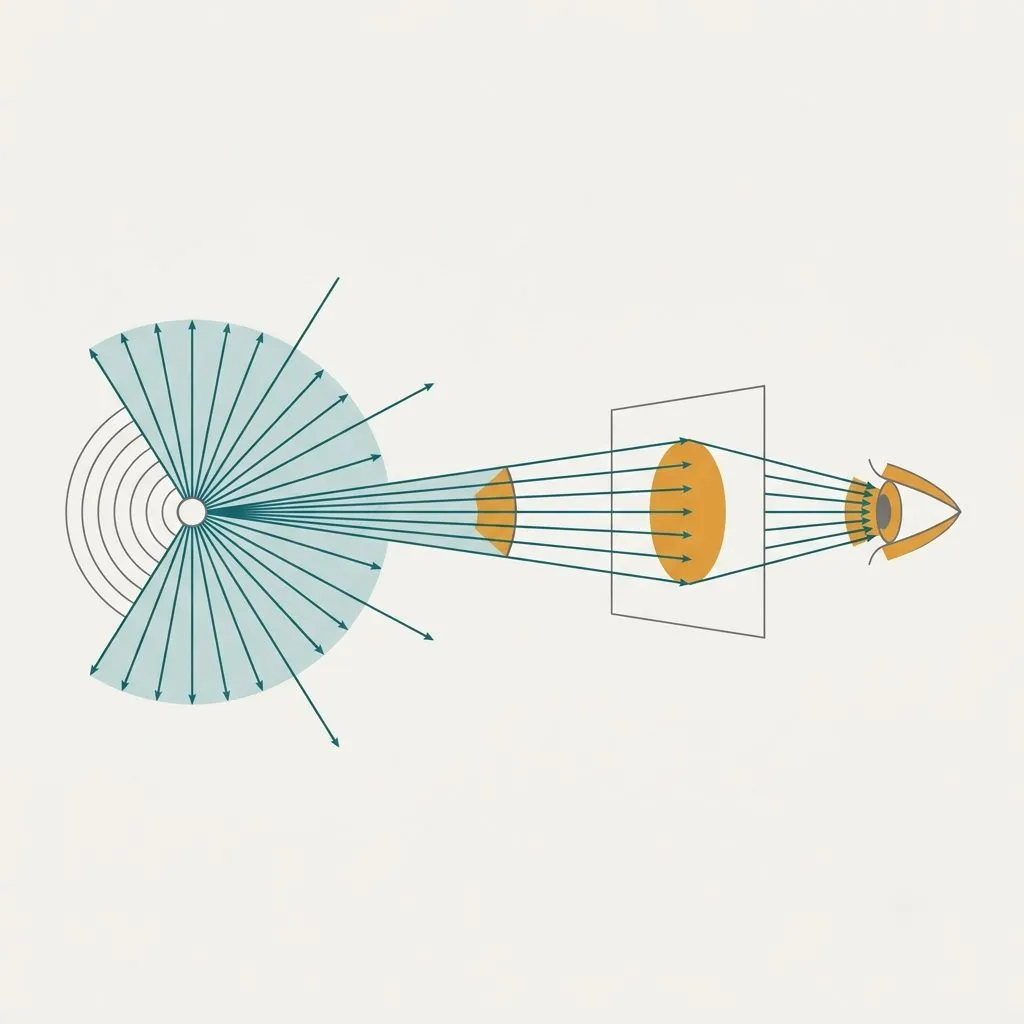
Luminous flux, intensity, illuminance and luminance
The inverse-square law
For a point source, illuminance equals intensity divided by distance squared. Doubling the distance quarters the light on the subject. A lamp that gives 400 lx at 2 m gives 100 lx at 4 m and 1,600 lx at 1 m. This is why a small move of a lamp near an actor changes exposure strongly while the same move at 10 m does almost nothing, and why a lamp placed close falls off quickly across a moving subject.
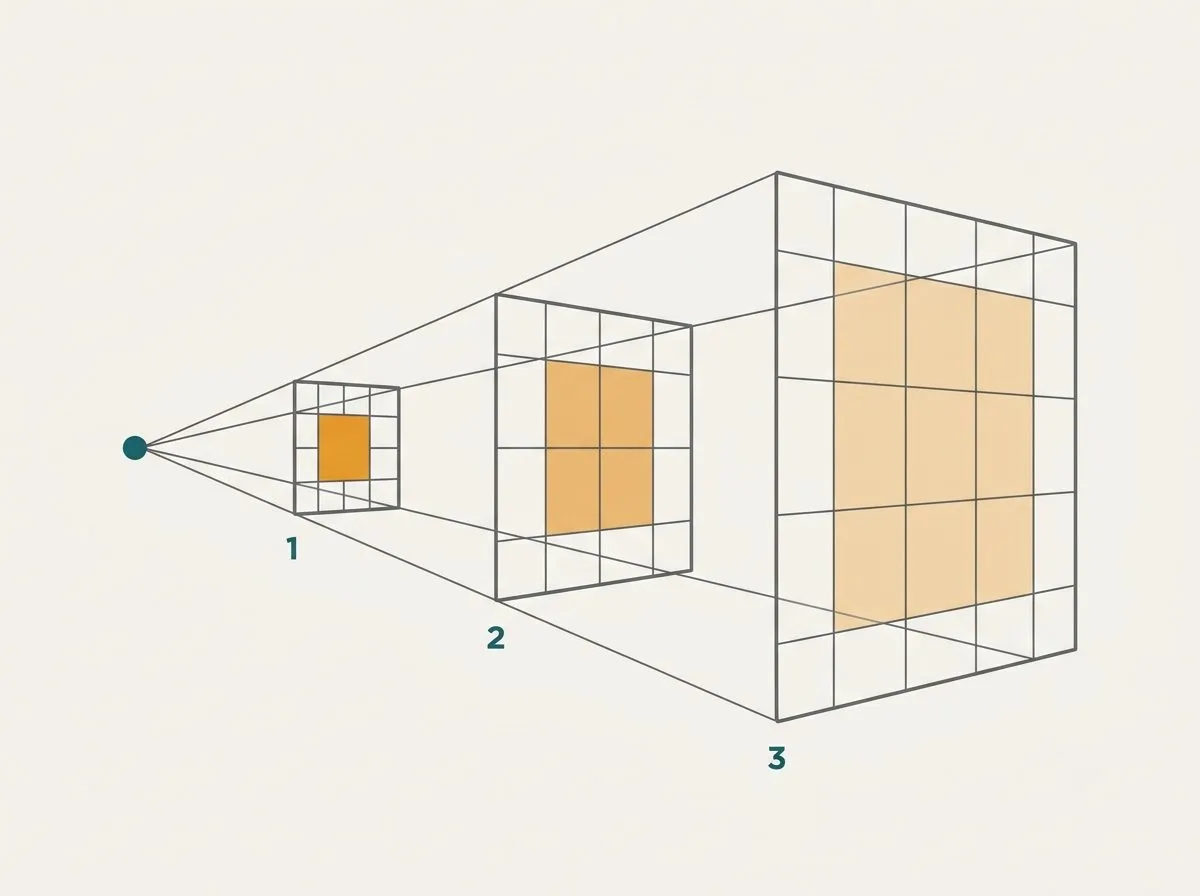
The inverse-square law
Reciprocity and rules of thumb
The Bunsen–Roscoe reciprocity law says that the photographic effect depends on the total energy received, H = E × t. A high illuminance for a short time gives the same density as a low illuminance for a long time. At extreme exposures the law breaks down, which is called reciprocity failure.
The Sunny 16 rule gives a starting point outdoors: at f/16 in sunlight the shutter speed in fractions of a second is about the reciprocal of the ISO speed.
Other terms worth knowing
- Apparent brightness and distance. Doubling the camera-to-subject distance halves the linear size of the image on the focal plane, so the same light is spread over a smaller area.
- Actinic light is light in the spectral band to which a given emulsion or sensor responds.
- Callier effect. The ratio of specular to diffuse density of a negative, caused by scattering inside the emulsion.
- Colour conventions. Cool blue-green tones read as night and warm amber tones as day, a psychological convention used constantly in lighting.
Quick answers
What is the difference between lux and nits? Lux measures light arriving at a surface; nits (cd/m²) measure light leaving it toward the viewer.
How much does a lamp lose when it is moved twice as far? Three quarters of the illuminance, by the inverse-square law.
Does exposure depend only on light level? It depends on light level times time, so a lower level can be balanced with a longer exposure, within the limits of reciprocity failure.
Read next
- Color Temperature, Mireds and CRI Explained for Cinematographers
- Exposure: The Zone System, Light Meters, Gray Cards and Lighting Ratios
- Key Light Principles: Hard vs Soft, High-Key vs Low-Key Lighting
Related on this site
- One light, two worlds: physical units from the film set to the render engine
- CG Lighting: a practical CGI guide
This article is part of the free handbook Technical Foundation. Filmmaking: The Cinematographer’s Handbook by Semen Klenov, an independent researcher of light and visual perception. Cite the handbook as: Klenov, S. (2026). Technical Foundation. Filmmaking: The Cinematographer’s Handbook. Zenodo. https://doi.org/10.5281/zenodo.24326083.