Home / Journal / Cinematography
Electricity Basics for Film Sets: Voltage, Current, Resistance, Ohm’s Law
Charge, voltage, current, resistance, power and series and parallel circuits explained for film crews, with worked wattage and amperage examples.
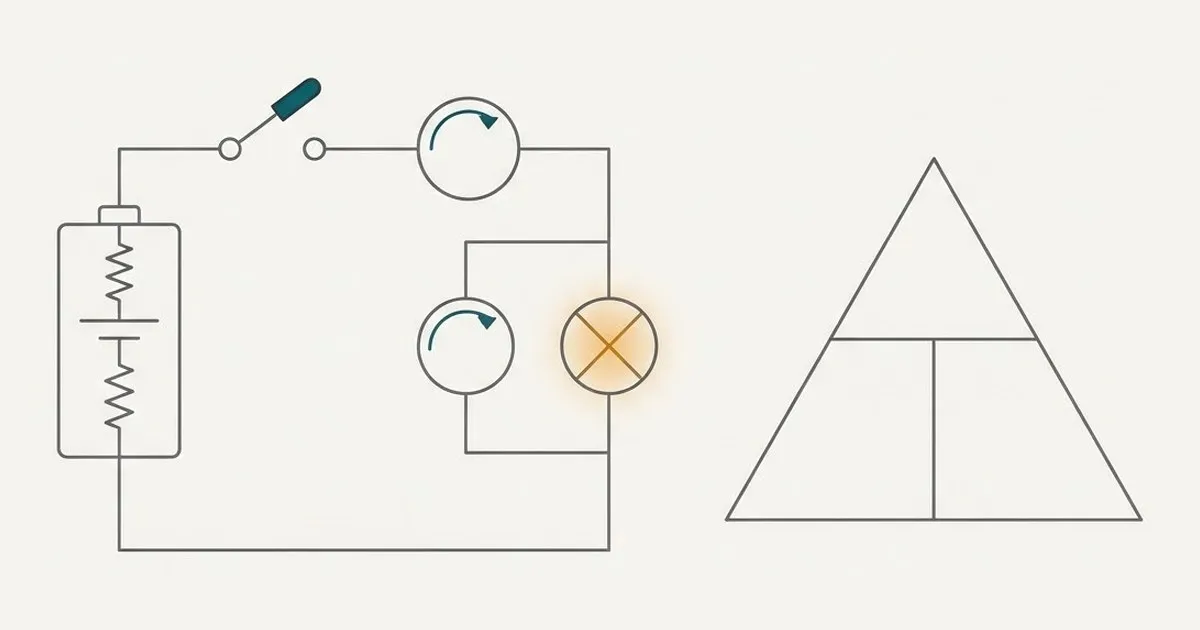
Lamps, ballasts and generators all obey the same few laws of electricity. A gaffer who knows them can size a cable, predict a tripped breaker and explain why lights dim at the end of a long run. This article covers the basics: charge, voltage, current, resistance, power and circuit layout.
Key points
- Voltage V is the work per unit charge (1 V = 1 J/C), current I is charge per second (1 A = 1 C/s), resistance R is measured in ohms.
- Ohm’s law: I = V / R. For a whole circuit with a source of EMF E and internal resistance r: I = E / (R + r).
- Power: P = V · I = I²R = V² / R, in watts. Heat in a conductor: Q = I²Rt (Joule–Lenz law).
- In a series circuit the current is the same everywhere and resistances add. In a parallel circuit the voltage is the same and currents add.
- Production lighting is wired in parallel, so switching one lamp does not change the voltage on the others.
Charge and field
Matter is built from a positive nucleus and negative electrons. Like charges repel, opposite charges attract, and the force between two point charges is proportional to the product of the charges and inversely proportional to the square of the distance (Coulomb’s law). Charge is conserved: it can only be moved from one body to another. The region around a charge, where it exerts force on other charges, is an electric field, and field lines run from positive charges to negative ones.
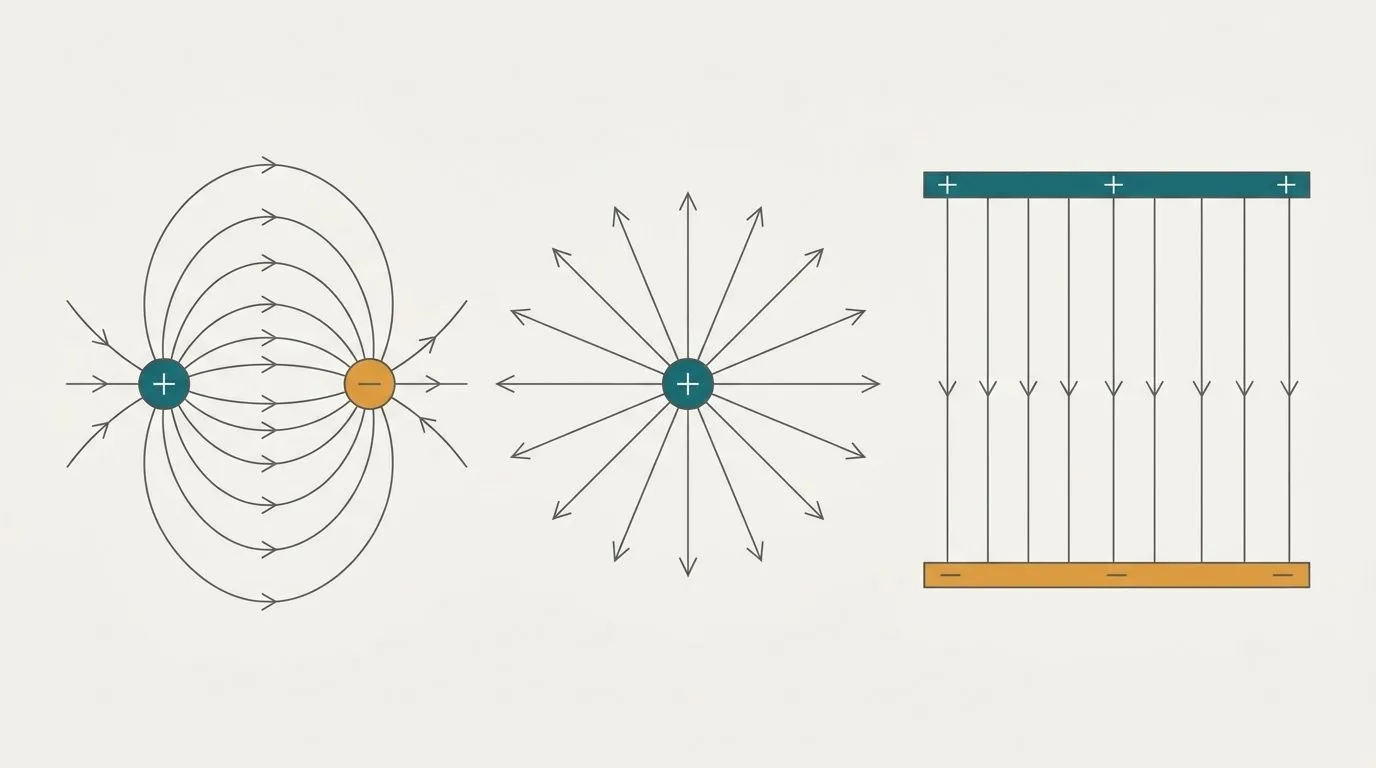
Electric field lines around charges and between plates
Conductors, such as metals, contain free charge carriers. Insulators, or dielectrics, such as glass, dry wood, rubber and air, do not. Current needs two things: an electric field, that is a potential difference, and free carriers. A source such as a battery or an alternator keeps the potential difference alive through non-electrostatic forces, chemical in a battery, magnetic in an alternator. This is the electromotive force, measured in volts.
Ohm’s law and power
The current through a metal conductor is proportional to the voltage across it and inversely proportional to its resistance. The resistance of a wire grows with its length and shrinks with its cross-section: R = ρ · l / S, where ρ is the resistivity of the material. Real sources have internal resistance, so under heavy load the terminal voltage drops and the lights get less than the nominal voltage.
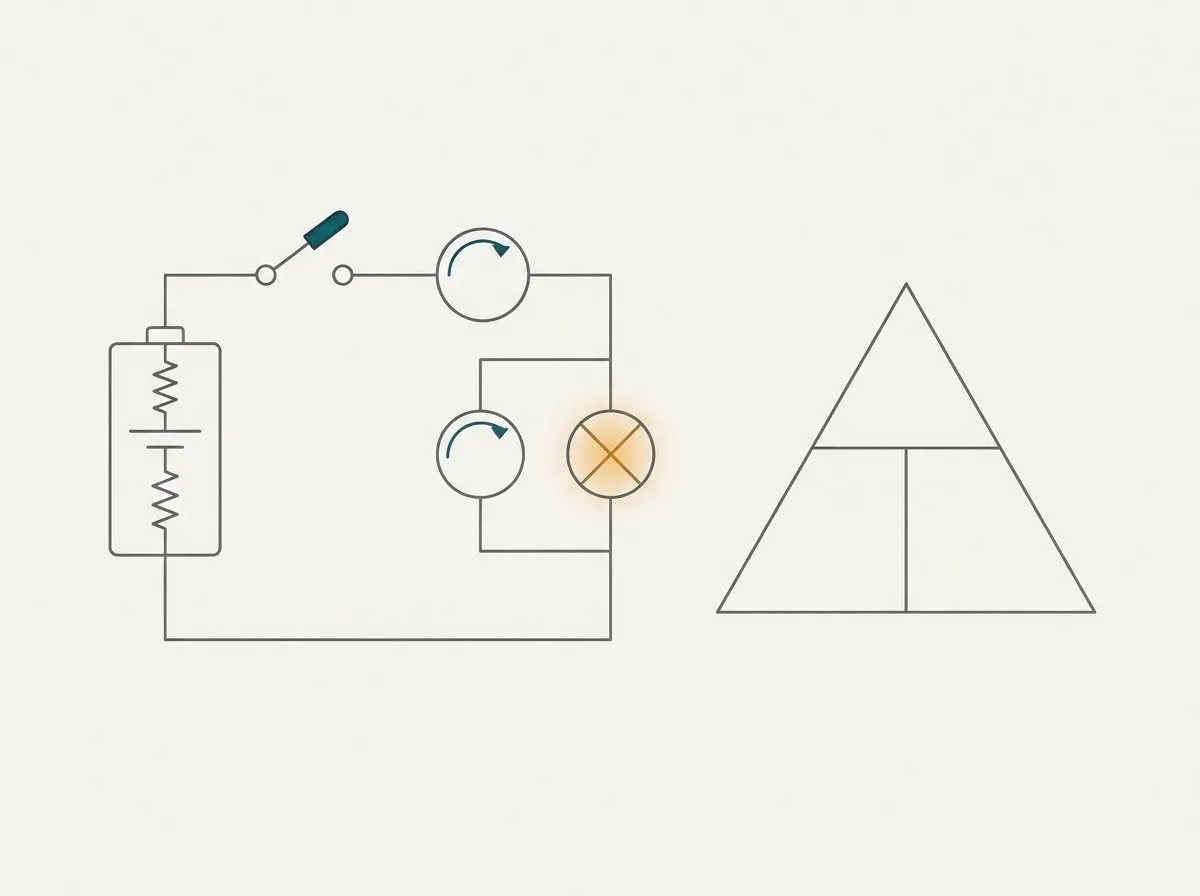
A complete circuit and Ohm’s law
Power is the rate of doing electrical work, measured in watts. A 1,000 W tungsten lamp on 120 V draws about 8.3 A (1000 / 120); on 230 V the same lamp draws about 4.3 A. All power that is not turned into light becomes heat, which is why cables must be sized for their current.
Two circuit faults follow directly. If resistance falls toward zero, current rises sharply: a short circuit. If the conductor breaks, current stops: an open circuit. Beyond the maximum current of a source, a breaker trips or a fuse melts.
Series and parallel wiring
In series, components sit one after another. The current is the same through all of them, voltages add, and resistances add. In parallel, all branches connect across the same two nodes. Voltage is the same on every branch, currents add, and the reciprocal of the total resistance is the sum of the reciprocals. Power distribution on a set uses parallel wiring, so that turning one fixture on or off does not change what the others receive.
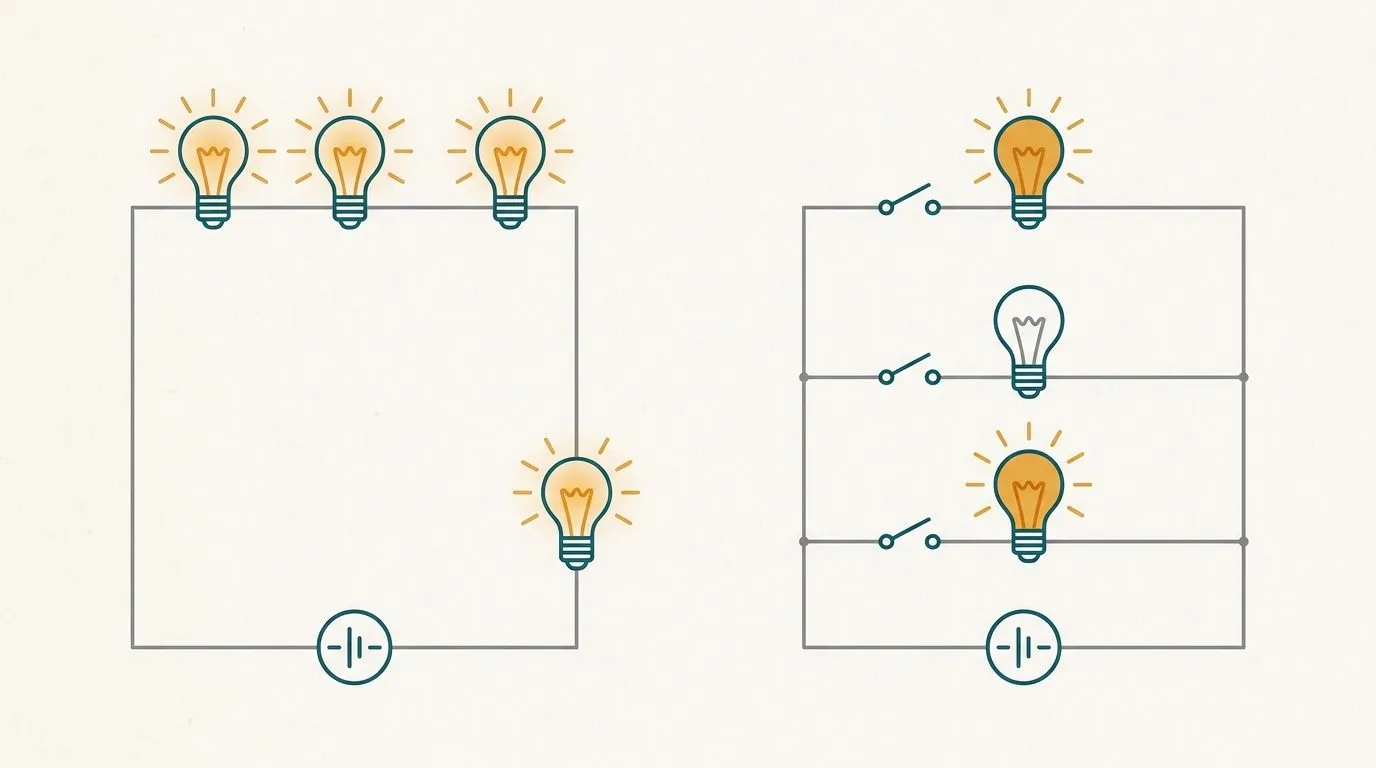
Series vs. parallel wiring of lamps
Capacitors, semiconductors and vacuum tubes
A capacitor stores electrostatic energy between two plates separated by a dielectric. It smooths ripple in power supplies, couples or blocks signals, and holds the charge that an electronic strobe releases in a flash. In metals, heating increases resistance because lattice vibrations scatter the electrons more; in semiconductors the opposite happens, resistivity falls as temperature rises. The boundary between p-type and n-type material, the p–n junction, conducts in one direction only, which is the basis of diodes and rectifiers. The vacuum diode works on a similar principle: a heated cathode emits electrons that a positive anode collects, while reversed polarity blocks the current.
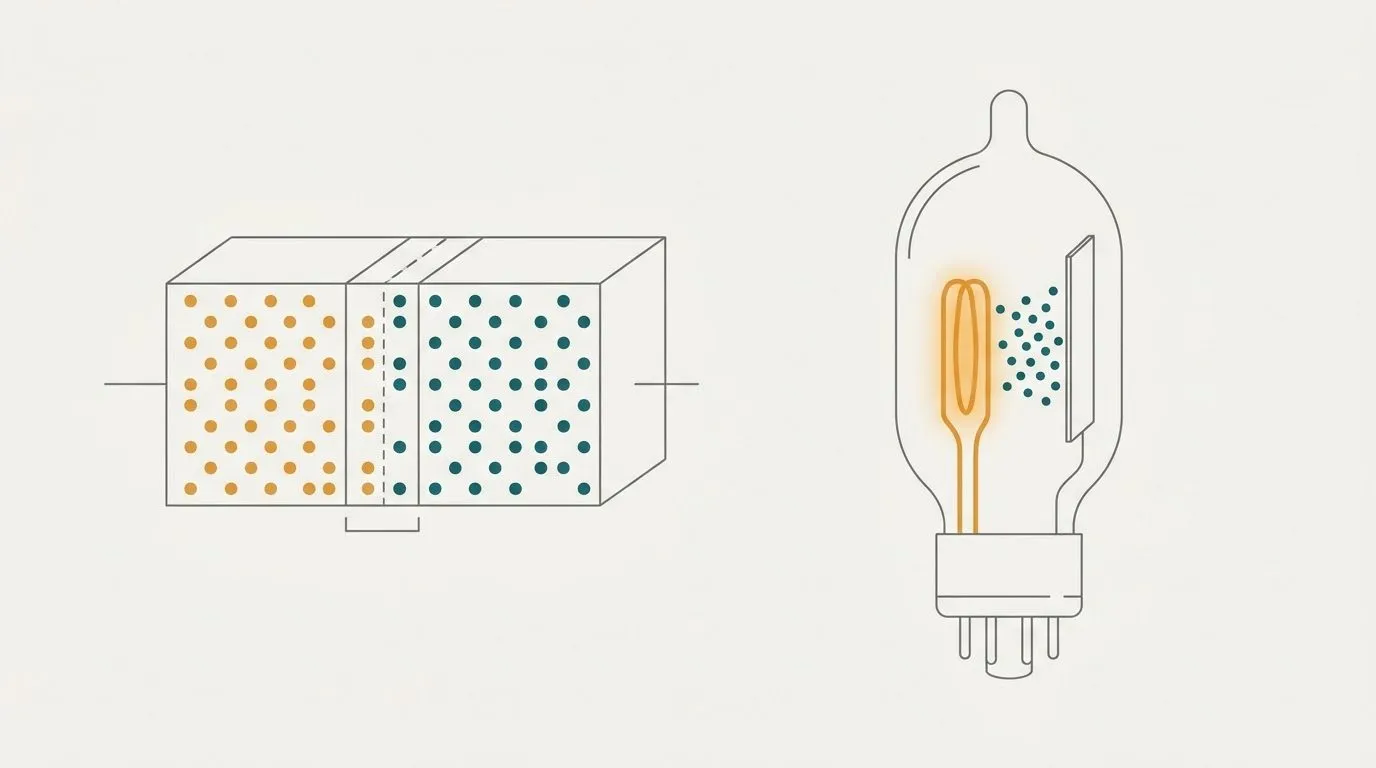
p–n junction and the vacuum diode
Quick answers
Why do lights dim at the end of a long cable? The cable has resistance, so part of the voltage is lost along it, and the loss grows with current.
How do I find the current of a lamp? Divide its wattage by the supply voltage.
What is the difference between a short and an overload? A short has almost zero resistance and a very high current; an overload is a normal circuit carrying more current than it is rated for.
Read next
- Alternating Current, Transformers and Three-Phase Power for Film Crews
- Power Distribution on a Film Set: Cables, Grounding, Load and Generators
- Photometry for Filmmakers: Lumens, Lux, Candela and Inverse-Square Law
Related on this site
- Hardware: a practical CGI guide
- One light, two worlds: physical units from the film set to the render engine
This article is part of the free handbook Technical Foundation. Filmmaking: The Cinematographer’s Handbook by Semen Klenov, an independent researcher of light and visual perception. Cite the handbook as: Klenov, S. (2026). Technical Foundation. Filmmaking: The Cinematographer’s Handbook. Zenodo. https://doi.org/10.5281/zenodo.24326083.