Home / Journal / Cinematography
Alternating Current, Transformers and Three-Phase Power for Film Crews
AC, RMS values, Faraday's induction, transformers and three-phase systems explained for gaffers, with the voltages used on set in North America and Europe.
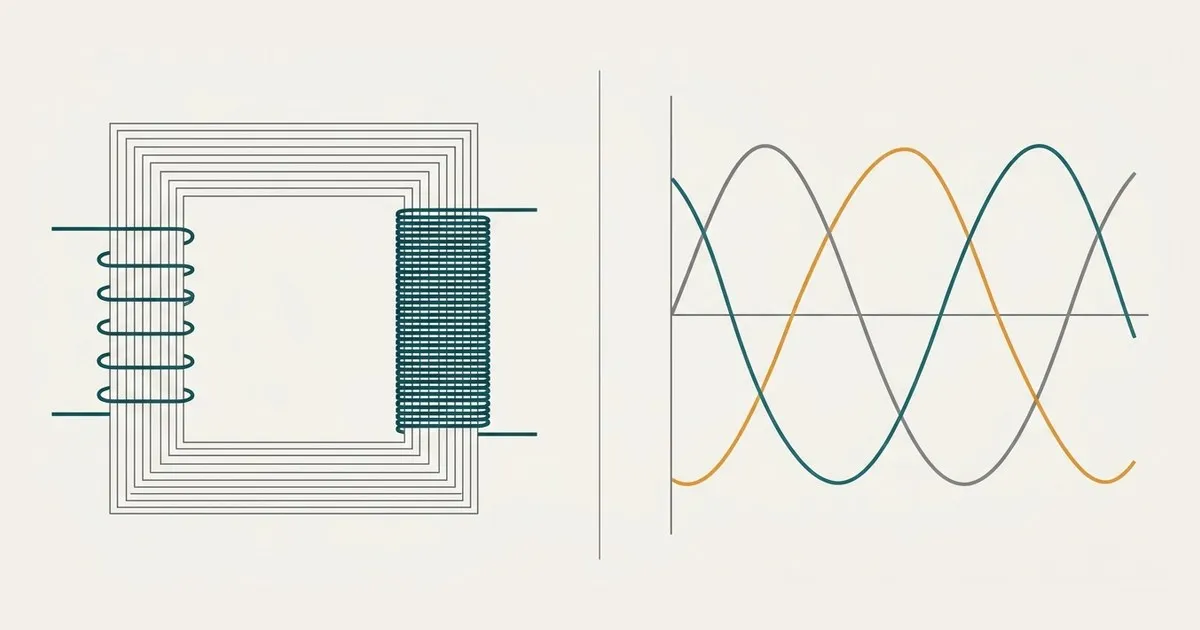
The mains on a film set is alternating current, and nearly every lamp ballast, dimmer and generator uses induction. This article explains why AC is used, what the numbers on a power label mean, how a transformer changes voltage, and why three-phase supply is standard for large lighting loads.
Key points
- Alternating current changes direction and magnitude continuously. Mains frequency is 50 or 60 Hz.
- The RMS value is the DC equivalent that heats a resistor equally: I_rms = I_peak / √2 ≈ 0.707 · I_peak.
- Faraday’s law: the induced EMF equals the rate of change of magnetic flux. Lenz’s law: the induced current opposes the change that caused it.
- A transformer changes voltage in proportion to its turns: V_s / V_p = N_s / N_p.
- Three-phase power uses three voltages of equal frequency and amplitude, offset by 120°.
What alternating current is
In a power network AC is generated by electromagnetic induction in alternators. The voltage follows a sine wave, so the useful value is not the peak but the root-mean-square (RMS) value, the steady current that would deliver the same heat to a resistive load over one cycle. Active power in a circuit where voltage and current are in phase is P = I_rms × V_rms. Real AC circuits are never purely resistive: a changing current induces a back-EMF in the conductor itself, so a circuit has both resistance and reactance.
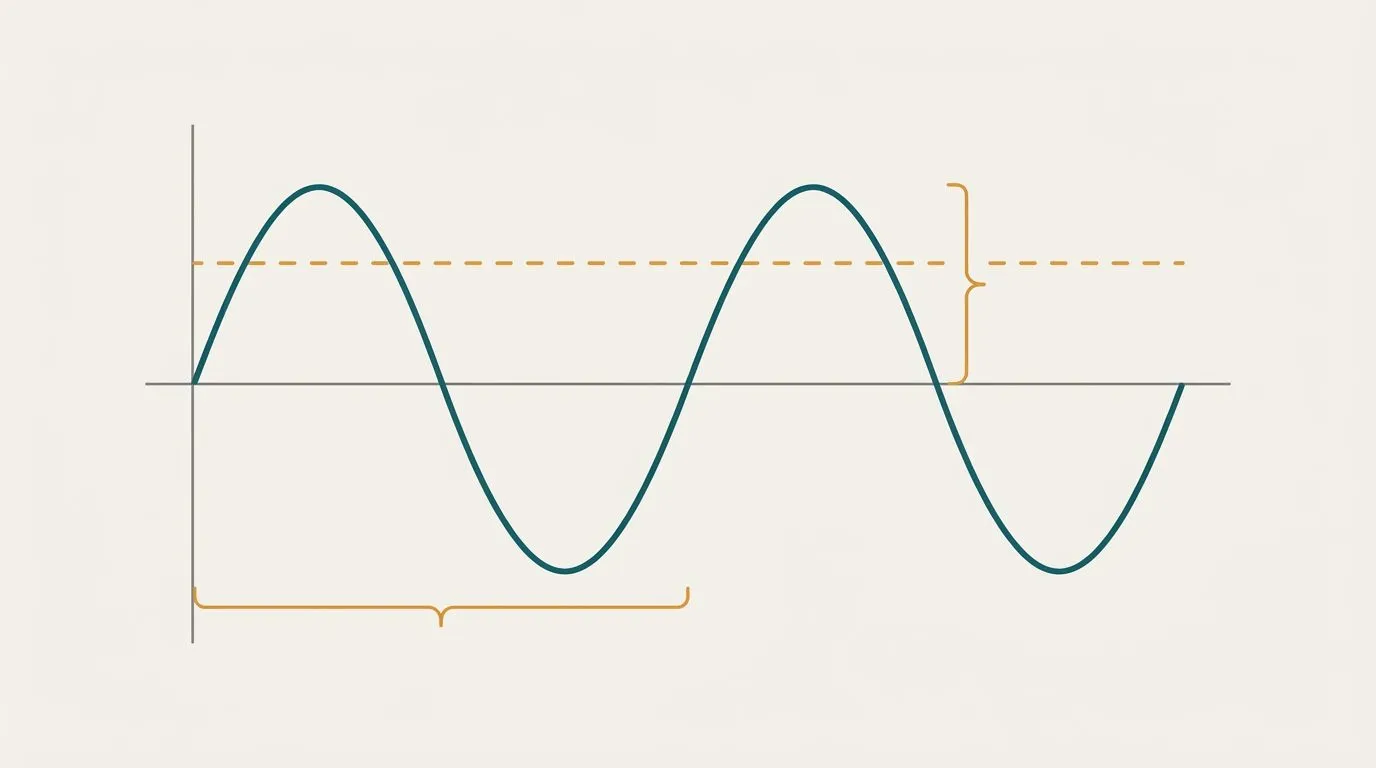
Alternating current: peak and RMS values
Electromagnetic induction
In 1831 Michael Faraday showed that a changing magnetic flux through a closed loop induces a current in it. Moving a magnet in and out of a coil does exactly that. The size of the induced EMF is the rate of change of the flux, and by Lenz’s law its direction is always such that the new magnetic field opposes the change that created it. Flux is measured in webers, 1 Wb = 1 V·s.
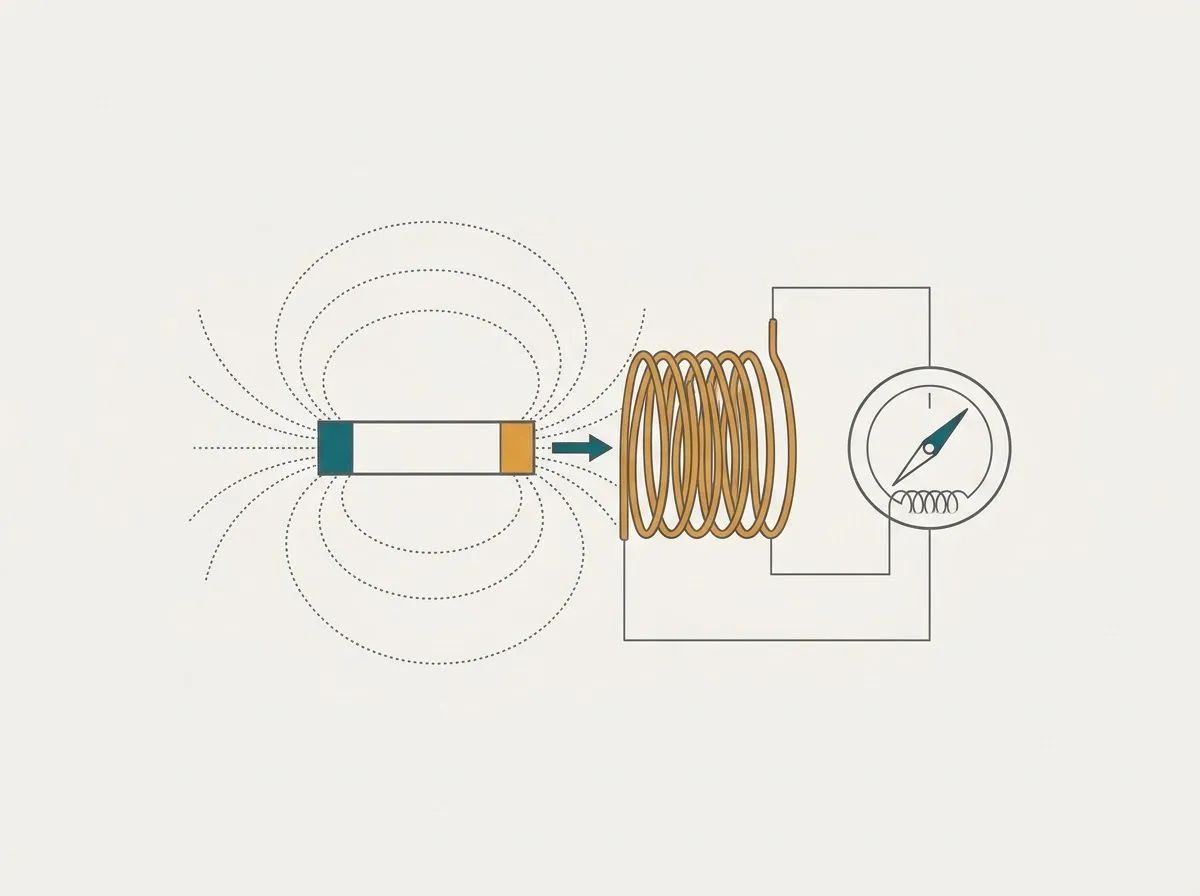
Faraday’s electromagnetic induction
A current in a conductor creates its own magnetic field, and the flux linked with the circuit is proportional to the current: Φ = L · I. The constant L is the inductance, measured in henries. One henry is the inductance in which a current change of 1 A per second induces an opposing EMF of 1 V. Self-induction is the reason a ballast limits the current of a discharge lamp.
Transformers
A transformer has two windings on a closed ferromagnetic core. The primary winding takes the AC supply, and the secondary delivers a different voltage to the load. The voltage ratio equals the turns ratio. Transformers matter because losses in a line grow with the square of the current (P_loss = I²R). For a given power P = V · I, a higher voltage means a lower current and lower loss, so power is generated efficiently, sent over long distances at high voltage and stepped down to safe levels on location. Pavel Yablochkov built the first practical AC transformer in 1876.
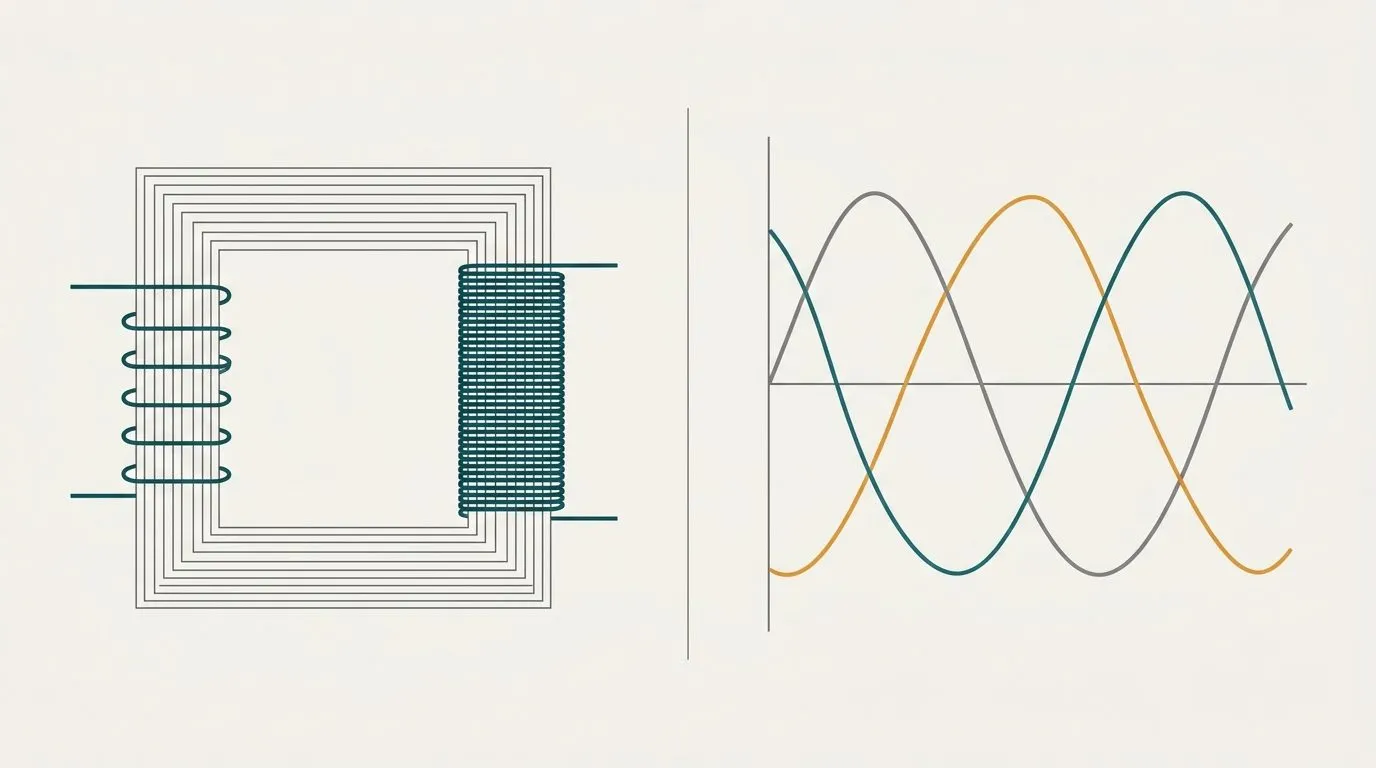
Transformer and three-phase voltages
Three-phase power
A three-phase system carries three sinusoidal voltages of equal amplitude and frequency, 120° apart. Large installations use four or five wires: three hot phases, a neutral and a ground. Typical voltages are:
| Measured between | North America | Europe |
|---|---|---|
| Phase and phase | 208 V | 380–400 V |
| Phase and neutral | 120 V | 220–240 V |
Loads should be spread evenly across the phases. A balanced system keeps the current in the common neutral conductor small.
Quick answers
Why is the RMS value used? It gives the equivalent heating power of a DC current, so a 120 V mains label can be used in ordinary power calculations.
Why do power companies use high voltage? The same power at higher voltage needs less current, and line losses fall with the square of the current.
What is the benefit of three phases on set? The load can be shared between three phases, which keeps the neutral current low and allows heavy lighting loads from one feed.
Read next
- Electricity Basics for Film Sets: Voltage, Current, Resistance, Ohm’s Law
- Power Distribution on a Film Set: Cables, Grounding, Load and Generators
- Ballasts, Flicker and Camera Sync for Film Lights
Related on this site
- Hardware: a practical CGI guide
- One light, two worlds: physical units from the film set to the render engine
This article is part of the free handbook Technical Foundation. Filmmaking: The Cinematographer’s Handbook by Semen Klenov, an independent researcher of light and visual perception. Cite the handbook as: Klenov, S. (2026). Technical Foundation. Filmmaking: The Cinematographer’s Handbook. Zenodo. https://doi.org/10.5281/zenodo.24326083.