Home / Journal / Cinematography
Ballasts, Flicker and Camera Sync for Film Lights
Why discharge lights flicker on camera, how magnetic and square-wave ballasts differ, and how line frequency, shutter angle and three-phase power affect it.
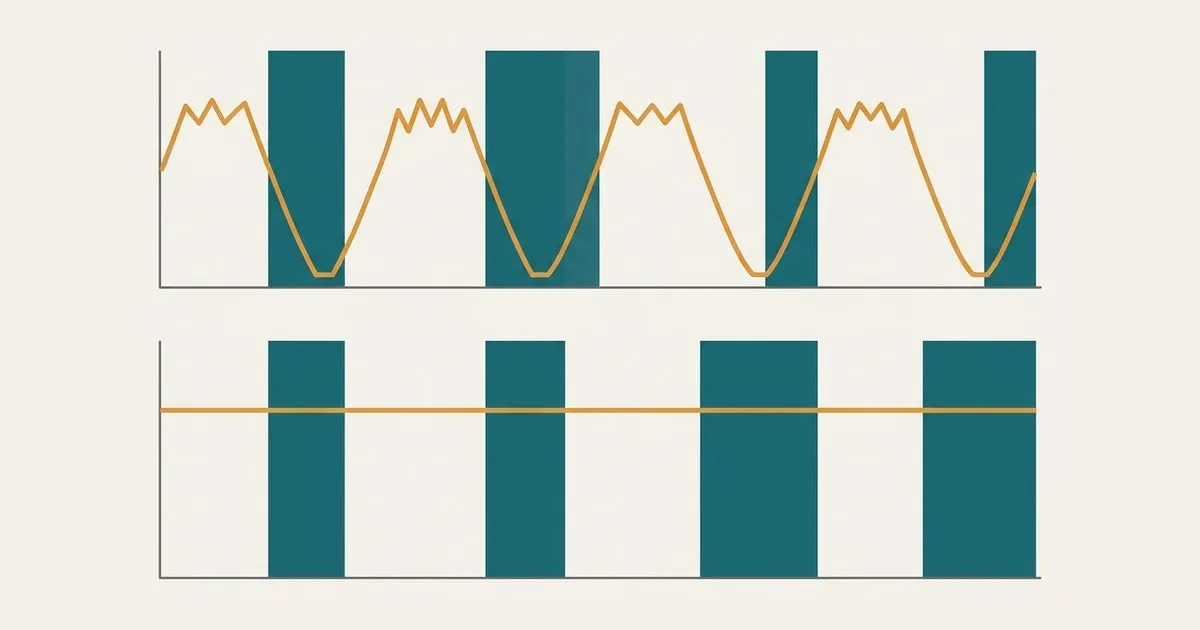
A light that looks steady to the eye can pulse at 100 or 120 times a second, and a camera shutter can see every pulse. Flicker is the most common technical fault with discharge lamps. This article explains what a ballast does, why magnetic and electronic ballasts behave differently, and how to keep light and shutter in step.
Key points
- A ballast raises the voltage to strike the arc (pulses of 20–50 kV) and then limits current so that the plasma stays stable.
- A magnetic ballast follows the mains and is tuned to 50 or 60 Hz ± 0.5 Hz. A square-wave electronic ballast reverses the polarity quickly and avoids the zero-current dead time of a sine wave.
- Discharge lamps have almost no thermal mass: on a magnetic ballast, output can drop by 60–85% between half-cycles of the mains. Tungsten filaments smooth the ripple to about 10–20% on larger lamps.
- Flicker-free electronic ballasts run at 75–300 Hz, and special high-speed units up to 1000 Hz and more.
- Power all lamps from one crystal-controlled generator, or spread them across three phases.
What a ballast does
A ballast combines a step-up transformer, which gives the strike voltage that ionizes the cold gap, with a choke or electronic regulator that throttles the voltage to the steady running level of the lamp. Once the arc exists it limits the current. Because the strike pulse is dangerous, the chassis must be reliably grounded to protect the crew.
Two kinds are in common use. Constant-wattage ballasts hold the lamp’s power while the line voltage varies. Square-wave electronic ballasts are generally universal: they accept 90–265 V AC and deliver flicker-free square waves. High-wattage 18 kW units often need three-phase input stepped to 220 or 380 V.
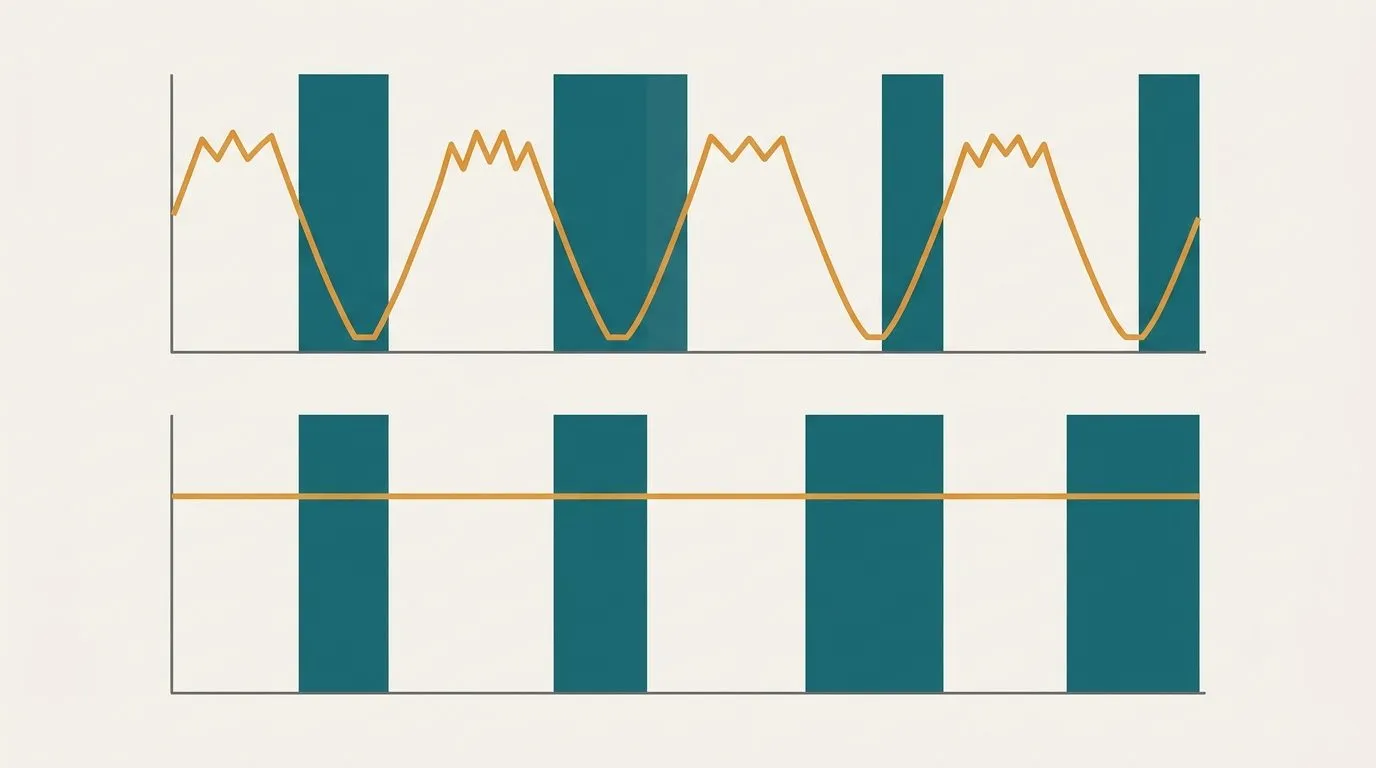
Flicker: magnetic vs. square-wave ballast
How to avoid flicker
The practical rules are short.
- Match the line frequency to the shutter. With a 180° shutter at 24 or 25 fps, and mains at the local frequency, the exposure sees a consistent part of the cycle.
- Run all lamps from one source whose frequency is crystal-controlled.
- For high-frame-rate work use square-wave ballasts.
- Give each lamp a different phase on a three-phase supply.
A worked example shows why. At 60 Hz the mains pulse 120 times a second. At 24 fps that is 5 pulses per frame. With a 180° shutter the exposure lasts 1/48 s and covers 2.5 pulses, a fractional number. As long as the mains and the camera keep their phase relation the result is stable, but any drift between line frequency and camera speed shows up as exposure breathing. That is why frequency has to be locked or a high-frequency ballast used.
Three phases and high frequencies
On a large stage, feeding three fixtures from the three phases, which are offset by 120°, means that when one lamp dips the others rise, so the combined ripple of the set is smoother. A balanced three-phase load also gives an even neutral load and avoids voltage drop on long runs.
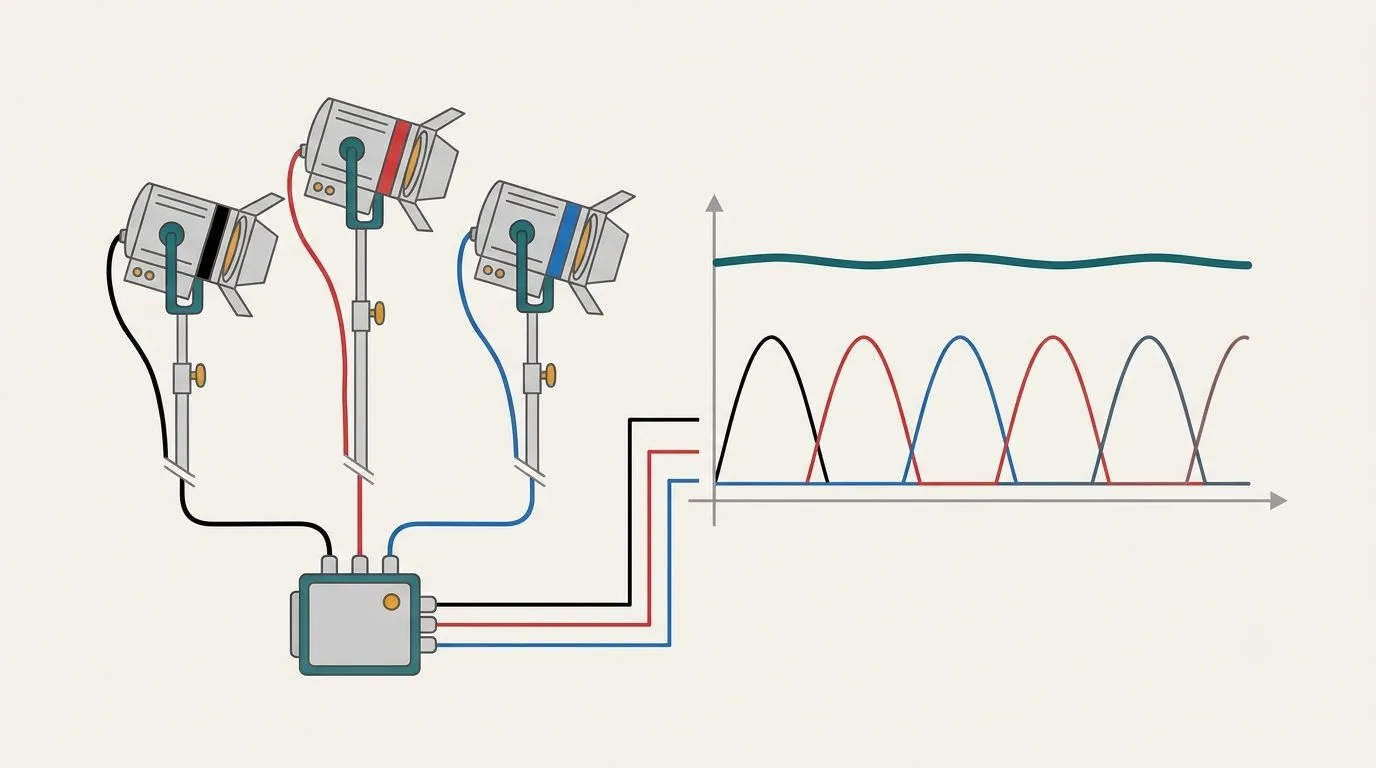
Smoothing flicker by spreading lamps across three phases
Higher ballast frequencies make the variation less visible on camera. There is one side effect: high-frequency operation between 200 and 250 Hz can excite acoustic resonance in the quartz envelope and produce an audible hum or whine.
Other discharge sources
Two more discharge lamps appear in older equipment: CSI (compact source iodine, 4200 K) and CID (compact indium discharge, 5500 K), both metal-halide. CID lamps were used for broad illumination in large sports arenas and stadium shoots.
Quick answers
Why does an HMI flicker at high frame rates? The arc follows the mains and falls almost to zero twice per cycle. At high speed the shutter is open for a shorter time and catches different parts of the cycle.
Does tungsten flicker too? It fluctuates a little on AC, but thermal inertia smooths it.
What is the simplest fix? A square-wave electronic ballast, and one clean power source for all lights.
Read next
- HMI, Fluorescent and Flash: Discharge Light Sources for Film
- Alternating Current, Transformers and Three-Phase Power for Film Crews
- Film Lighting Fixtures: Fresnels, Open-Face, Ellipsoidals and Soft Lights
Related on this site
- Analogue vs digital: sampling, bits and aliasing explained with two experiments
- One light, two worlds: physical units from the film set to the render engine
This article is part of the free handbook Technical Foundation. Filmmaking: The Cinematographer’s Handbook by Semen Klenov, an independent researcher of light and visual perception. Cite the handbook as: Klenov, S. (2026). Technical Foundation. Filmmaking: The Cinematographer’s Handbook. Zenodo. https://doi.org/10.5281/zenodo.24326083.