Home / Journal / Cinematography
Film Lighting Fixtures: Fresnels, Open-Face, Ellipsoidals and Soft Lights
How film lights are built: Fresnel spotlights, open-face and soft lights, ellipsoidals, Dedolights and fibre optics, with lens and reflector types.
A lighting fixture is a lamp plus optics: a reflector, a lens and a housing that together decide how the beam looks. This article describes the main families of film fixtures, how they are focused, and how lenses and reflectors change the quality of light.
Key points
- A concave reflector sends parallel rays to its focal point, which lies at half its radius of curvature. Put a lamp at that point and the reflector returns a parallel beam.
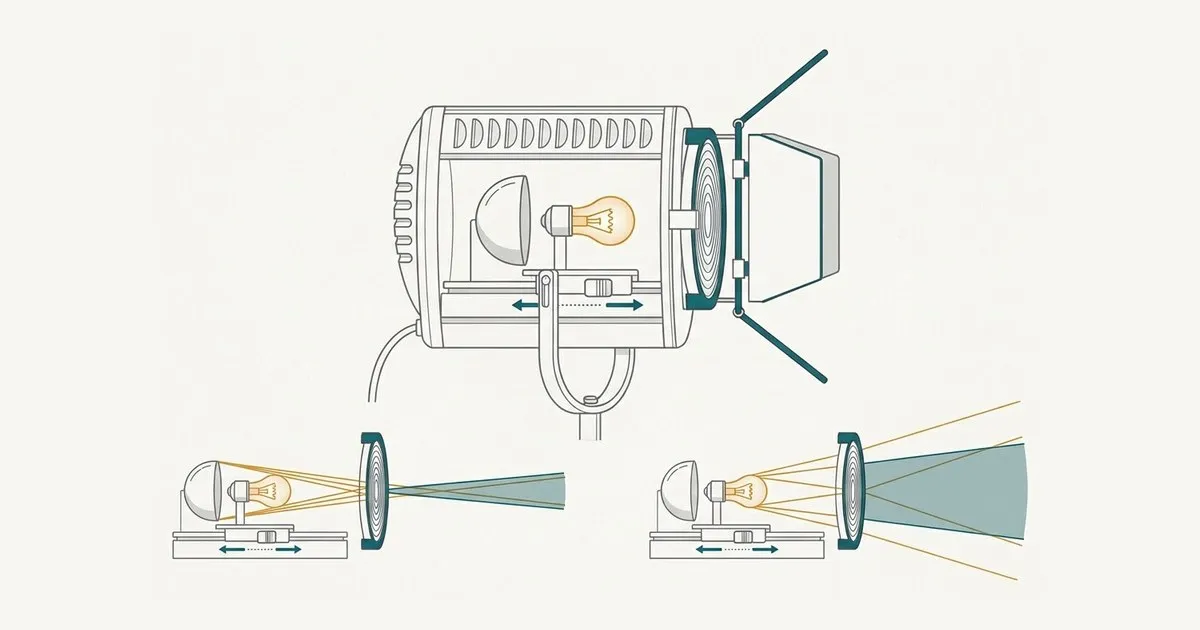
- In a Fresnel spotlight, moving the lamp and reflector toward the lens floods the beam, moving them away narrows it into a spot.
- Open-face fixtures have no front lens, and their beam is set by the reflector alone.
- Ellipsoidal (profile) spotlights have shutters in the focal gate that give razor-sharp edges and can project gobo patterns.
- Specular reflectors give a punchy beam, diffuse reflectors scatter light, and semi-specular reflectors give a directional core with feathered edges.
Spotlights
Fixture housings are made of sheet steel, die-cast aluminium or magnesium alloy, and carry a yoke fitted with a junior pin (1⅛”) or a baby receiver (⅝”). Ventilation louvers cool the lamp without leaking stray light. A front door opens for lamp changes, and an accessory bracket holds barn doors, scrims and colour frames. Compact “baby” fixtures, such as the Baby 1K and Baby 2K, put the output of a larger unit in a smaller housing.
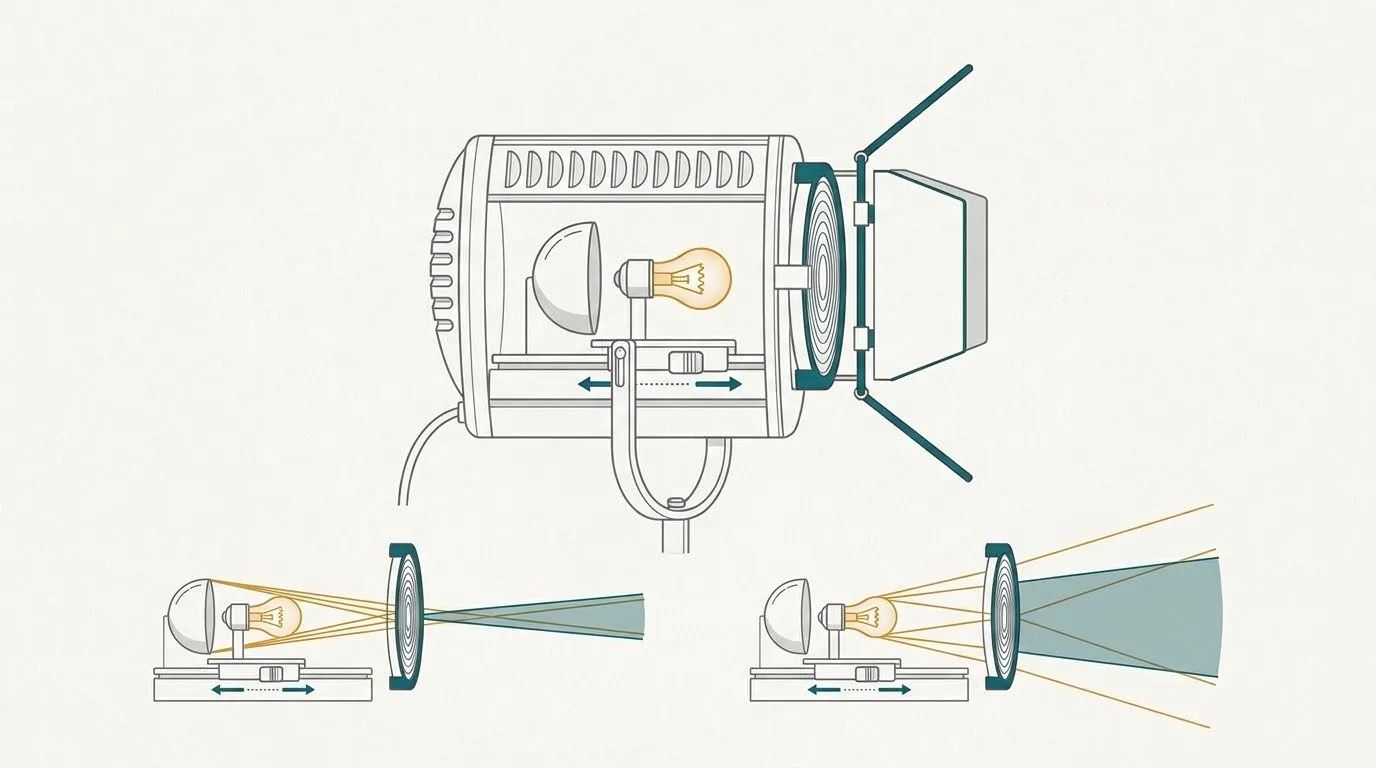
Fresnel spotlight: construction and spot/flood focusing
Power arrives through stage-pin (Bates), twist-lock or grounded household connectors. Ellipsoidal spotlights (Leko or profile) pair an ellipsoidal reflector with plano-convex lenses and place framing shutters in the focal gate between lamp and lens. The beam is highly collimated and uniform, ideal for long throws, and a sliding lens barrel sharpens or softens the edge.
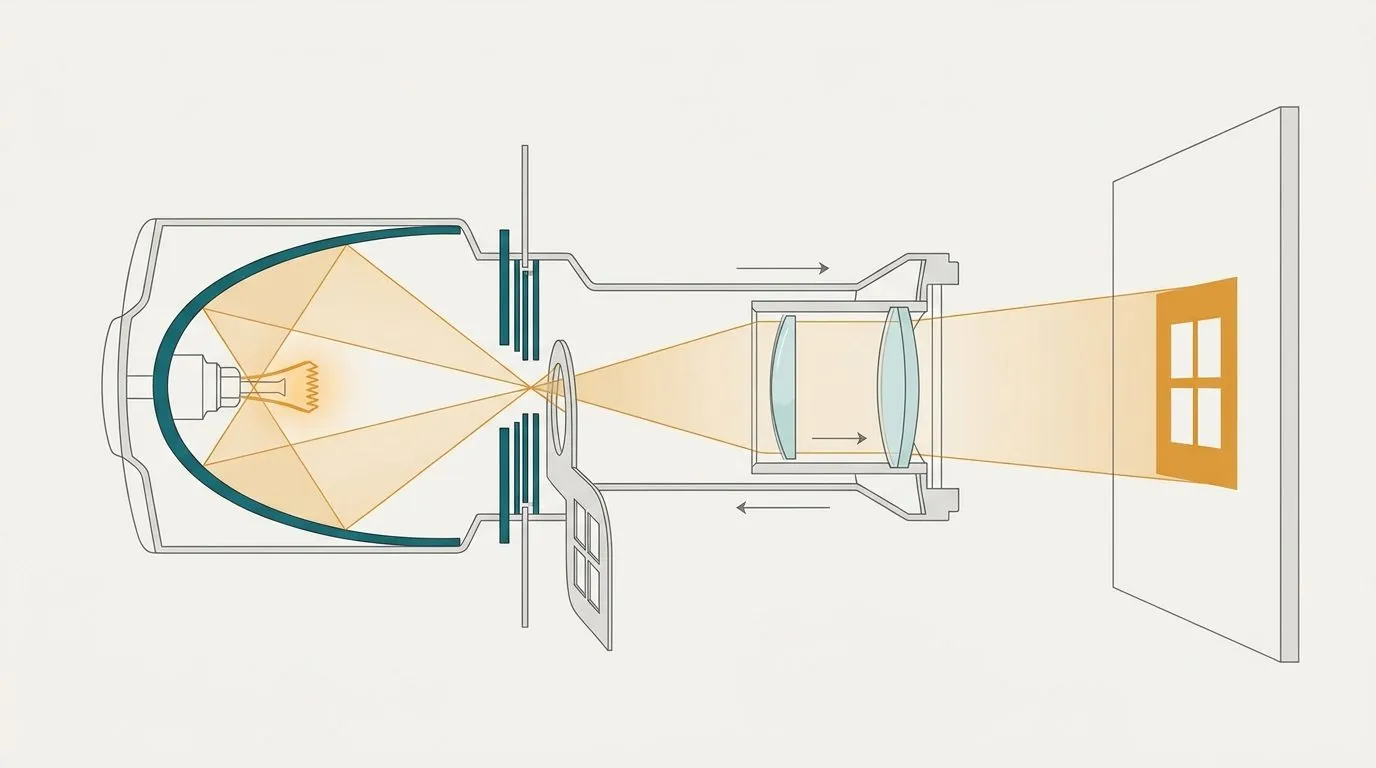
Ellipsoidal (profile) spotlight
Open-face, soft and compact fixtures
- Directional open-face lights have a textured parabolic reflector and a wire guard. Moving the lamp toward the reflector widens the beam.
- Broads and scoops give wide, soft fill.
- Cyc and strip lights wash a backdrop evenly from top to bottom, grouped in banks for colour mixing.
- Soft lights shield the lamp with a baffle so that all the light bounces from a white or silvered bowl: soft, shadowless and impossible to focus tightly.
- Compact fixtures fit in car interiors, practical lamps and corners. The Dedolight uses two moving lenses and a 12 V or 24 V halogen lamp of 100–150 W for an even beam and high output per watt.
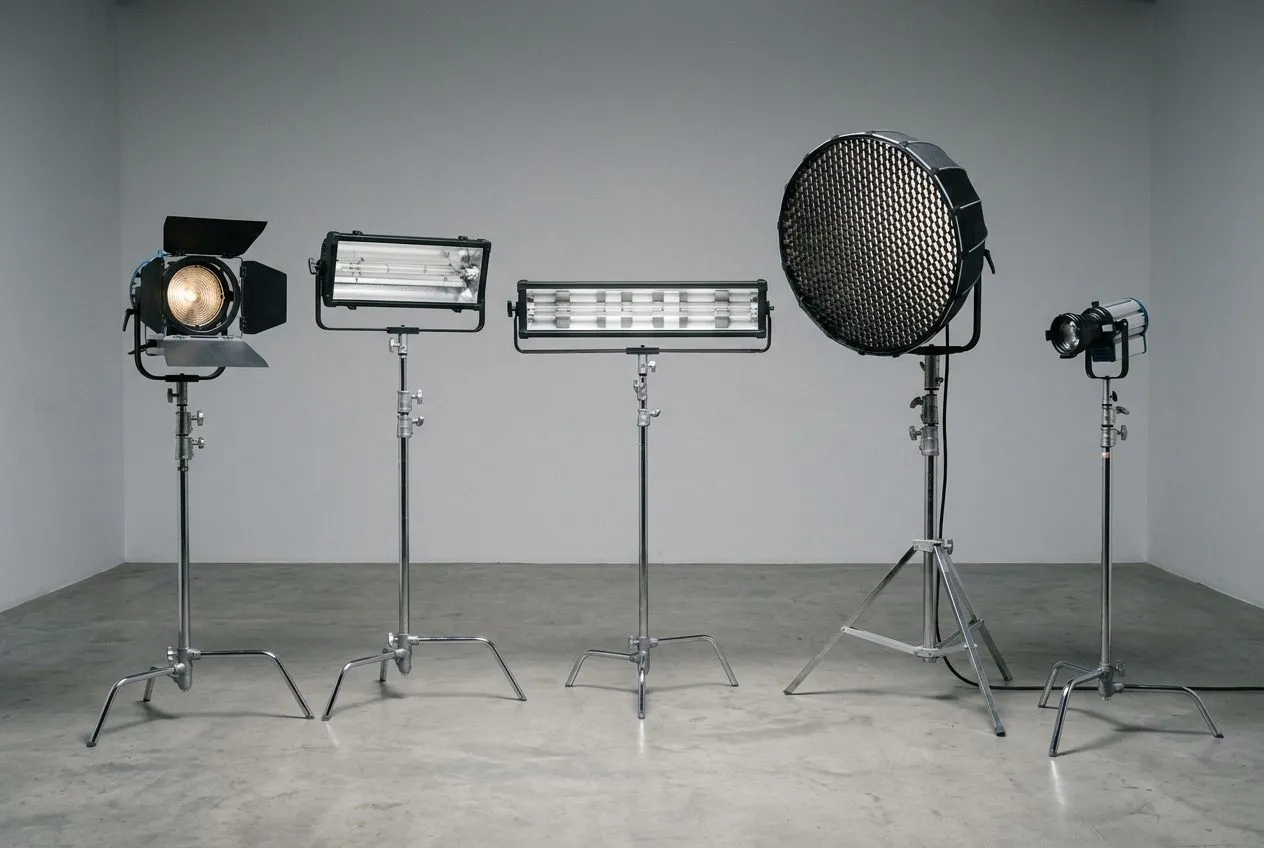
Open-face, broad, cyc, softlight and compact fixtures
Strobe fixtures freeze fast action in high-speed work. Above 50–60 flashes per second the eye sees continuous light; below it flicker is visible, and rates of 10–30 Hz can trigger seizures in people with photosensitive epilepsy.
Fibre-optic fixtures pipe light from a metal-halide or tungsten illuminator through flexible bundles by total internal reflection. No current or heat travels along the cable, so light can go into liquids, delicate props and tight spaces near talent. They suit macro work and miniatures.
Lenses and reflectors
Where the lamp sits relative to the lens focal point decides the beam. At the focal point the beam is parallel (spot). Closer to the lens the beam spreads (flood). Farther back the rays cross in front of the fixture before diverging. Clear polished glass gives a hard beam, frosted glass a diffused one.
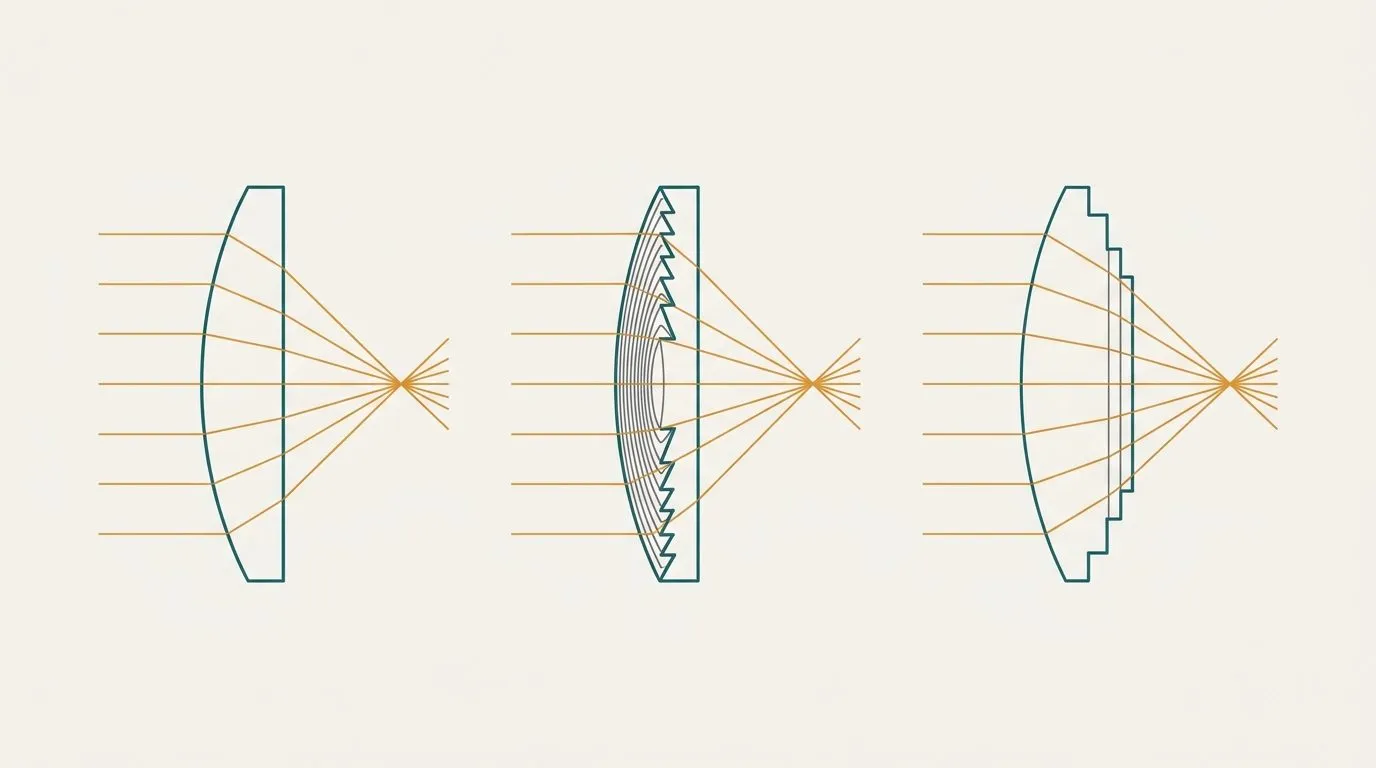
Plano-convex, Fresnel and stepped lens profiles
- A plano-convex lens has one flat and one spherical surface. A thick, strongly curved lens gives a wide beam.
- A Fresnel lens keeps the curvature of a thick lens but collapses it into concentric steps, so it is thin and light and dissipates heat quickly, with less risk of thermal shock. The stippled back smooths hot spots for a soft-edged beam.
- A stepped lens is a hybrid: a smooth convex face and a stepped back, with frosted or black risers between the steps to reduce scatter.
Reflector performance depends on polish, material and curvature. A beaded or textured surface breaks the hot spot of the filament into many small reflections and softens shadow edges. Precise alignment of the lamp in a parabolic reflector avoids a dark hole in the centre of the beam. Sockets matter too: pitting on the contacts means high resistance, local arcing and burned pins, and high-temperature anti-seize prevents mismatched metals from seizing.
Quick answers
What decides spot or flood? The distance between lamp-and-reflector and the lens, or between lamp and reflector in an open-face light.
Why use a Fresnel lens? It gives the beam control of a thick lens with a fraction of the glass, and survives heat better.
When is an ellipsoidal better than a Fresnel? When you need sharp edges, shaped cuts or a projected pattern over a long throw.
Read next
- Ballasts, Flicker and Camera Sync for Film Lights
- Flags, Nets, Diffusion and Gels: Shaping and Controlling Light on Set
- Tungsten, Tungsten-Halogen and Carbon Arc Lamps for Film Lighting
Related on this site
This article is part of the free handbook Technical Foundation. Filmmaking: The Cinematographer’s Handbook by Semen Klenov, an independent researcher of light and visual perception. Cite the handbook as: Klenov, S. (2026). Technical Foundation. Filmmaking: The Cinematographer’s Handbook. Zenodo. https://doi.org/10.5281/zenodo.24326083.