Home / Journal / Cinematography
HMI, Fluorescent and Flash: Discharge Light Sources for Film
How HMI, fluorescent, high-pressure discharge and xenon flash sources make light, why some of them tint skin, and how to correct and handle them on set.
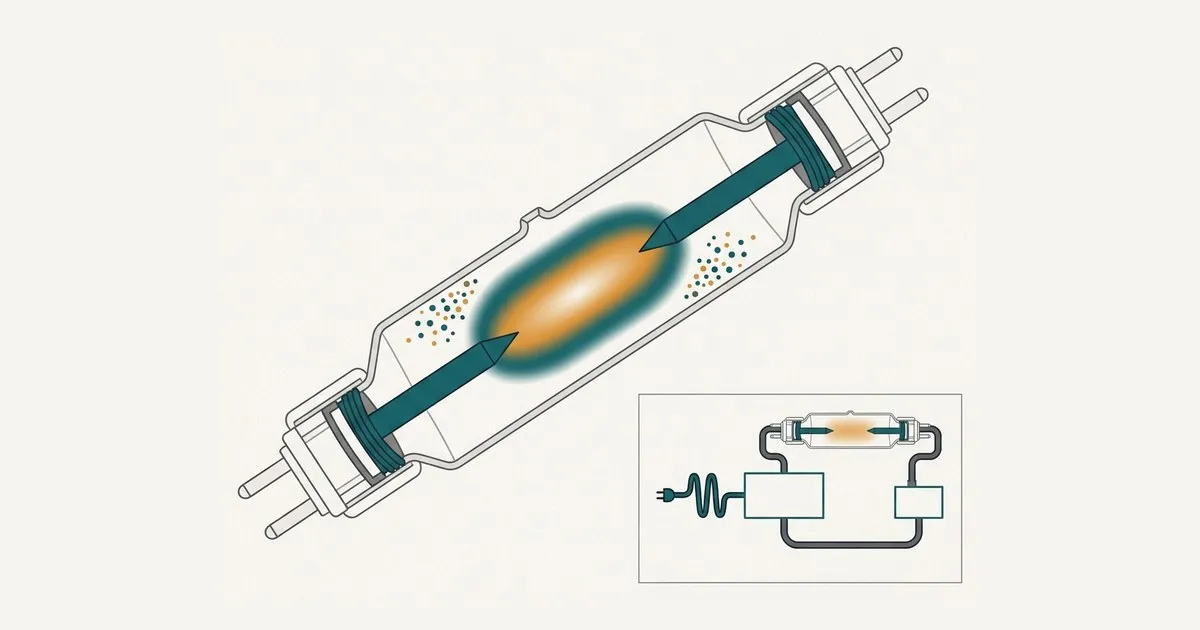
Discharge lamps make light from an arc through gas instead of a hot wire. They are efficient and can be daylight-balanced, which makes them the standard for big film lights, but their spectra are made of lines, and that is where the colour problems begin. This article covers HMI, fluorescent, industrial gas-discharge and electronic flash sources.
Key points
- HMI (mercury, medium arc length, iodides of rare earths) was developed by Osram in 1972. Its efficacy is three to four times that of tungsten, about 85–105 lm/W.
- HMI is rated 5600 K ± 400 K, 6000 K ± 500 K for daylight, or 3200 K ± 200 K. Lower supply voltage makes it bluer, higher voltage warmer, and dimming shifts it toward cyan.
- Fluorescent tubes make UV in a mercury arc (the 253.7 nm line) and a phosphor coating turns it into visible light. Ordinary tubes have green spikes.
- Street lamps (mercury, sodium) have discontinuous spectra that distort skin tones and need correction.
- A xenon flash is daylight-balanced at about 5600 K. Flash energy is E = ½CV², and guide number = distance × f-number at ISO 100.
HMI lamps
The arc tube of an HMI is blown from pure fused quartz and contains mercury, argon and iodides of dysprosium, holmium and thulium. Their overlapping emission lines combine into a dense multi-line spectrum that imitates continuous daylight. Starting needs a high-voltage igniter pulse of up to 20–50 kV, and full brightness and colour settle after a 1–3 minute warm-up.
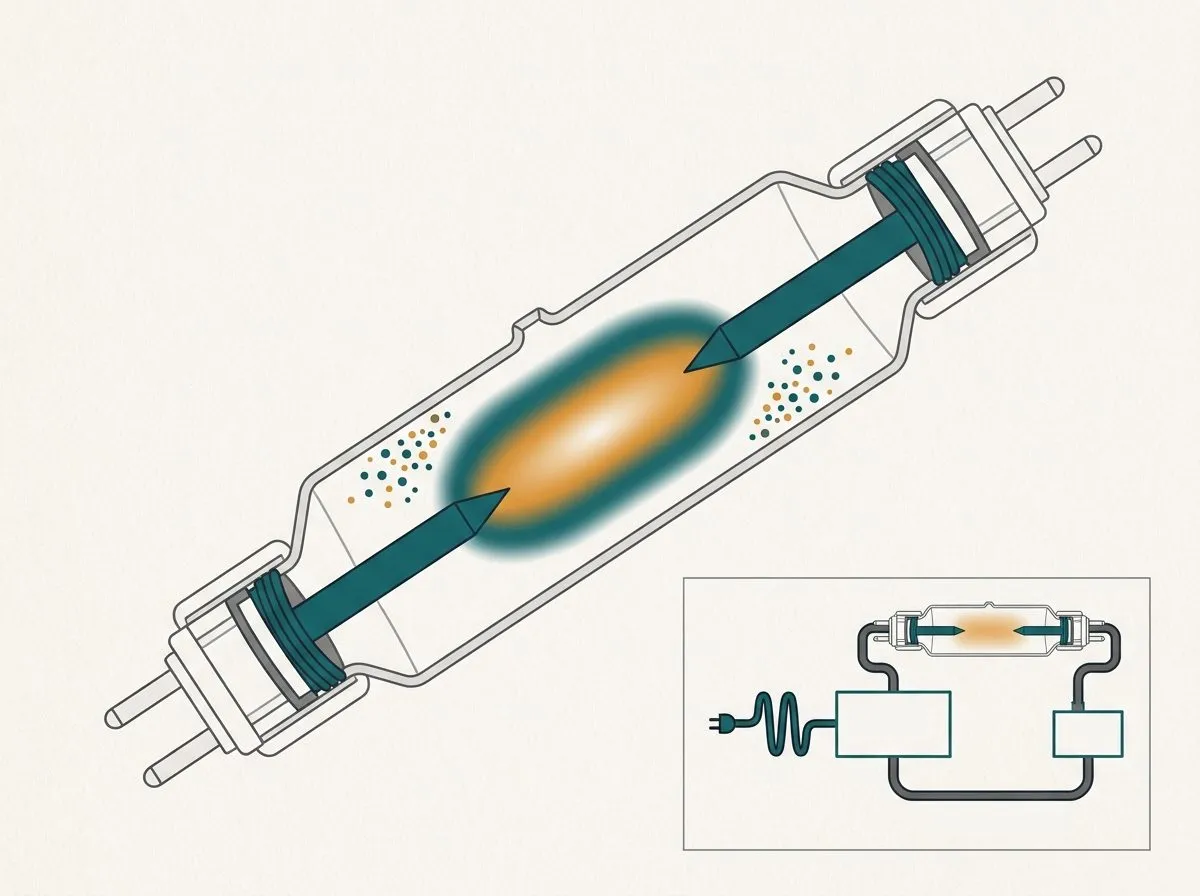
Construction of an HMI lamp
Handling rules worth remembering:
- Ultraviolet. The quartz emits dangerous UV-A, B and C, so HMI fixtures carry UV-absorbing safety glass, and fresh lamps give more UV until they are seasoned.
- Tilt. High-wattage double-ended lamps (2.5 kW to 18 kW) can become unstable, shift colour or flicker if tilted more than 15° off the horizontal. Smaller single-ended lamps (200 W, 575 W, 1200 W) burn in any orientation.
- Temperature. Operating envelope temperature is about 230 °C, up to 280 °C on 18 kW units, which need forced-air cooling. Poor sockets, loose lugs or blocked louvers cause overheating.
- Quartz. Do not touch it with bare hands.
Fluorescent lamps
A fluorescent tube is a low-pressure discharge in argon and mercury vapour between two cathodes. The arc emits ultraviolet, invisible to the eye, and the phosphor on the inside of the tube absorbs it and re-emits visible light. The phosphor mix sets the colour temperature and the quality of the spectrum. An external ballast must limit the current, otherwise the tube destroys itself.
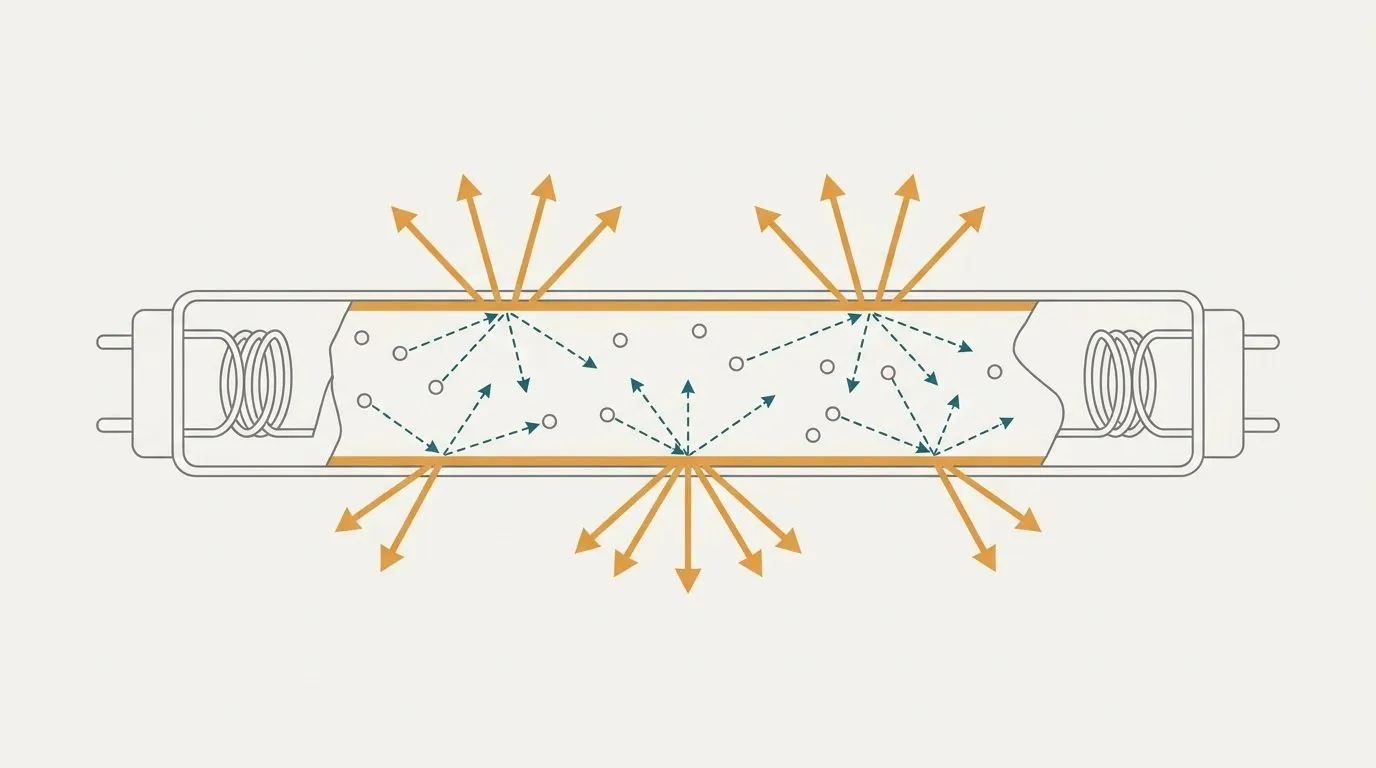
How a fluorescent tube makes light
Ordinary commercial tubes (warm white near 3000 K, cool white near 4800 K, daylight near 6500 K, with CRI between 56 and 75) have green spikes from the mercury lines and give a green cast on film and sensors. Two corrections exist: minus-green (magenta) gel on the tubes, or a CC30M or FL-D filter on the lens. Cinema tubes such as Kino Flo’s use multi-phosphor coatings for smooth spectra with CRI above 95 at 3200 K or 5600 K. Their high-frequency electronic ballasts, 25–40 kHz, remove flicker and camera-sync problems entirely.
Ultraviolet and luminescence
Luminescence is light from non-thermal excitation, and fluorescence is luminescence that stops almost at once, within 10⁻⁸ s, when the excitation ends. UV-A (320–400 nm) is the tanning and blacklight band, UV-B (280–320 nm) causes sunburn and UV-C (100–280 nm) is germicidal and absorbed by atmospheric ozone. Blacklight tubes absorb visible light and emit UV-A near 365 nm, for effects with stains, fluorescent props and treated documents.
Street lamps and other high-intensity discharge sources
High-pressure mercury has about 5900 K and CRI 20–40, metal-halide 3400–4700 K and CRI 65–80, and high-pressure sodium 1800–2100 K and CRI 20–25, with its intense doublet at 589.0 and 589.6 nm. Mercury has almost no deep red, so warm tones turn dull, brown or black and skin looks pale. On location, uncorrected street lamps need filtration or balanced fill from continuous sources. Their ballasts run on 50 or 60 Hz AC and can strobe the exposure unless the shutter is synchronized.
Electronic flash
A trigger circuit releases the charge of a bank of capacitors through a xenon-filled quartz tube. The flash is broad-spectrum and daylight-balanced, near 5600 K. After a flash the capacitors need a short recycling time. Energy is E = ½CV², and the guide number (distance × f-number at ISO 100) rates the output.
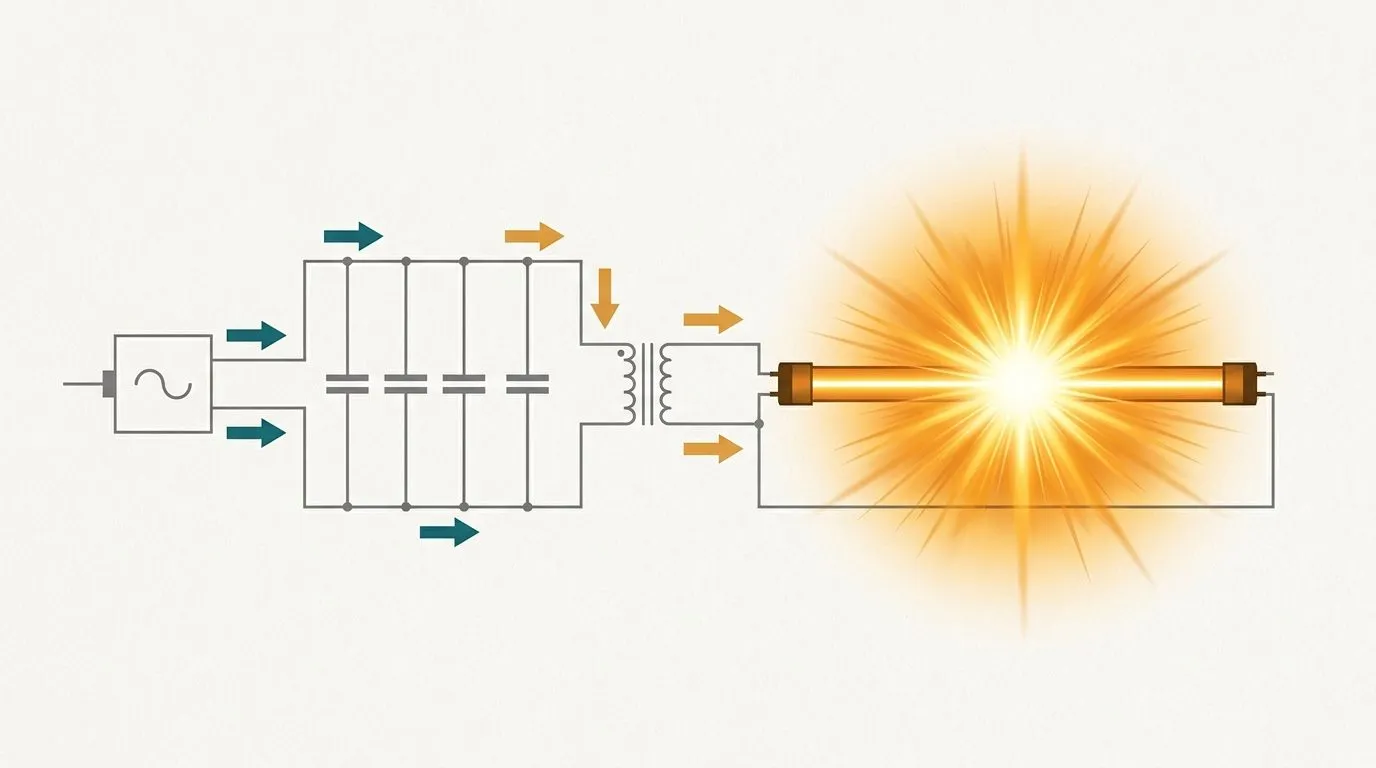
Electronic flash circuit
Quick answers
Why is an HMI bluer when dimmed? Less power increases the share of blue mercury lines, so the beam runs cold.
Why do fluorescent tubes look green on camera? The mercury lines give green spikes in a discontinuous spectrum; use a minus-green gel or a correction filter.
Why do old street lamps ruin skin tones? Their spectra lack deep red, so warm colours cannot be recorded.
Read next
- Tungsten, Tungsten-Halogen and Carbon Arc Lamps for Film Lighting
- Ballasts, Flicker and Camera Sync for Film Lights
- Color Temperature, Mireds and CRI Explained for Cinematographers
Related on this site
- One light, two worlds: physical units from the film set to the render engine
- CG Lighting: a practical CGI guide
This article is part of the free handbook Technical Foundation. Filmmaking: The Cinematographer’s Handbook by Semen Klenov, an independent researcher of light and visual perception. Cite the handbook as: Klenov, S. (2026). Technical Foundation. Filmmaking: The Cinematographer’s Handbook. Zenodo. https://doi.org/10.5281/zenodo.24326083.