Home / Journal / Cinematography
Tungsten, Tungsten-Halogen and Carbon Arc Lamps for Film Lighting
How incandescent, tungsten-halogen and carbon arc lamps work: filaments, the halogen cycle, burn-position codes and the handling rules that save lamps on set.
For most of the history of film, light meant a hot wire or a burning arc. Tungsten and tungsten-halogen lamps are still the reference for warm, continuous, dimmable light, and the carbon arc shows where daylight-balanced lighting began. This article explains how each lamp makes light and how to handle it.
Key points
- Luminous efficacy is lumens per watt. A 500 W tungsten lamp that yields 5,000 lm has an efficacy of 10 lm/W.
- A filament must work in a vacuum or an inert gas, otherwise oxygen burns it out at once. Gas-filled bulbs evaporate less tungsten and run hotter than vacuum bulbs.
- Tungsten melts at about 3,422 °C. A hot filament is brittle, so avoid moving or jarring an energized lamp.
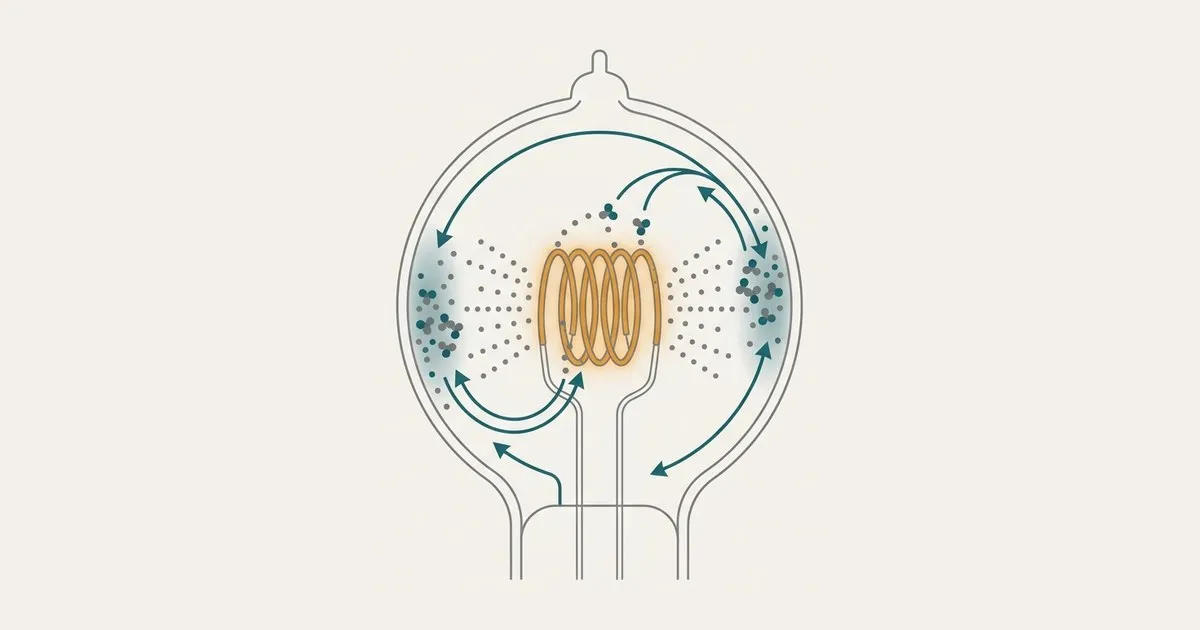
- In a tungsten-halogen lamp a regenerative cycle returns evaporated tungsten to the filament, so output and colour stay constant through the lamp’s life.
- Never touch a quartz envelope with bare hands: skin oil causes local overheating and blistering.
Incandescent lamps
Incandescence is light from a thermally excited solid. A lamp has three parts: a glass or quartz envelope, the filament and a metal base. Standard bulbs use borosilicate glass; high-output tungsten-halogen lamps use fused quartz because it withstands the temperature. Inert gases such as argon or nitrogen in the envelope suppress evaporation of the tungsten. A milky internal coating diffuses the raw glare of the filament. In 1878 Sir Joseph Swan built the first practical incandescent lamp, with a carbonized thread as the filament.
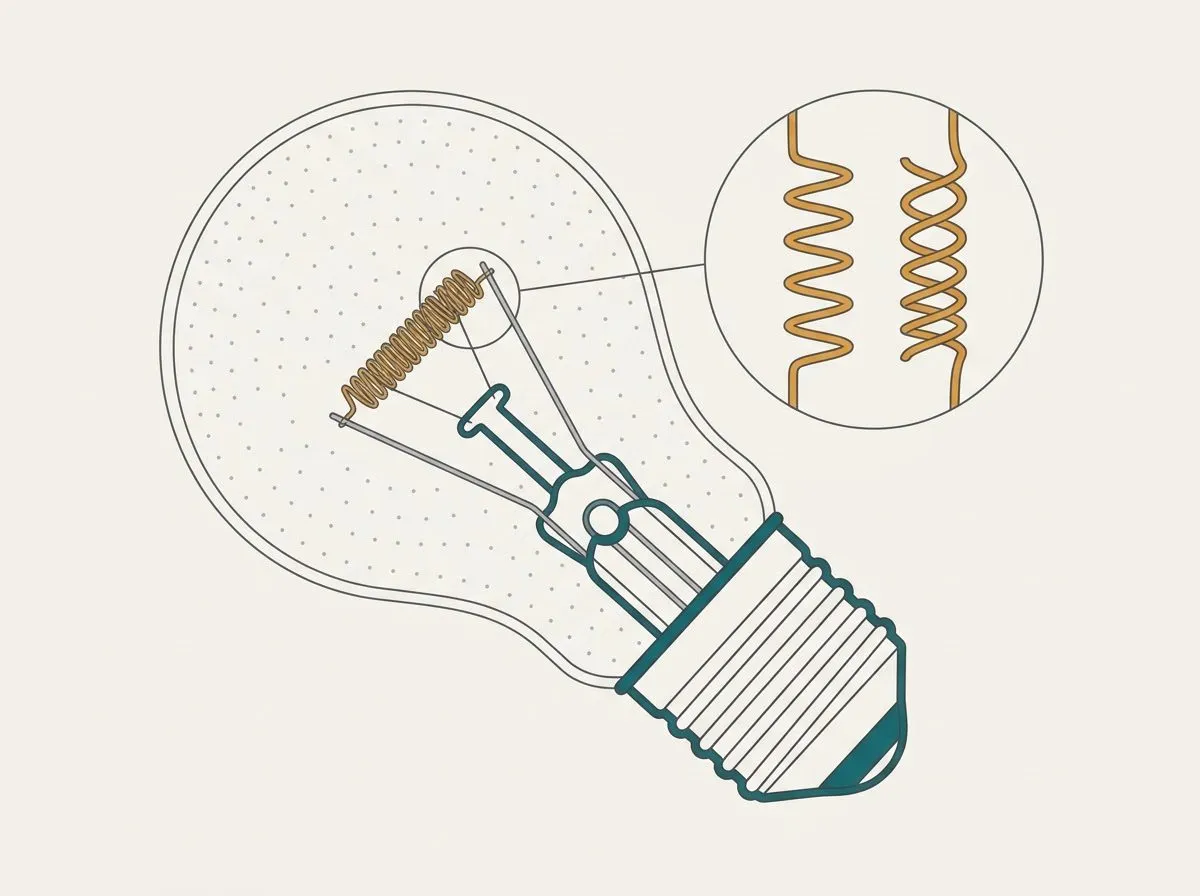
Anatomy of an incandescent lamp
Filaments come as compact, linear or planar arrays, and are wound S (straight), C (coiled) or CC (coiled-coil), the last of which concentrates heat and gives the highest efficacy. Higher wattage needs a thicker filament to carry the current. A lamp may also carry a burn-position code: BD (base down), BU (base up) or universal.
Typical failures are easy to recognise:
- Darkened bulb: evaporated tungsten has deposited on the glass. Some high-wattage lamps have a collector mesh above the filament to catch it.
- White, yellow or blue-grey deposits: air has entered the envelope and formed tungsten oxide.
- Cracks: a drop of cold water on a hot quartz envelope causes thermal shock.
- Blistering of the quartz: local overheating from fingerprints, grease, over-voltage, or a misaligned reflector focusing heat back onto the filament.
The halogen cycle
A tungsten-halogen lamp has a quartz envelope filled with an inert gas and a little halogen vapour, iodine or bromine. Tungsten evaporating from the filament combines with the halogen into a gas, tungsten halide. Convection carries it back to the white-hot filament, where the heat splits the compound, deposits tungsten on the filament and frees the halogen to start again. The cycle only works when the envelope wall stays above about 250 °C, which is why the envelope is small and made of quartz.
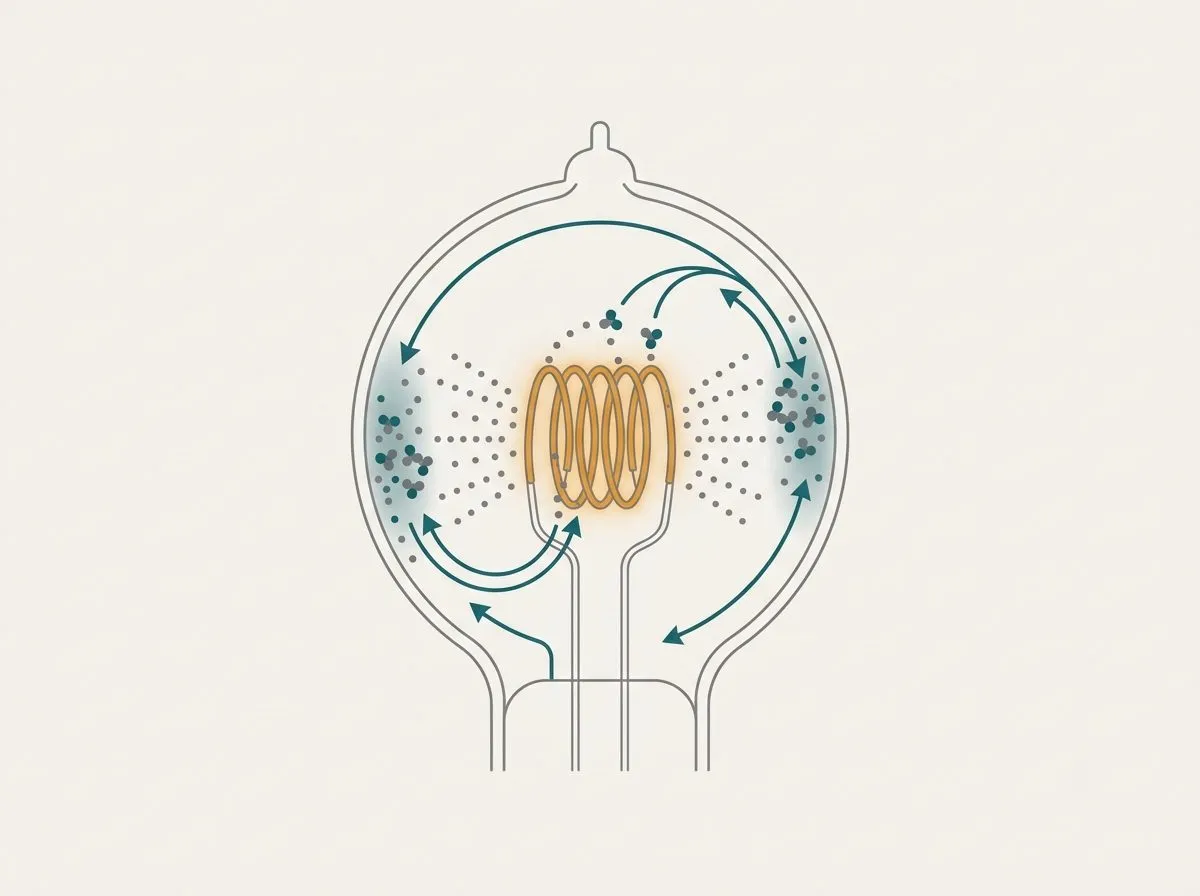
The tungsten-halogen regenerative cycle
The carbon arc
The carbon arc was invented by Sir Humphry Davy in 1801. Light comes from an electric arc across a gap of ionized plasma between two carbon rods that burn away. It produces brilliant light with crisp shadows and was used for daylight simulation and for searchlights. A Fresnel lens can focus the beam.
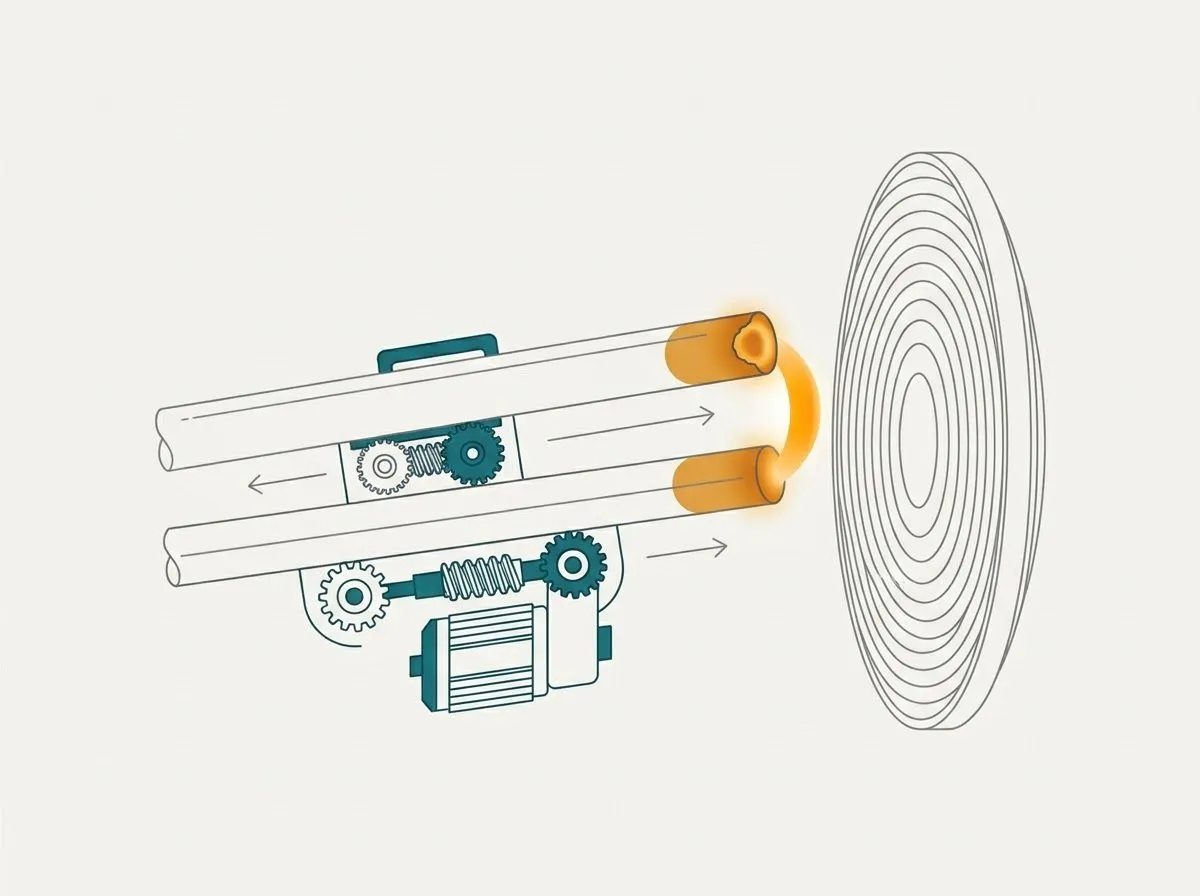
Carbon arc lamp
Running an arc takes more than a lamp:
- matched positive and negative carbons and a motorized feed that holds the gap constant as the rods burn;
- a ballast resistor, to stabilize the arc’s negative resistance, which drops a supply of, for example, 115 V DC to the arc’s 60–75 V;
- DC power, with a copper-coated negative carbon ground to a cone;
- a burning arc may not be tilted more than 45° from horizontal.
White-flame carbons burn daylight-balanced and yellow-flame carbons tungsten-balanced. High-current positive carbons have a soft core packed with rare-earth fluorides that vaporize into a bright plasma crater. The arc gives out a lot of ultraviolet, so protective glass must stand in front of the fixture.
Quick answers
Why does a halogen lamp keep its colour? The halogen cycle keeps the filament and the glass clean, so output and colour temperature stay stable.
Why must quartz be kept clean? Grease or fingerprints bake into the quartz, heat unevenly and make it blister or devitrify. Clean it with isopropyl alcohol and a lint-free cloth.
Why do carbon arcs need DC? The rods burn at a steady rate and the arc is stable only with direct current and a ballast resistor.
Read next
- HMI, Fluorescent and Flash: Discharge Light Sources for Film
- Film Lighting Fixtures: Fresnels, Open-Face, Ellipsoidals and Soft Lights
- Color Temperature, Mireds and CRI Explained for Cinematographers
Related on this site
- One light, two worlds: physical units from the film set to the render engine
- CG Lighting: a practical CGI guide
This article is part of the free handbook Technical Foundation. Filmmaking: The Cinematographer’s Handbook by Semen Klenov, an independent researcher of light and visual perception. Cite the handbook as: Klenov, S. (2026). Technical Foundation. Filmmaking: The Cinematographer’s Handbook. Zenodo. https://doi.org/10.5281/zenodo.24326083.