Home / Journal / Cinematography
Digital Cinema Sensors: CCD vs CMOS, Bayer Filters, Bit Depth and Bitrate
How cameras turn photons into pixels: CCD and CMOS, Bayer filters, bit depth, dynamic range, rolling and global shutters, scanning and bitrate.
A digital camera replaces silver halide with silicon. The optics are the same, but everything after the lens changes: photons become charge, charge becomes numbers, and the numbers are compressed and recorded at some bitrate. This article follows that chain and explains the terms on a camera spec sheet.
Key points
- A sensor is an array of photodiodes. Each one converts photons into charge proportional to the light that falls on it; an analog-to-digital converter (ADC) turns the charge into a number.
- Bit depth sets the number of levels: 8 bits = 256 per channel, 10 bits = 1,024, 12 bits = 4,096.
- Larger photosites collect more photons, which gives more full-well capacity, a better signal-to-noise ratio and wider dynamic range.
- A Bayer filter gives a single sensor colour with 50% green, 25% red and 25% blue pixels; demosaicing reconstructs full RGB.
- A rolling shutter reads rows in sequence and can skew fast pans; a global shutter exposes all pixels at once.
From photon to number
Digital capture does not change how the lens forms the image. The sensor is a silicon array of millions of photosites. The charge each one collects follows the illuminance and colour of the scene, and spatial resolution is set by the number of active photosites. The ADC quantizes the voltage into a binary number; 10 or 12 bits per channel is typical for digital video. Resolution is the number of pixels per unit length, and the true optical resolution is limited by both lens MTF and pixel count. Interpolated resolution, from upscaling software, smooths coarse steps but does not create real detail.
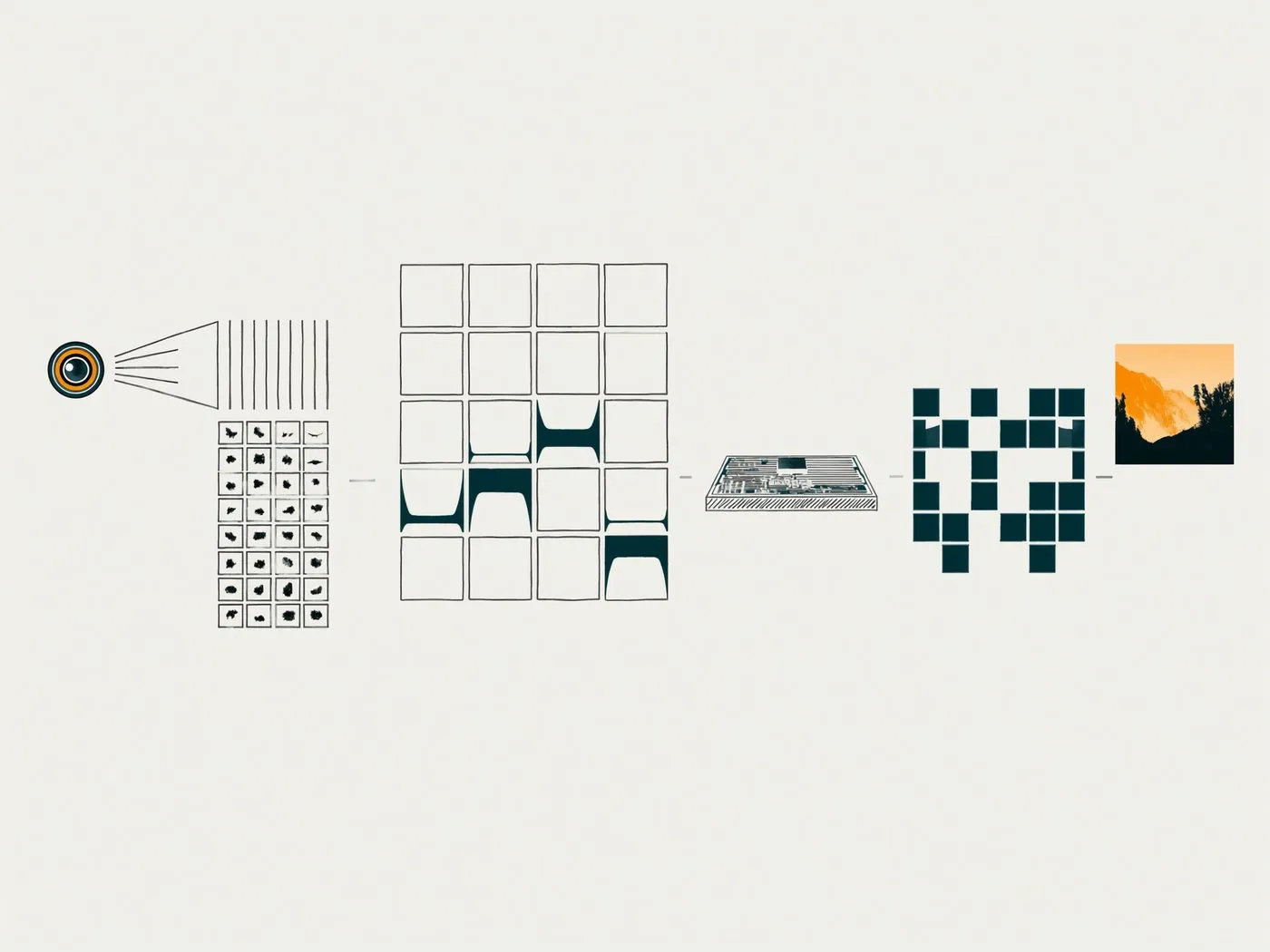
From photon to pixel
Bit depth gives 2ⁿ levels per channel. 8 bits yield 16.7 million colours, 10 bits about 1.07 billion and 12 bits about 68.7 billion. Dynamic range is the span from the lowest light the sensor can detect above its noise floor to the highest it can record before clipping to white. Too few bits show as banding in smooth gradients.
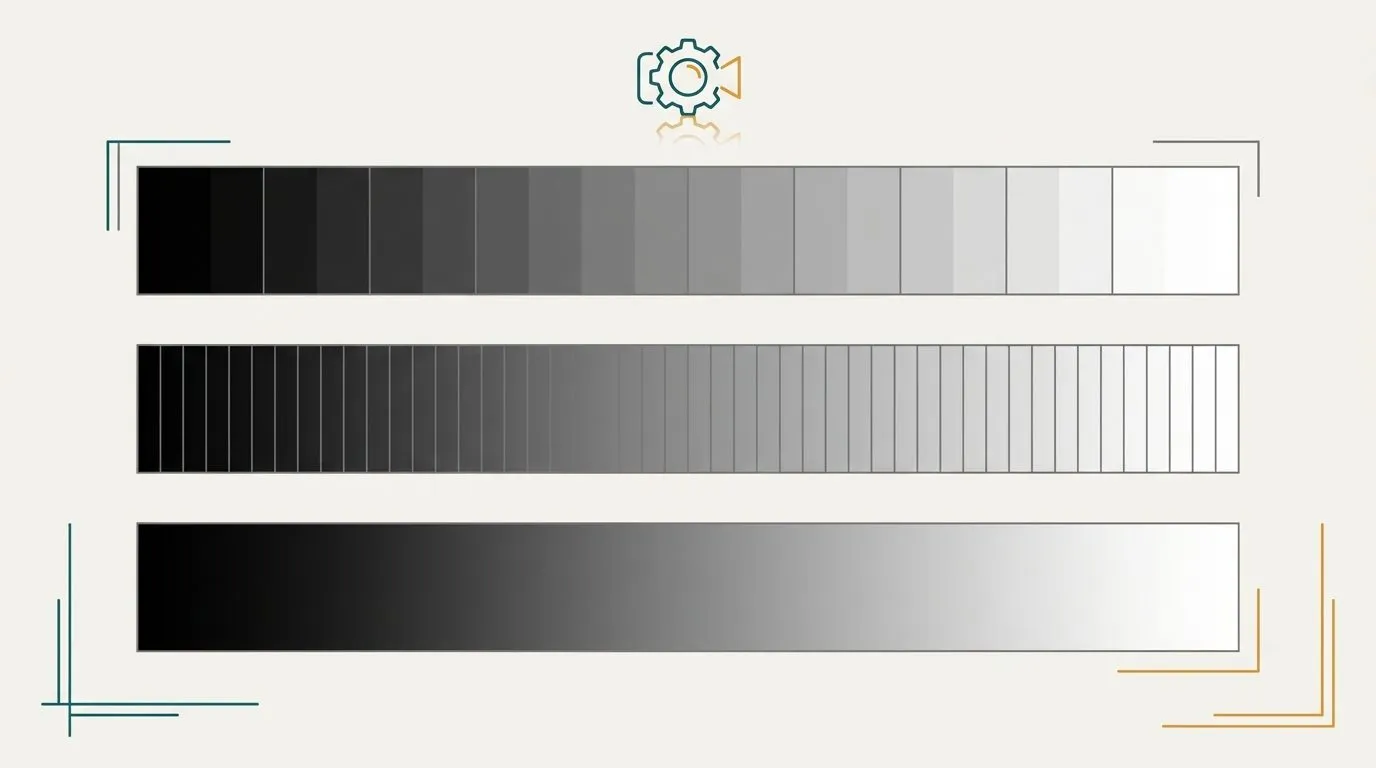
Bit depth and tonal banding
CCD and CMOS
The charge-coupled device was invented in 1969 by Willard Boyle and George E. Smith at Bell Laboratories. In a CCD the accumulated charges shift into vertical registers, then down line by line into a horizontal register and through one output amplifier before reaching the ADC. Sequential readout limits the frame rate of big CCD arrays. The maximum charge a photosite can hold before it spills into its neighbours (blooming) is its full-well capacity.
In a CMOS sensor every photosite has its own charge-to-voltage conversion, amplifier and reset transistors, so pixels can be read directly. CMOS reads faster, uses less power and allows windowing. Active pixel designs add noise reduction inside each pixel, and back-illuminated (BSI) designs move the wiring behind the silicon to capture more light. Early sensors had fill factors of only 30–40% because metal traces took up the surface; microlenses over each photosite raise the effective fill factor above 70%.
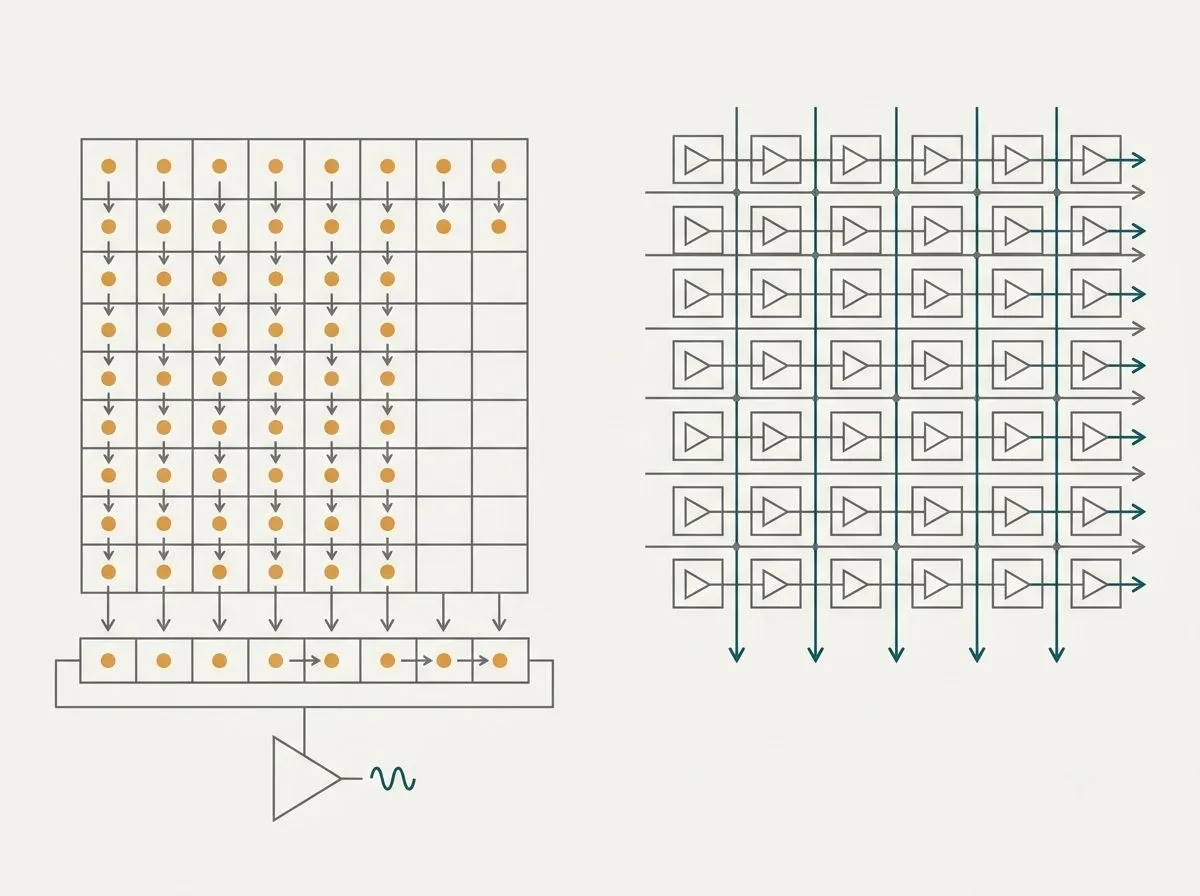
CCD vs. CMOS readout
Colour: Bayer and 3CCD
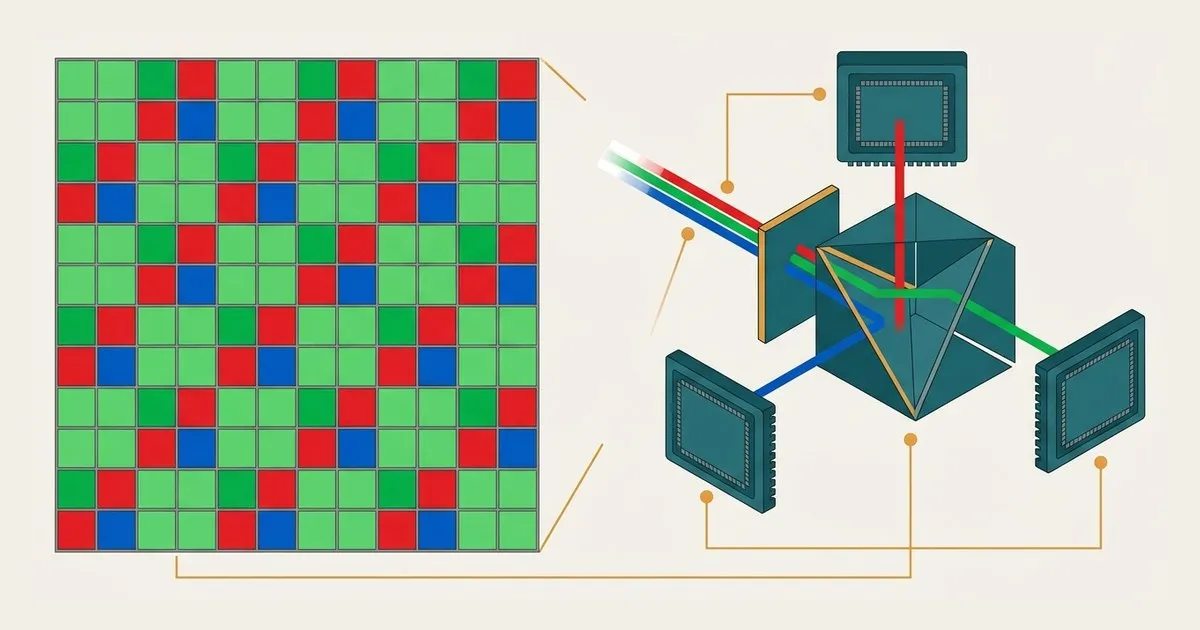
In a 3CCD camera a dichroic prism splits the beam into red, green and blue, each focused on its own sensor. It needs no demosaicing, gives high colour fidelity and avoids colour moiré. A single-sensor cinema camera instead places a Bayer mosaic of colour filters over the pixels. Alternate rows of red-green and green-blue filters make 50% green, 25% red and 25% blue, which follows the peak sensitivity of human vision. Raw data are demosaiced to calculate the full three-channel colour for every pixel.
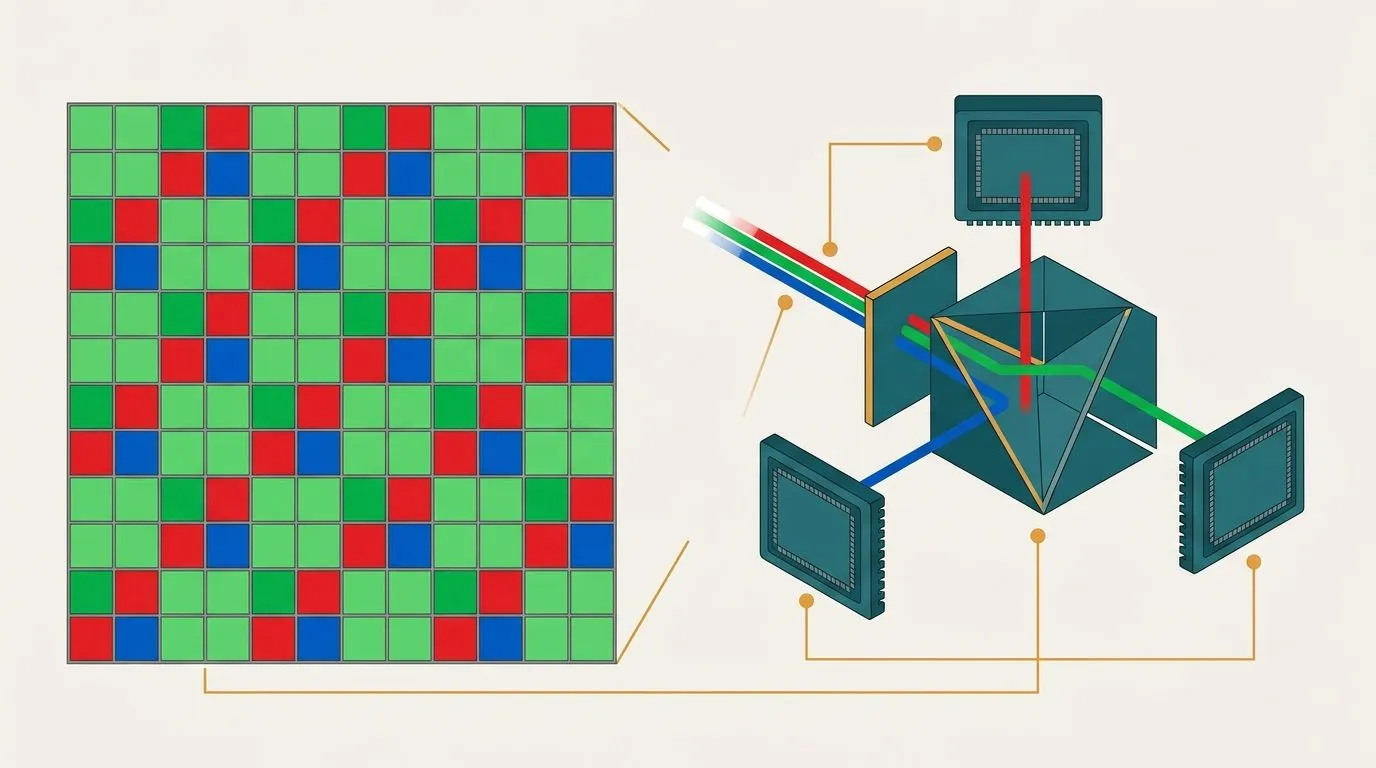
Bayer color filter array and 3CCD prism
Shutters
Full-frame sensors often use a mechanical focal-plane shutter to keep light off the silicon while charge is read, to avoid vertical smear. An electronic rolling shutter reads the rows one after another, so quick pans and fast subjects can skew (the “jello” effect). A global shutter exposes and freezes all photosites at the same time and avoids it.

Rolling shutter vs. global shutter
Sensitivity, bitrate and scanning
The ISO rating on a digital camera amplifies the analog signal. That brightens the image and also raises noise. Bitrate, in megabits per second, is the amount of data recorded per unit time; higher bitrates keep finer detail and cleaner gradients. CBR allocates a fixed rate, while VBR raises it for fast action and complex textures and lowers it for static frames.
Progressive scanning draws every line of the frame in one pass (1080p, 4K UHD), and gives crisp edges on moving subjects. Interlaced scanning splits a frame into two fields of odd and even lines (1080i), a legacy of halving broadcast bandwidth, and shows comb artefacts on progressive displays. In volumetric capture, resolution is measured in voxels, cubic pixels in a three-dimensional coordinate space.
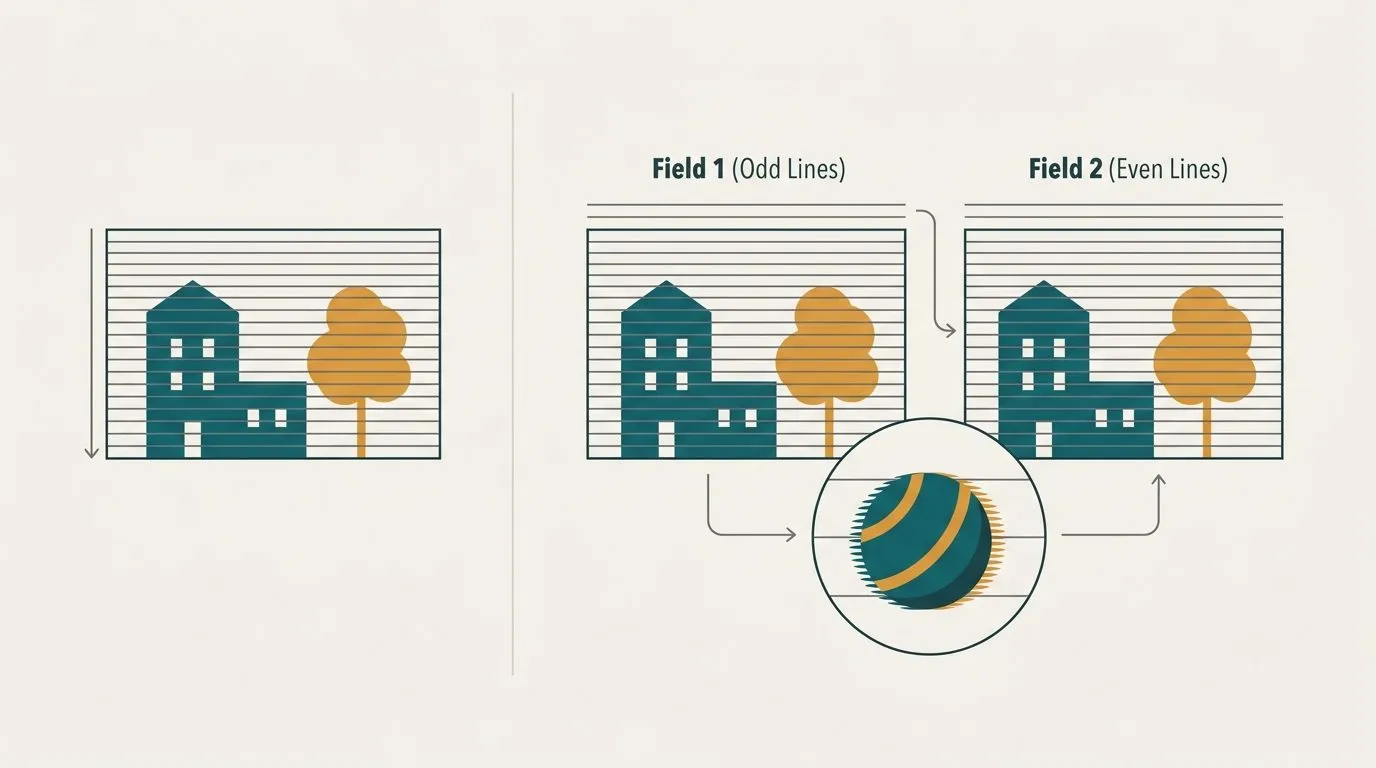
Progressive vs. interlaced scanning
Quick answers
Why does a bigger photosite help? It collects more photons, so the signal stands further above the noise and highlights have more headroom.
Why is green doubled in a Bayer mosaic? The eye is most sensitive to green, so extra green samples serve perceived detail best.
When does rolling shutter matter? With fast pans, whip movements and fast-moving subjects, where the delay between rows becomes visible.
Read next
- Photographic Film: Structure, the Characteristic Curve and Processing
- Exposure: The Zone System, Light Meters, Gray Cards and Lighting Ratios
- How a Film Camera Works: Pulldown Claw, Rotary Shutter and Film Gate
Related on this site
- Analogue vs digital: sampling, bits and aliasing explained with two experiments
- Pixels and Resolution: a practical CGI guide
- Compression explained: what JPEG and video codecs throw away
- A digital photo is not reality: what your camera really records
This article is part of the free handbook Technical Foundation. Filmmaking: The Cinematographer’s Handbook by Semen Klenov, an independent researcher of light and visual perception. Cite the handbook as: Klenov, S. (2026). Technical Foundation. Filmmaking: The Cinematographer’s Handbook. Zenodo. https://doi.org/10.5281/zenodo.24326083.