Home / Journal / Cinematography
Photographic Film: Structure, the Characteristic Curve and Processing
How film is built, how the H&D characteristic curve describes speed, latitude and contrast, and how film is developed, fixed and washed.
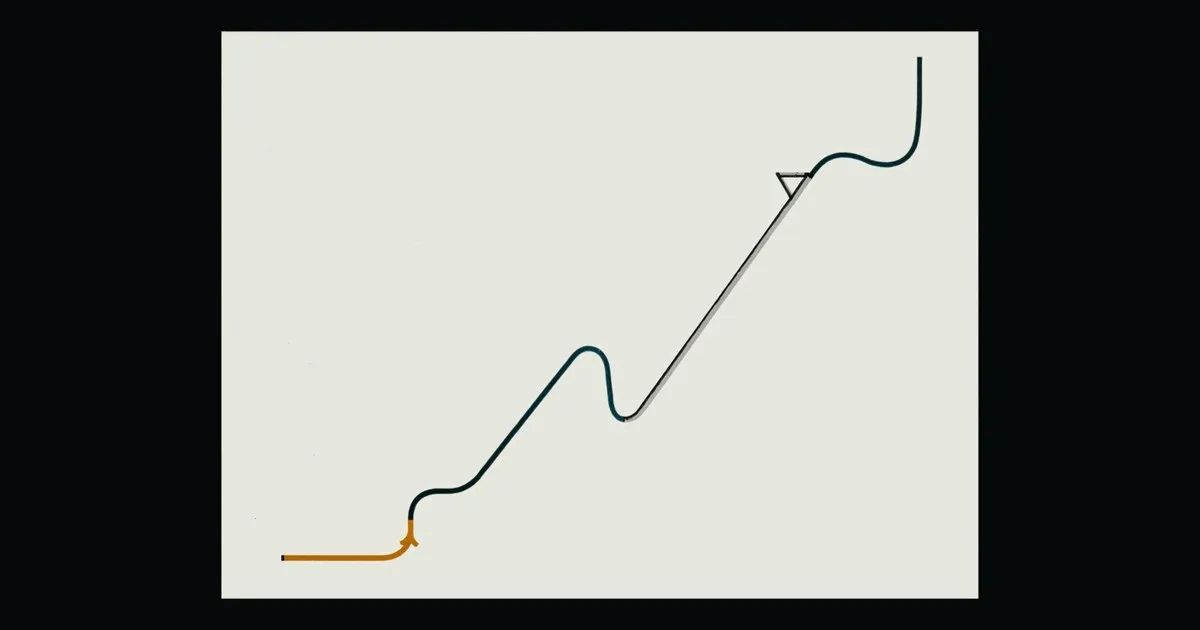
Film records light chemically. Its response to exposure is not a straight line, and that shape, the toe, the straight section and the shoulder, defines how it handles shadows, midtones and highlights. This article describes how film is built, how its behaviour is measured, and how an exposed negative becomes a stable image.
Key points
- Black-and-white film is a base, an adhesive subbing layer, a silver-halide emulsion in gelatin and an antihalation layer.
- Colour negative film stacks three emulsions: blue-sensitive on top, then a yellow filter layer, then green-sensitive and red-sensitive layers.
- The characteristic curve plots density D against the logarithm of exposure. Its slope in the straight section is gamma, a measure of contrast.
- Colour negative stock typically has wide latitude: about 3–4 stops of over-exposure margin and 1.5–2 stops of under-exposure recovery.
- Processing has three basic steps: exposure forms a latent image, development turns exposed silver halide into metallic silver, and fixing removes the rest.
How film is built
The emulsion is a suspension of silver halide crystals (bromide, iodide, chloride) in purified gelatin. Unsensitized crystals respond only to ultraviolet, violet and blue; sulphur and gold sensitizers raise sensitivity, and optical dyes extend it into green and red. A subbing layer bonds the gelatin to the polyester or triacetate base. An antihalation layer absorbs light that has passed through the emulsion so that it does not bounce back from the base and create halos around highlights. In motion picture stock it is often a removable carbon-black rem-jet layer that also lubricates the film and drains static.
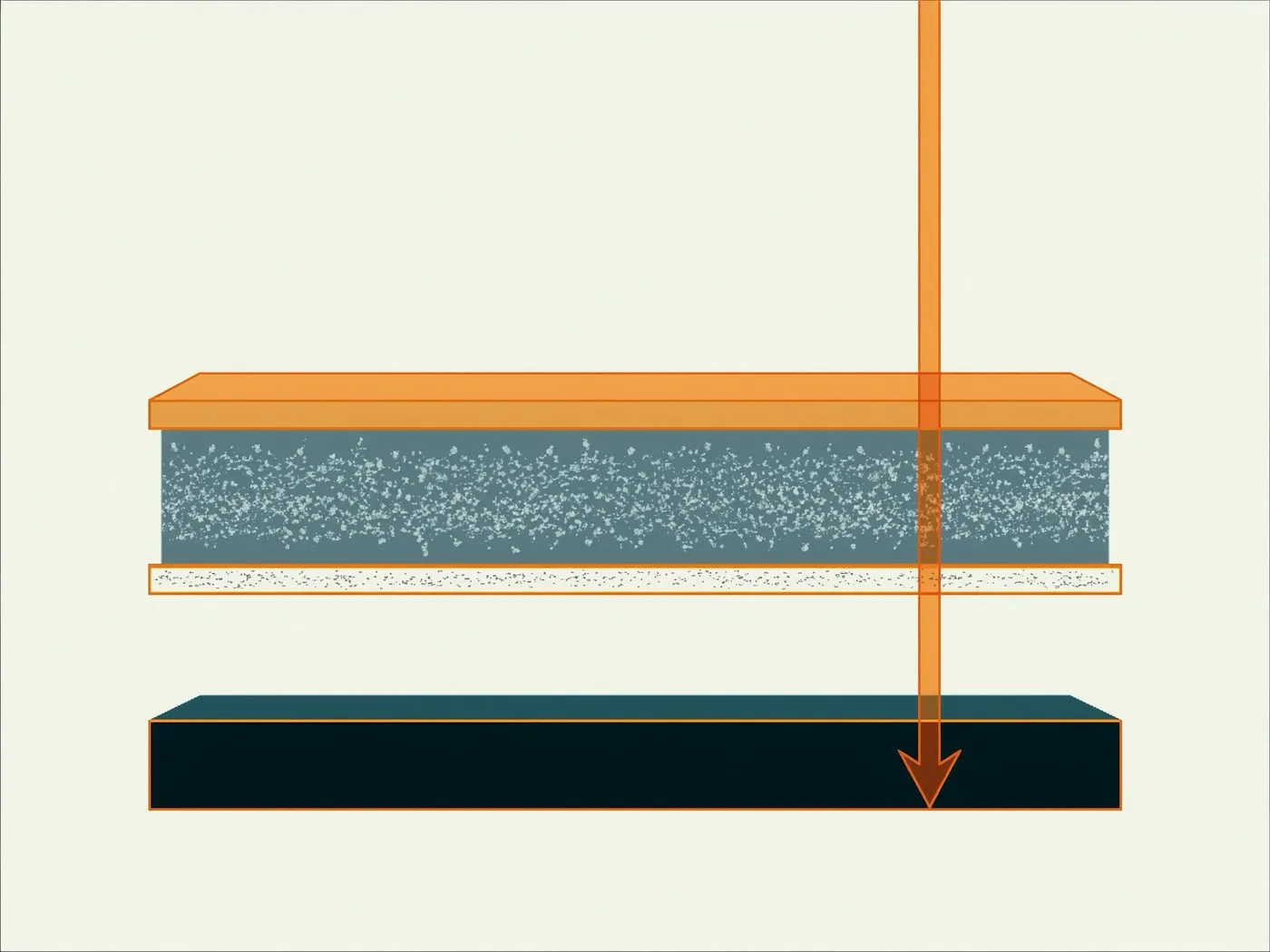
Structure of black-and-white film
Colour film adds dye couplers to each layer, which form complementary dyes (yellow, magenta, cyan) during development. Colour reversal (slide) film yields a direct positive through a first black-and-white developer, re-exposure and colour development.
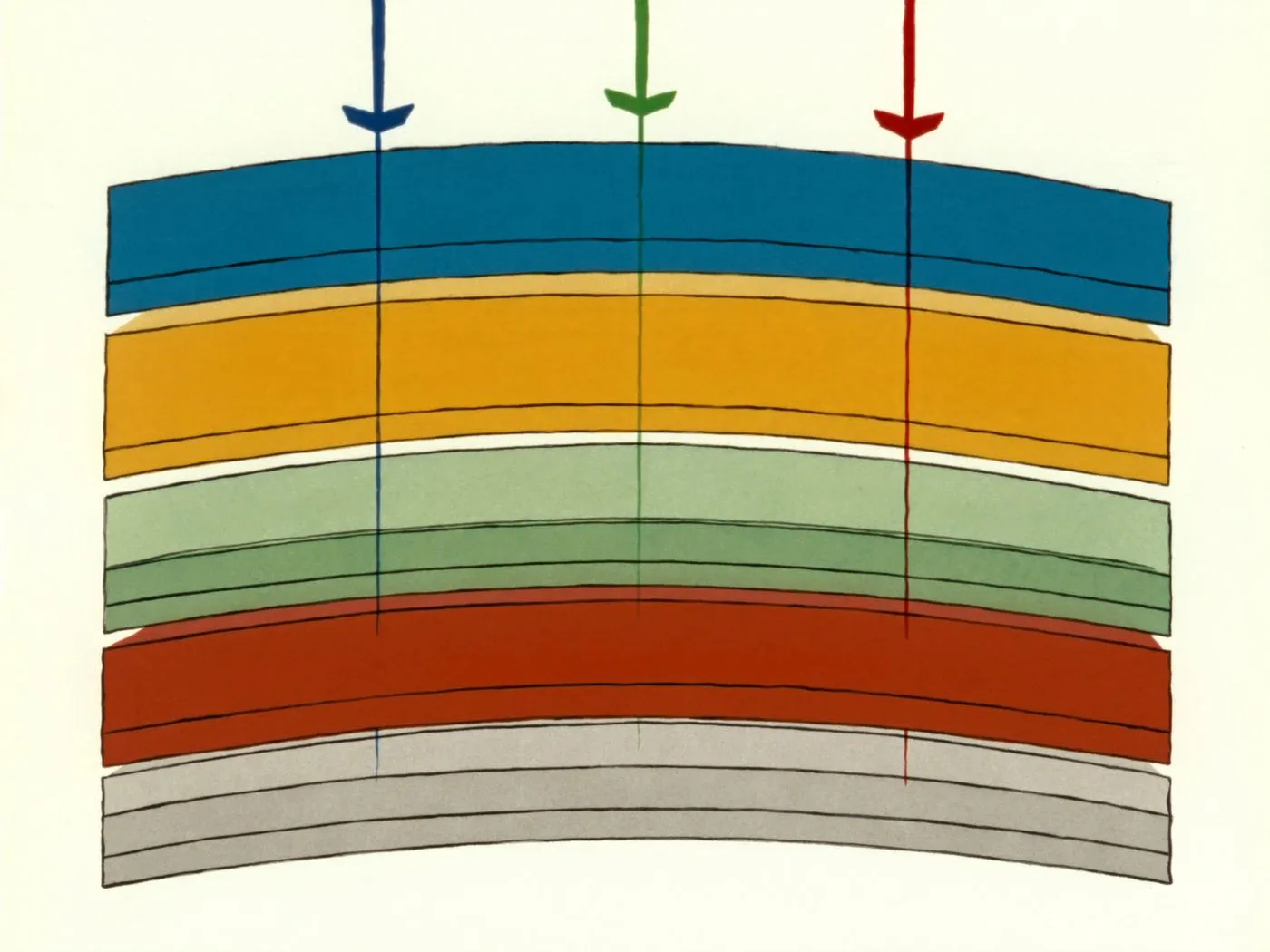
Structure of color negative film
The characteristic curve
Sensitometry is the measurement of film response. The curve of density against log exposure has four regions: base plus fog (D-min, unexposed processed film), the toe, where shadow detail begins to emerge at low contrast, the straight-line portion, where density follows exposure and normal scenes sit, and the shoulder, where highlights compress toward the maximum density. Extreme overexposure can even reverse the curve (solarization).
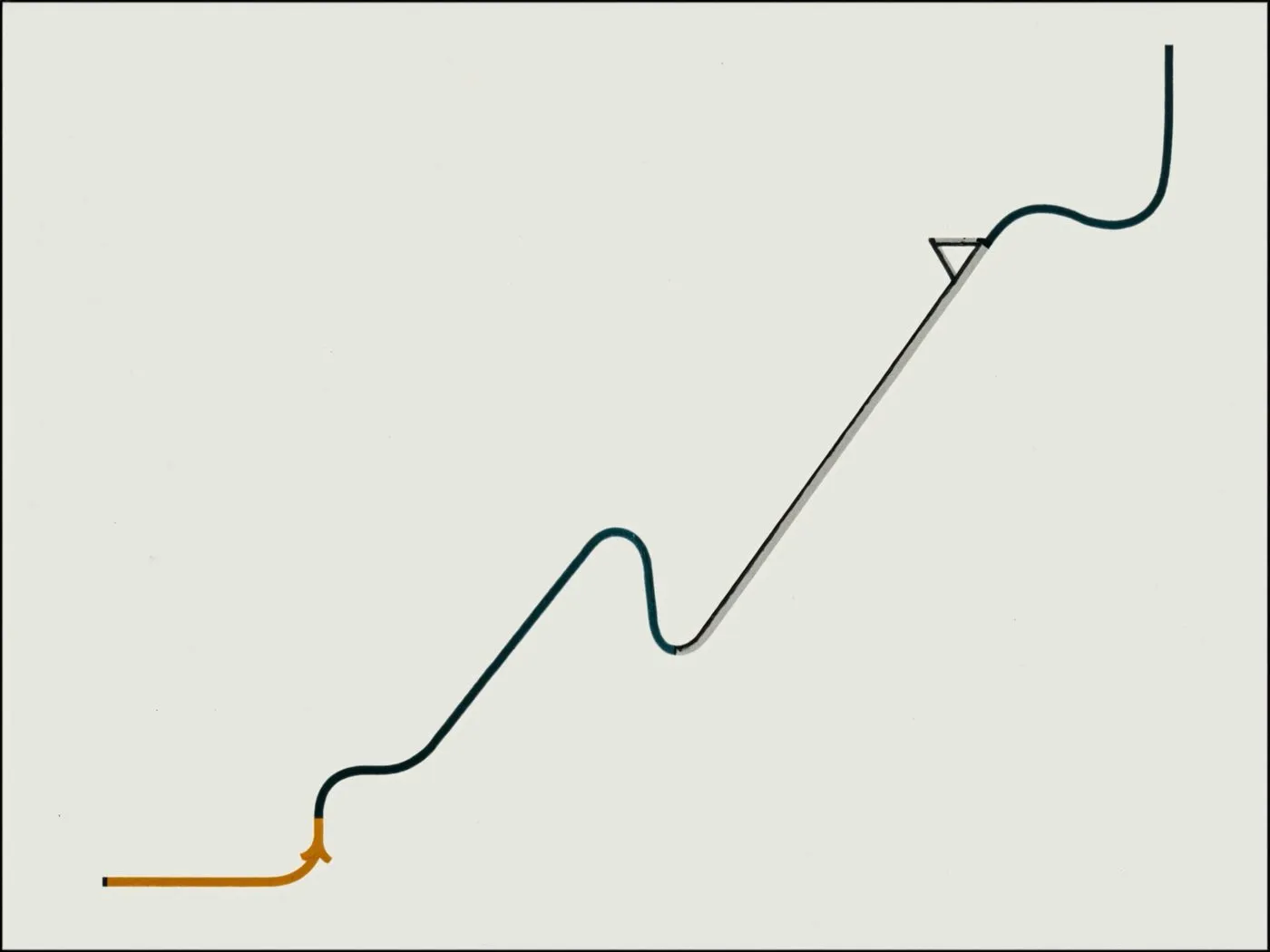
The characteristic (H&D) curve
The slope of the straight section is gamma. In colour film the three layers must share the same slope. If they do not, midtones and shadows acquire opposing colour casts that cannot be corrected, an effect called colour crossover. Speed is the exposure needed to reach a standard density above base fog, and latitude is the range of scene brightness the film records cleanly on the straight section. Reversal stocks have a much steeper curve and much narrower latitude than negative.
Reciprocity failure and infrared film
The Bunsen–Roscoe law (H = E × t) fails at very short exposures, below about 1/1000 s, and long ones, above about one second. More exposure and adjusted development are then needed, and in colour stock the balance shifts because the layers respond at different rates.
Infrared emulsions record 700–900 nm. A clear blue sky emits little infrared and goes deep black, while green foliage reflects a lot and glows white (the Wood effect). Long wavelengths scatter little, so infrared cuts through haze. Deep red or opaque infrared filters block visible light.
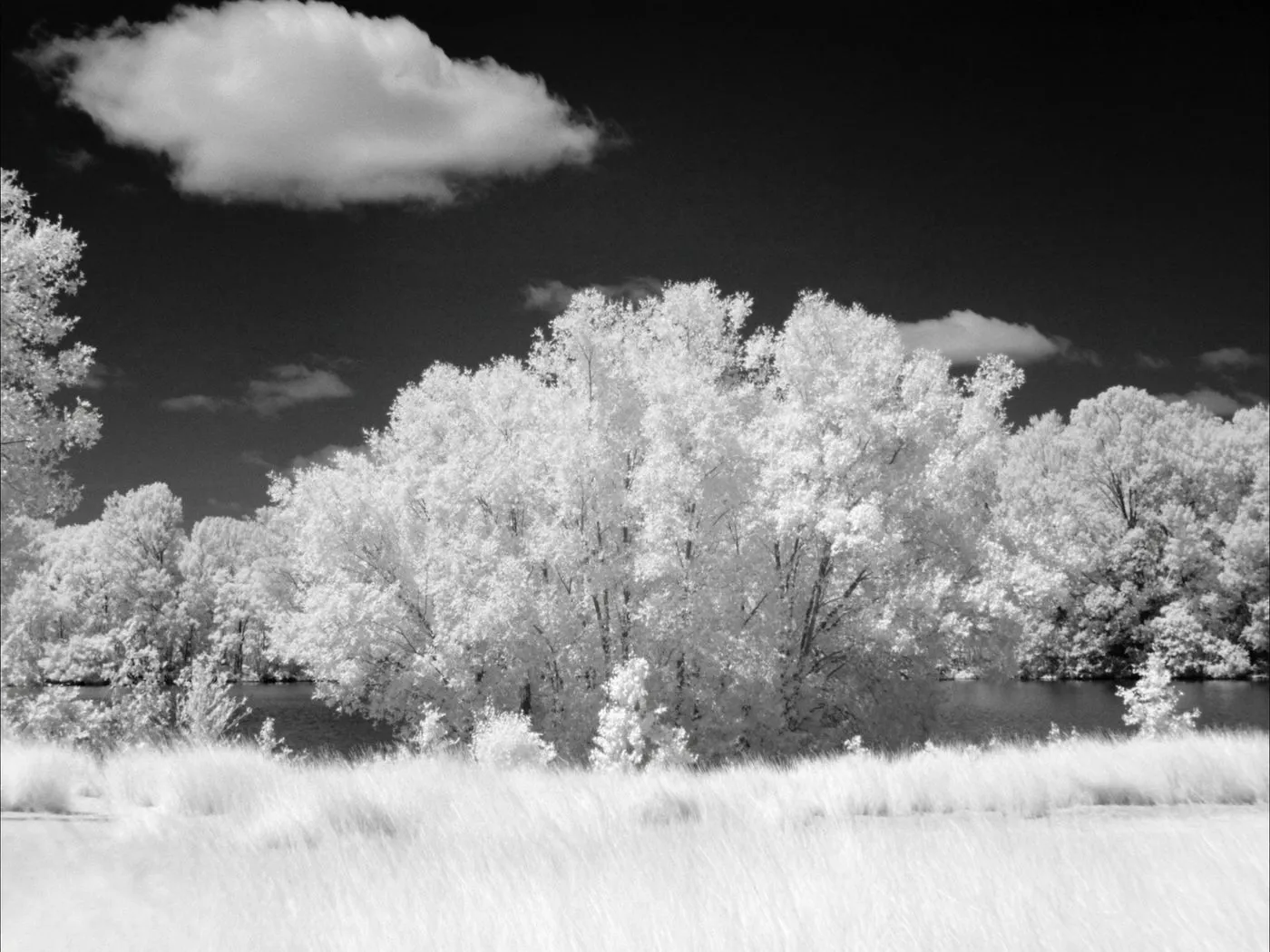
Infrared photograph: the Wood effect
Development, stop bath and fixing
A developer contains developing agents (electron donors that reduce exposed silver halide), a preservative such as sodium sulphite, an alkaline accelerator and a restrainer that keeps fog low. Development rate depends on temperature, concentration and agitation; the standard temperature is 20 °C (68 °F). Regular agitation gives even density, while stand development, with almost no agitation, compresses extreme contrast and protects shadow detail.
A stop bath of 1–2% acetic acid neutralizes the developer at once. The fixer, of sodium or ammonium thiosulphate, converts unexposed silver halide into soluble complexes that wash out; clearing time is normally doubled to be sure. An ageing fixer clears more slowly. A long wash in running water removes residual thiosulphate, which is what gives archival permanence.
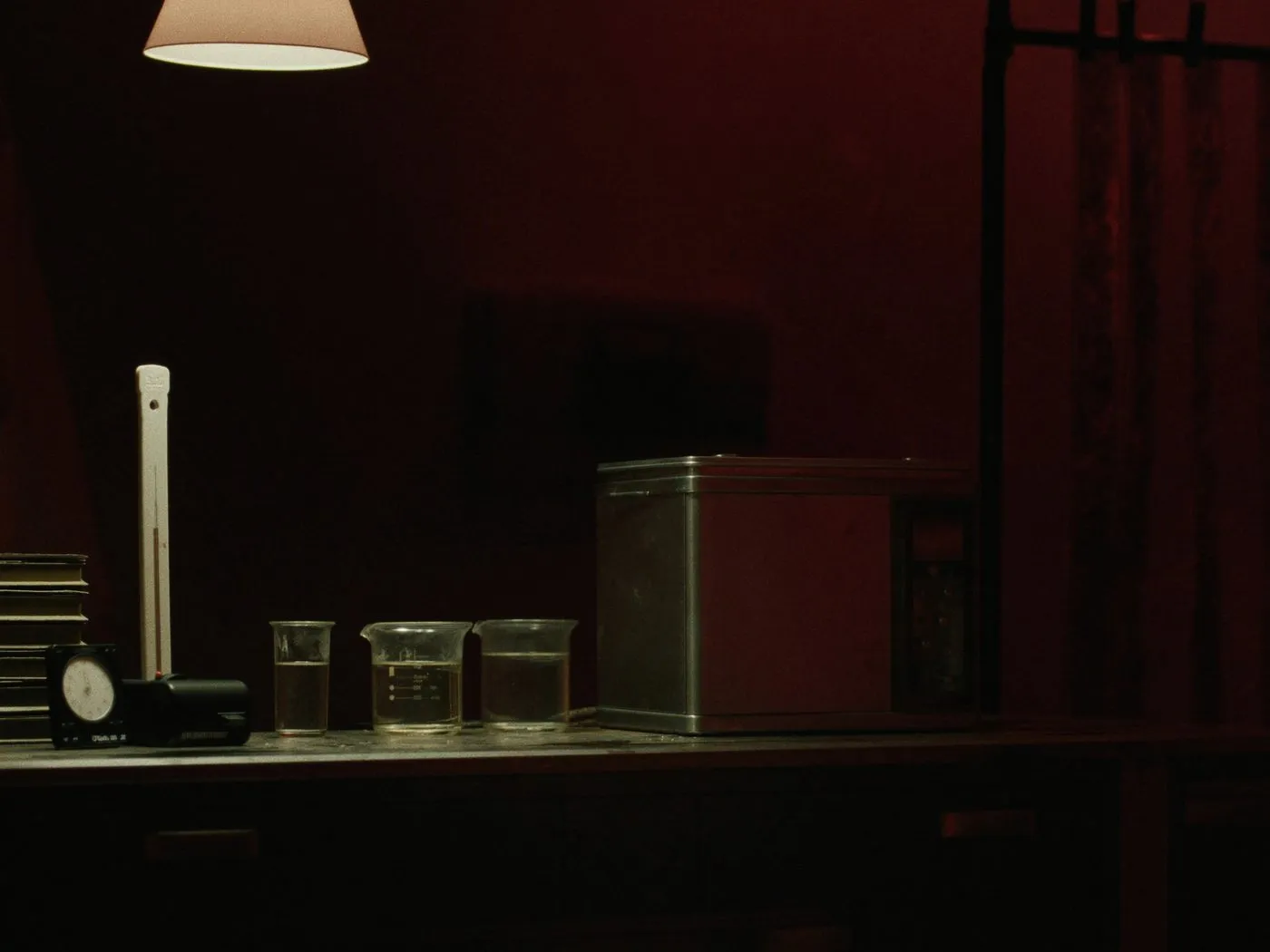
Black-and-white film processing
A typical black-and-white run is: developer with a timed agitation schedule, a pour-out shortly before the end, 30–60 seconds of stop bath, 3–5 minutes in the fixer, about 20 minutes of washing, a final rinse with wetting agent, and drying in a dust-free cabinet.
Quick answers
What does gamma tell me? The contrast of the negative: the steeper the straight section, the higher the contrast.
Why does colour film need a yellow filter layer? It stops unused blue light from reaching the green- and red-sensitive layers below.
Why wash film for so long? Leftover fixer degrades the image over time; washing makes it archival.
Read next
- How a Film Camera Works: Pulldown Claw, Rotary Shutter and Film Gate
- Exposure: The Zone System, Light Meters, Gray Cards and Lighting Ratios
- Digital Cinema Sensors: CCD vs CMOS, Bayer Filters, Bit Depth and Bitrate
Related on this site
- Analogue vs digital: sampling, bits and aliasing explained with two experiments
- A digital photo is not reality: what your camera really records
This article is part of the free handbook Technical Foundation. Filmmaking: The Cinematographer’s Handbook by Semen Klenov, an independent researcher of light and visual perception. Cite the handbook as: Klenov, S. (2026). Technical Foundation. Filmmaking: The Cinematographer’s Handbook. Zenodo. https://doi.org/10.5281/zenodo.24326083.