Home / Journal / Cinematography
Lenses, Focal Length, Aperture and Depth of Field Explained for Filmmakers
Converging lenses, focal length and angle of view, f-stops versus T-stops, light falloff and depth of field with hyperfocal distance, explained with examples.
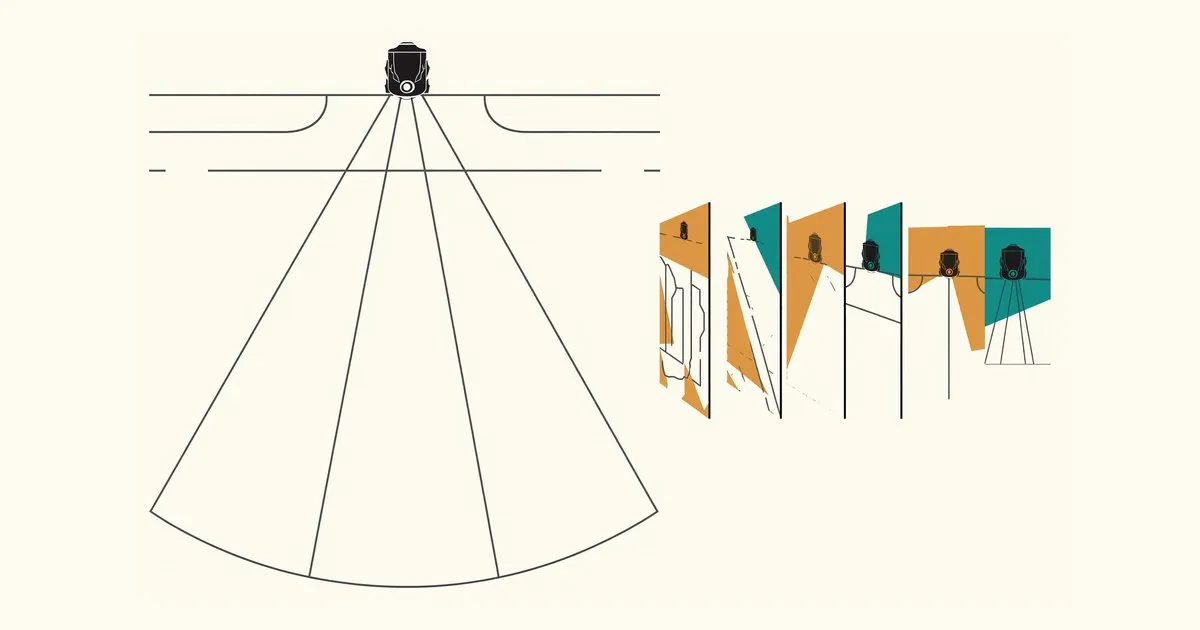
A lens decides what the camera sees, how bright the image is and how much of it is sharp. This article explains the optical ideas behind those three things: focal length, aperture and depth of field, and why cinema lenses are marked in T-stops.
Key points
- A convex (converging) lens is thicker at the centre and focuses rays; a concave (diverging) lens is thinner at the centre and spreads them. Optical power is D = 1 / f in diopters, with f in metres.
- Focal length sets the angle of view and the scale of the subject for a given sensor or film format.
- Relative aperture is D / f; the f-number is its inverse, N = f / D. Each full stop changes the pupil area by a factor of 2.
- T-stop = f-number / √(transmittance). It accounts for light lost inside the lens, so exposure stays consistent when lenses are swapped.
- Depth of field depends on focal length, aperture, focus distance and the circle-of-confusion standard of the format.
From a simple lens to a photographic lens
A simple bi-convex lens acts like a prism at its edge and splits white light into colours. Classic designs fix that step by step: the meniscus is a single curved element, the achromatic doublet cements a low-dispersion crown glass to a high-dispersion flint, the aplanat pairs two doublets around a stop, the dialyte uses four air-spaced elements, and the Cooke triplet, with three air-spaced elements, became the base of modern photographic optics.
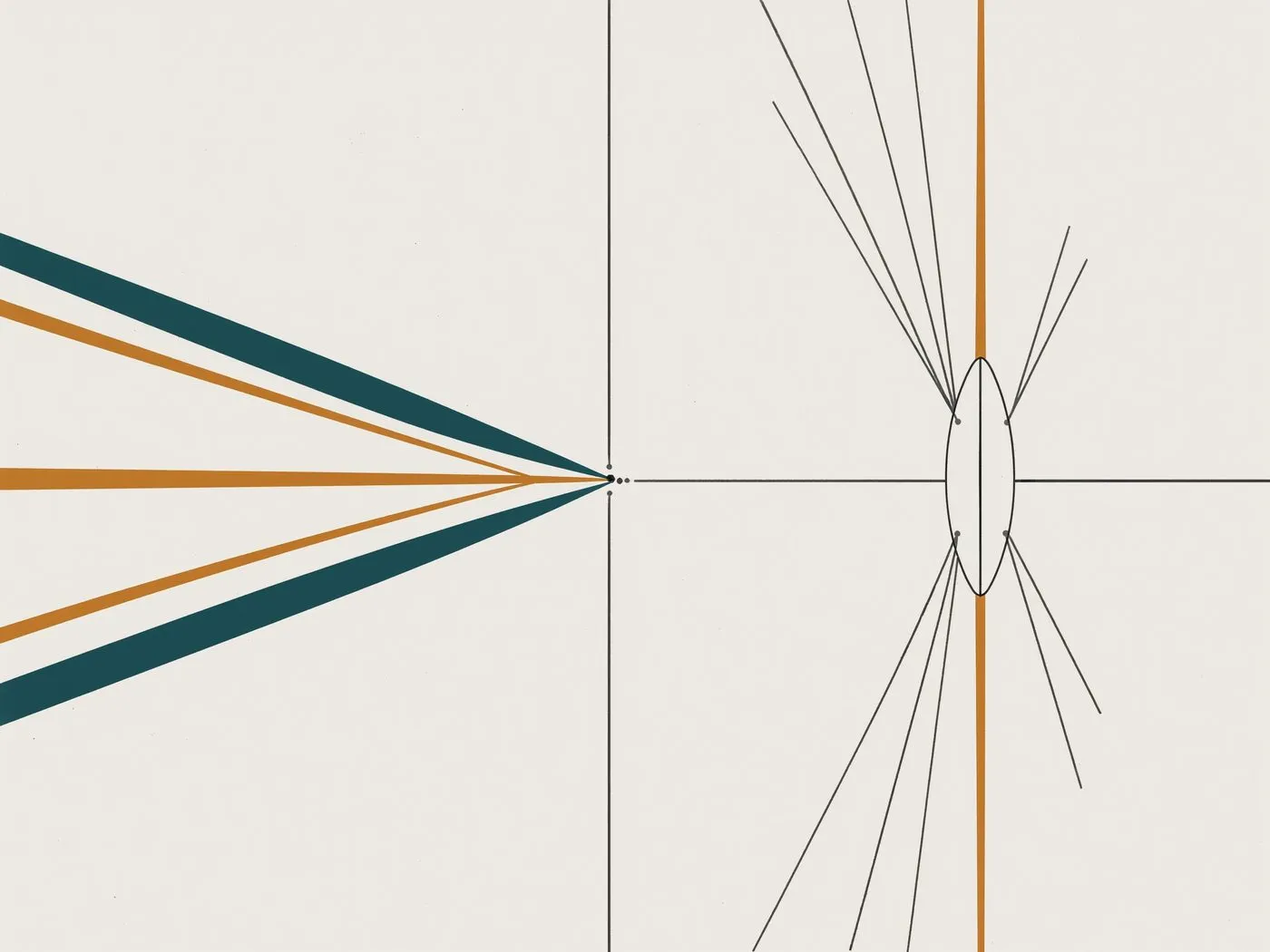
Converging and diverging lenses
A photographic lens is a precision assembly in a barrel that projects a flat, sharp image of a three-dimensional scene onto the film plane or sensor. Its main parameters are focal length, relative aperture, T-stop, angle of view and image circle, resolving power with MTF contrast, and depth of field.
Focal length and angle of view
Focal length is measured along the optical axis from the rear principal plane to the focal point when the lens is focused at infinity. Parallel rays entering a positive lens converge at that point. Together with the format, it fixes the angle of view, the part of the scene that falls on the active sensor, measured horizontally, vertically and diagonally. The image circle the lens projects must be large enough to cover the sensor, otherwise the corners vignette.
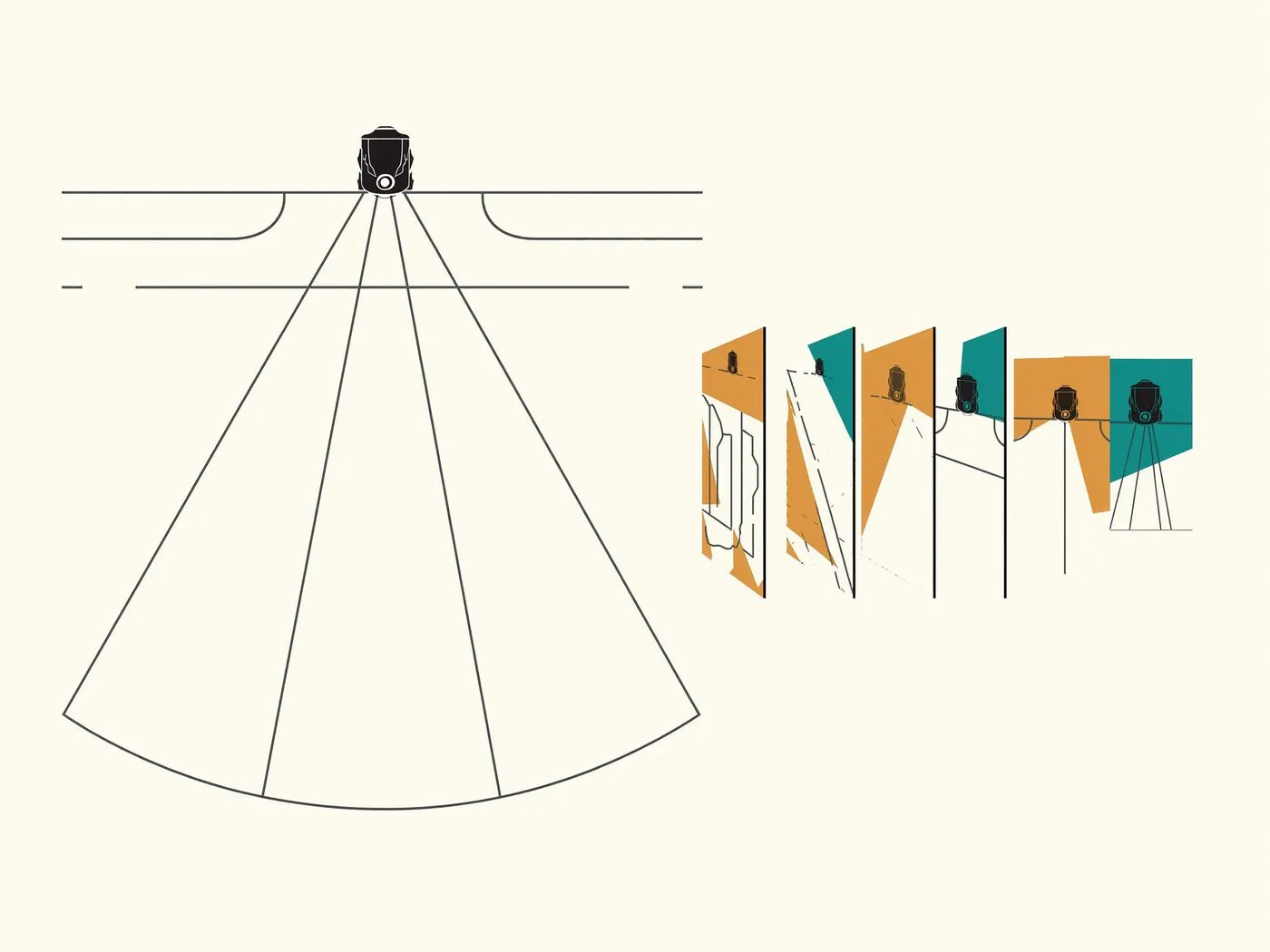
Focal length and angle of view
Aperture, f-stops and T-stops
The iris is a ring of overlapping curved blades between lens groups. The standard progression is f/1.0, 1.4, 2.0, 2.8, 4, 5.6, 8, 11, 16, 22. Each step multiplies the f-number by about 1.4, which halves the area of the pupil and so the light. Doubling the pupil diameter quadruples its area, a two-stop gain.
The f-number takes no account of absorption and reflection inside the glass. The T-stop does. A lens at f/2.0 with 80% transmittance has T = 2.0 / √0.8 ≈ 2.2. Cine lenses are calibrated in T-stops so that a lens change does not change the exposure.
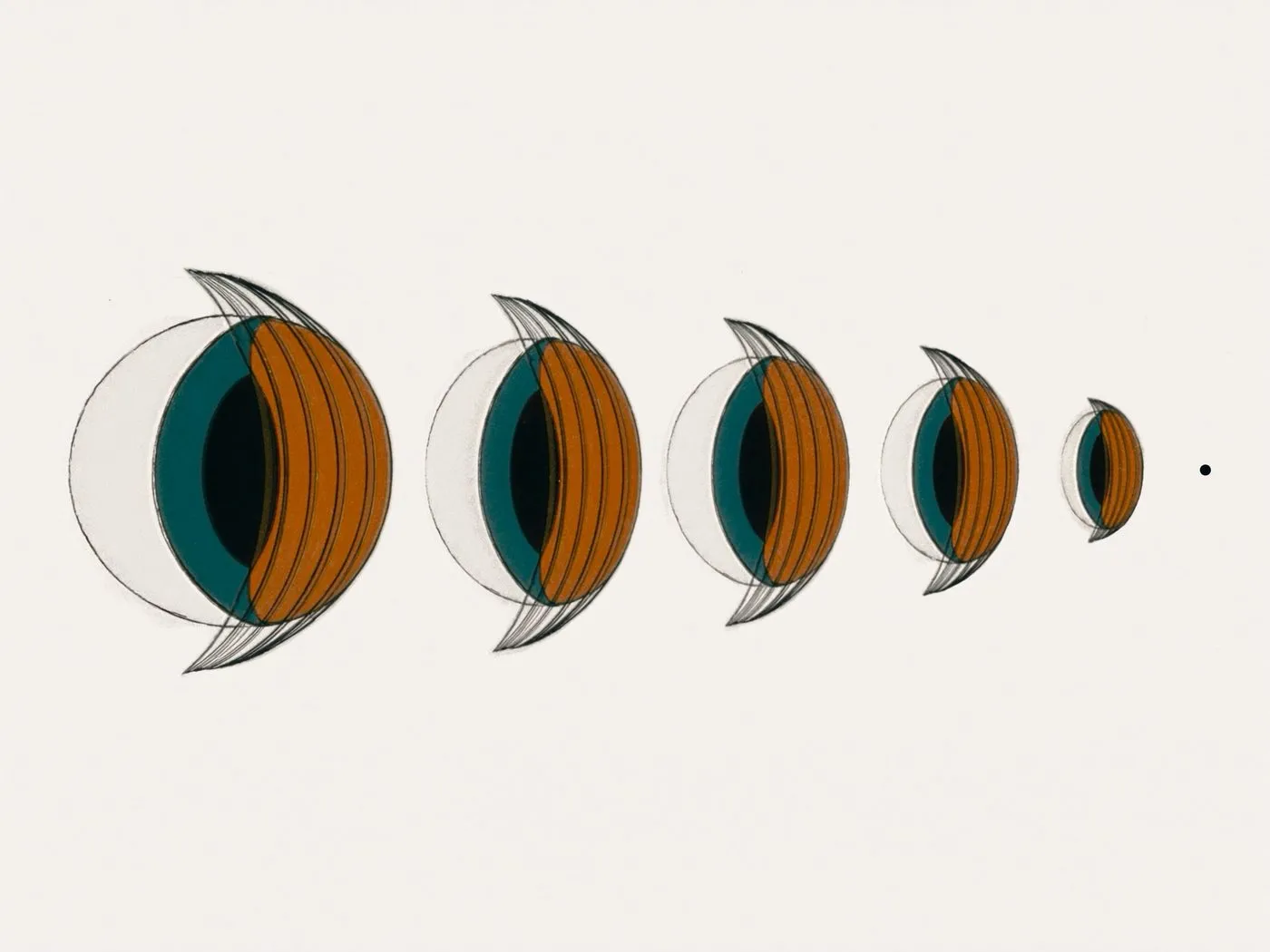
Aperture: the iris from wide open to stopped down
Illumination is highest at the centre of the image circle and falls toward the corners following the cos⁴ law. Modern anti-reflective coatings cut surface losses from 4–6% to 0.1–0.3% per surface. Resolving power of 40–60 lines per millimetre or more is needed to render texture on high-resolution sensors and fine-grain film.
Depth of field
Depth of field is the range in front of and behind the plane of focus that looks acceptably sharp on screen. It depends on four things: focal length, aperture, subject distance and the circle of confusion allowed for the format. It is not symmetrical: about one third of the sharp zone lies in front of the focus plane and two thirds behind. The hyperfocal distance is the closest focus setting at a given aperture for which the sharp zone reaches infinity. Focus there and everything from half that distance to infinity is acceptably sharp.
Depth of field and hyperfocal distance
Quick answers
Does a longer lens give less depth of field? Yes, at the same aperture and distance, depth of field shrinks as focal length grows.
What is the difference between f/2 and T2? The f-number comes from geometry; the T-stop also includes losses in the glass, so T is slightly higher than f.
What does the hyperfocal setting give me? The widest sharp zone for that aperture, from half the hyperfocal distance to infinity.
Read next
- Lens Coatings and Optical Aberrations: Flare, Fringing and Distortion
- Camera Filters: ND, Diffusion, Polarizing and Colour-Conversion Filters
- Exposure: The Zone System, Light Meters, Gray Cards and Lighting Ratios
Related on this site
This article is part of the free handbook Technical Foundation. Filmmaking: The Cinematographer’s Handbook by Semen Klenov, an independent researcher of light and visual perception. Cite the handbook as: Klenov, S. (2026). Technical Foundation. Filmmaking: The Cinematographer’s Handbook. Zenodo. https://doi.org/10.5281/zenodo.24326083.