Home / Journal / Cinematography
Lens Coatings and Optical Aberrations: Flare, Fringing and Distortion
How anti-reflective coatings work, from quarter-wave layers to moth-eye surfaces, and how chromatic and spherical aberration, coma and distortion are corrected.
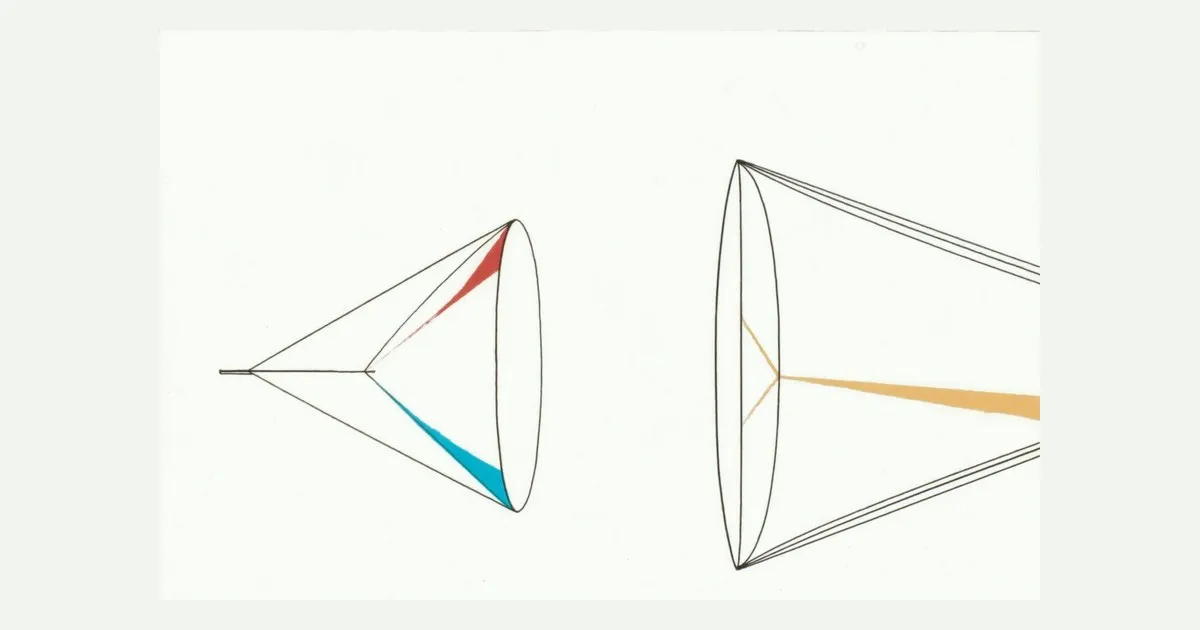
No lens is perfect. Glass reflects part of the light that strikes it, and the geometry of a spherical surface cannot bring every ray to one point. Coatings and careful lens design reduce both problems. This article explains how, and how to recognise each defect in a picture.
Key points
- Anti-reflective coatings are thin layers that cancel reflections by destructive interference. They raise contrast and remove ghost images.
- A single quarter-wave layer is one quarter of the target wavelength thick, with an ideal index equal to the square root of the glass index. It works at one wavelength only.
- Multi-layer coatings of 3 to 7 alternating layers cover the whole visible spectrum.
- Chromatic aberration is colour fringing, because blue light focuses closer to the lens than red. Pairing crown and flint glass in an achromatic doublet corrects it.
- Barrel distortion is typical of wide lenses and pincushion distortion of telephotos.
Anti-reflective coatings
The purpose of a coating is to put one or more ultra-thin layers on the glass-to-air surfaces so that more light is transmitted. In a single-layer coating of magnesium fluoride or silicon dioxide, the thickness is one quarter of the target wavelength. Light reflected from the outer face and light reflected from the coating-glass interface are then 180° out of phase and cancel. The ideal index of the layer is n_c = √n_g, and MgF₂ is common because its index is low and it is durable. Reflection is minimized only at the design wavelength, typically the green peak near 555 nm, so early coated lenses showed a magenta, violet or amber sheen (“bloomed optics”).
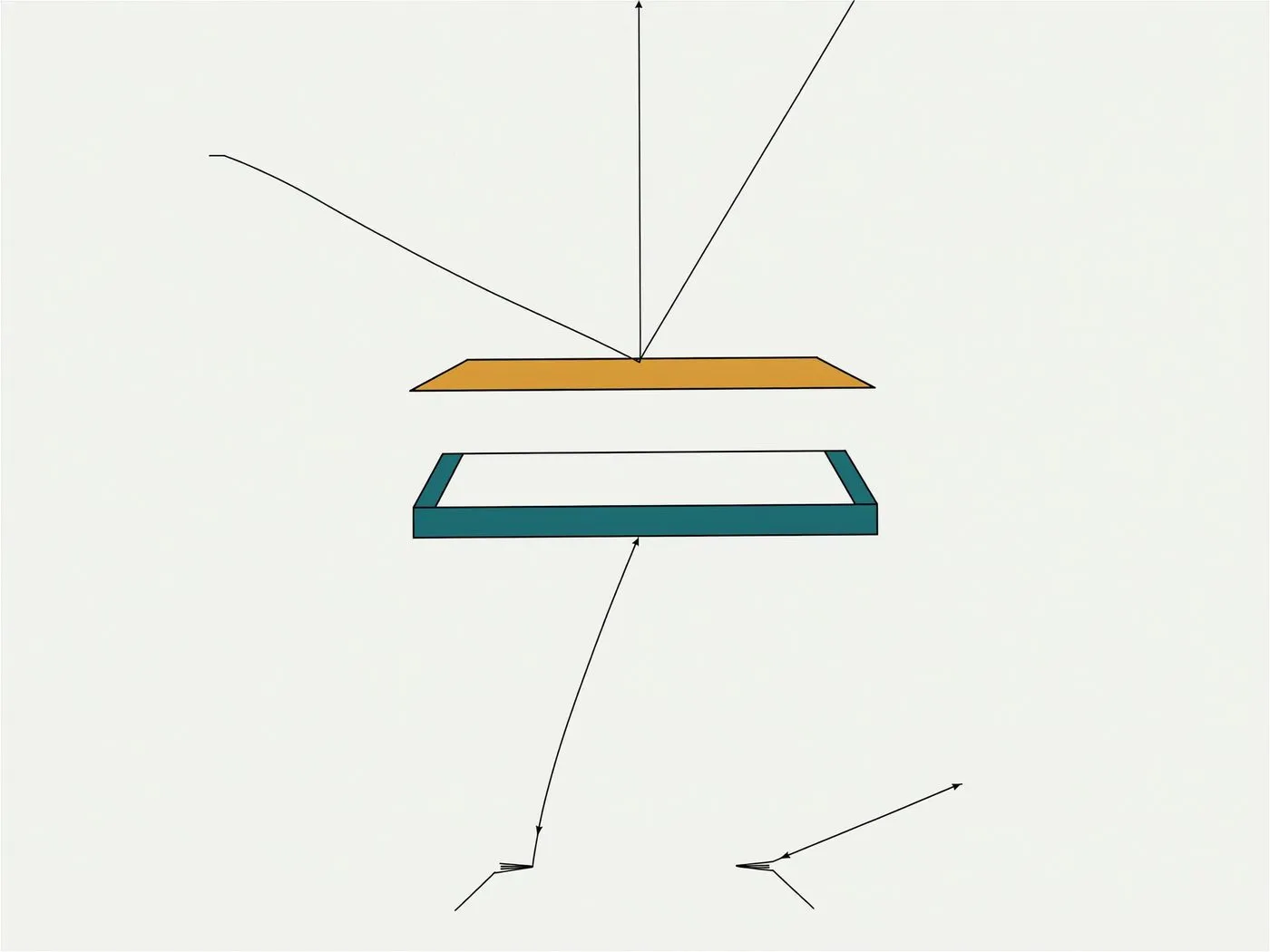
Quarter-wave anti-reflective coating
Multi-layer coatings stack alternating high- and low-index dielectric layers. Three to seven layers suppress reflections across the visible spectrum and keep colour transmission even. The faint green, purple or amber reflections that remain are not a sign of poor quality. Modern coatings add hard layers against scratches and hydrophobic and oleophobic topcoats.
A different approach copies the moth’s eye. The cornea of a nocturnal moth carries conical bumps 200–300 nm high, smaller than a wavelength of light. They make a smooth gradient of refractive index from air to tissue and so prevent a sharp boundary reflection. Such sub-wavelength textures work over wide angles and broad spectral bands.
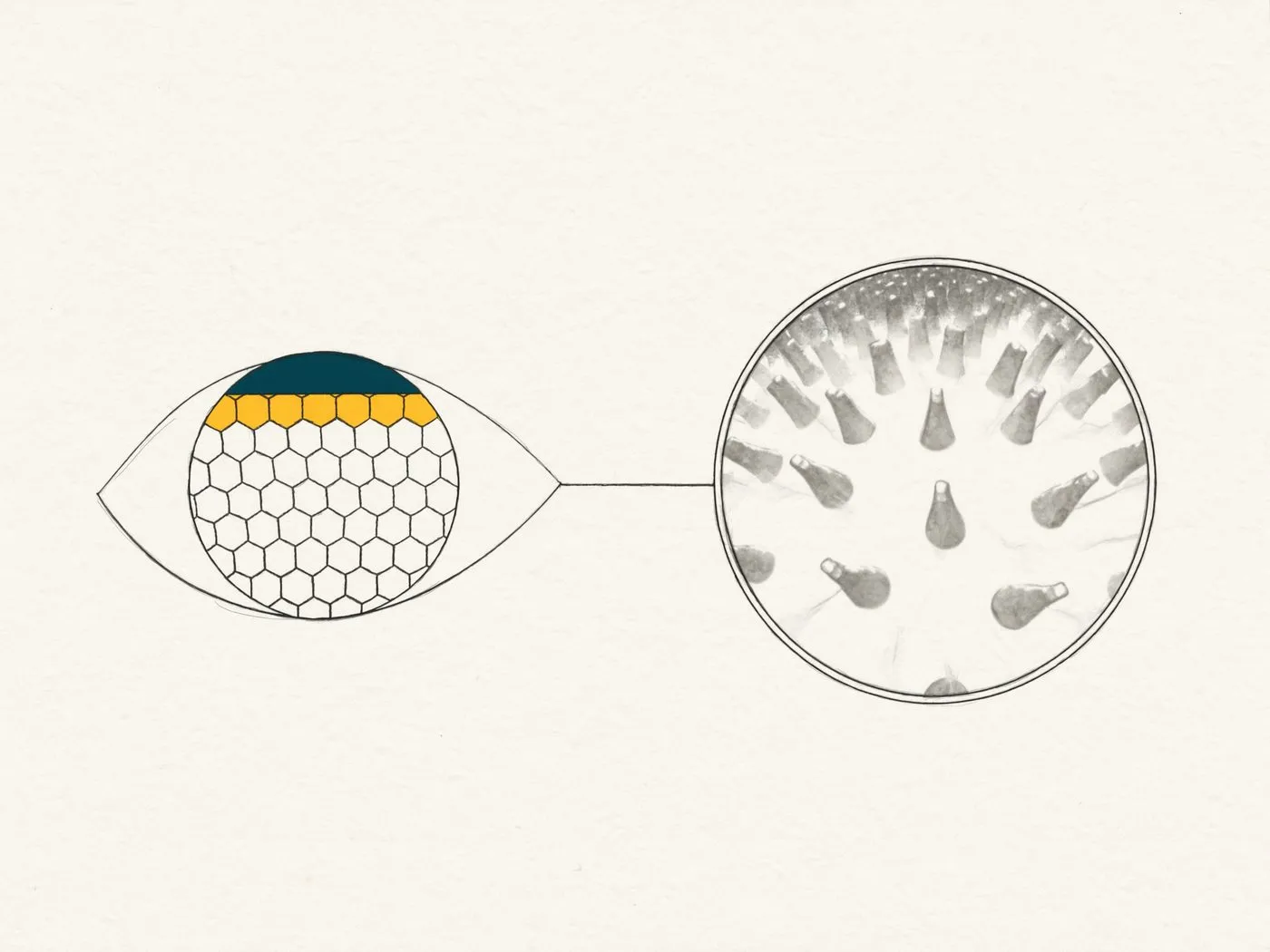
Moth-eye sub-wavelength anti-reflective structure
Chromatic aberration
Glass bends each wavelength differently (dispersion), so blue focuses closer to the lens than red. The result is colour fringes around high-contrast edges and a loss of fine detail. An achromat brings two wavelengths, usually red and blue, to the same focus; an apochromatic (APO) design aligns red, green and blue on one plane. Stopping down and adding a yellow-green filter can reduce the residual error in an uncorrected lens.
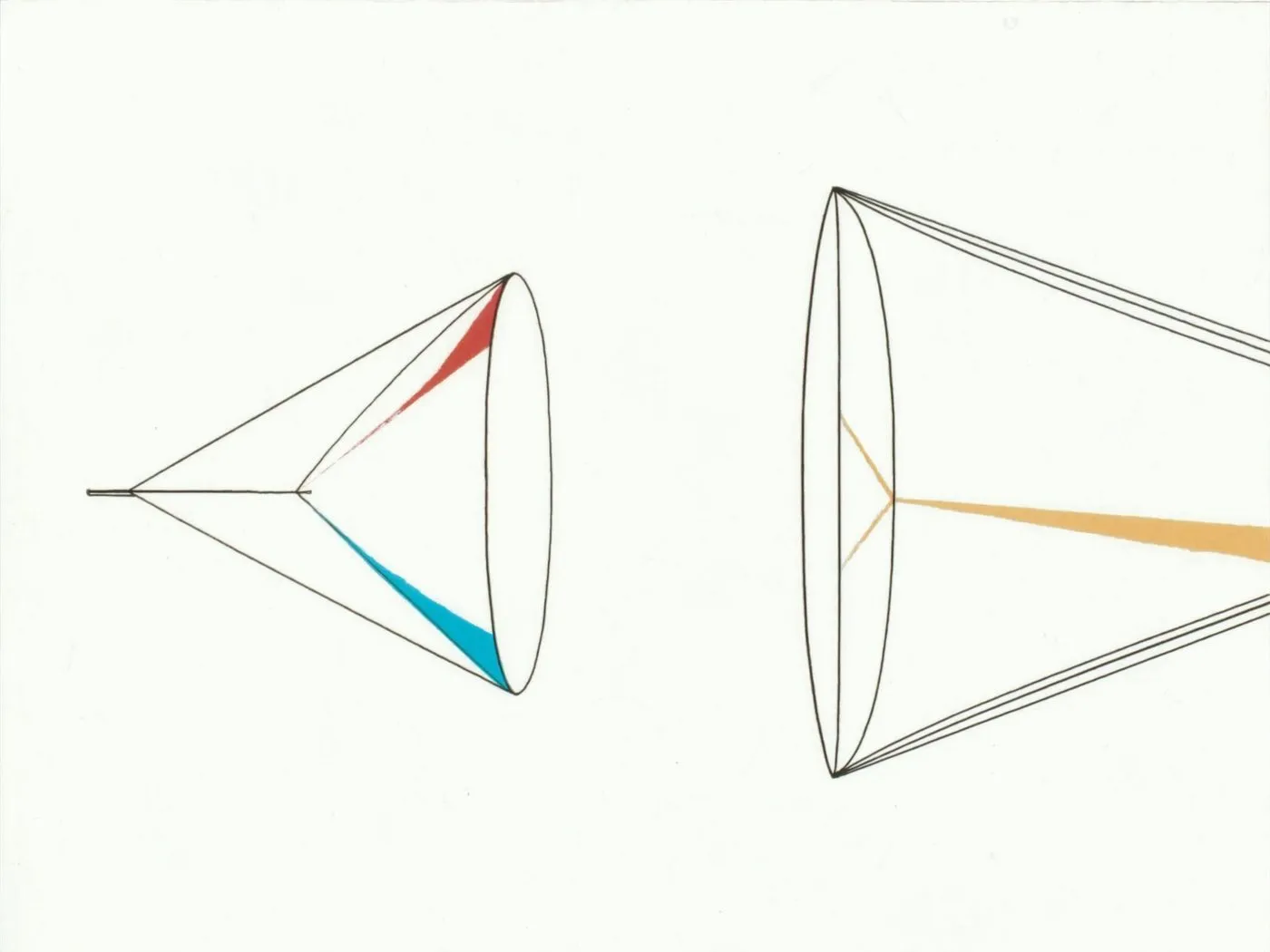
Chromatic and spherical aberration
Spherical aberration, distortion and coma
Rays through the outer part of a spherical lens refract more strongly and focus closer than central rays, which softens highlights and lowers contrast. The cure is to stop down, to block marginal rays, or to use aspherical elements. Other aberrations:
- Distortion is a change of magnification across the field. Barrel distortion, with lines bowing outward, is common in wide-angle lenses. Pincushion distortion, with lines pulled inward, is common in telephotos. Symmetrical doublet designs cancel both.
- Coma turns off-axis points into comet-shaped patches.
- Astigmatism focuses horizontal and vertical lines in different planes for off-axis rays.
- Field curvature focuses a flat subject onto a curved surface, so the edges go soft when the centre is sharp.
- Parallax is the difference between what a separate viewfinder shows and what the taking lens records, strongest in close-ups.
An anastigmat combines three or four air-spaced elements to correct spherical aberration, coma and astigmatism across a flat field. Modern cine lenses use many converging and diverging elements to keep sharpness, contrast and colour fidelity over the whole image.
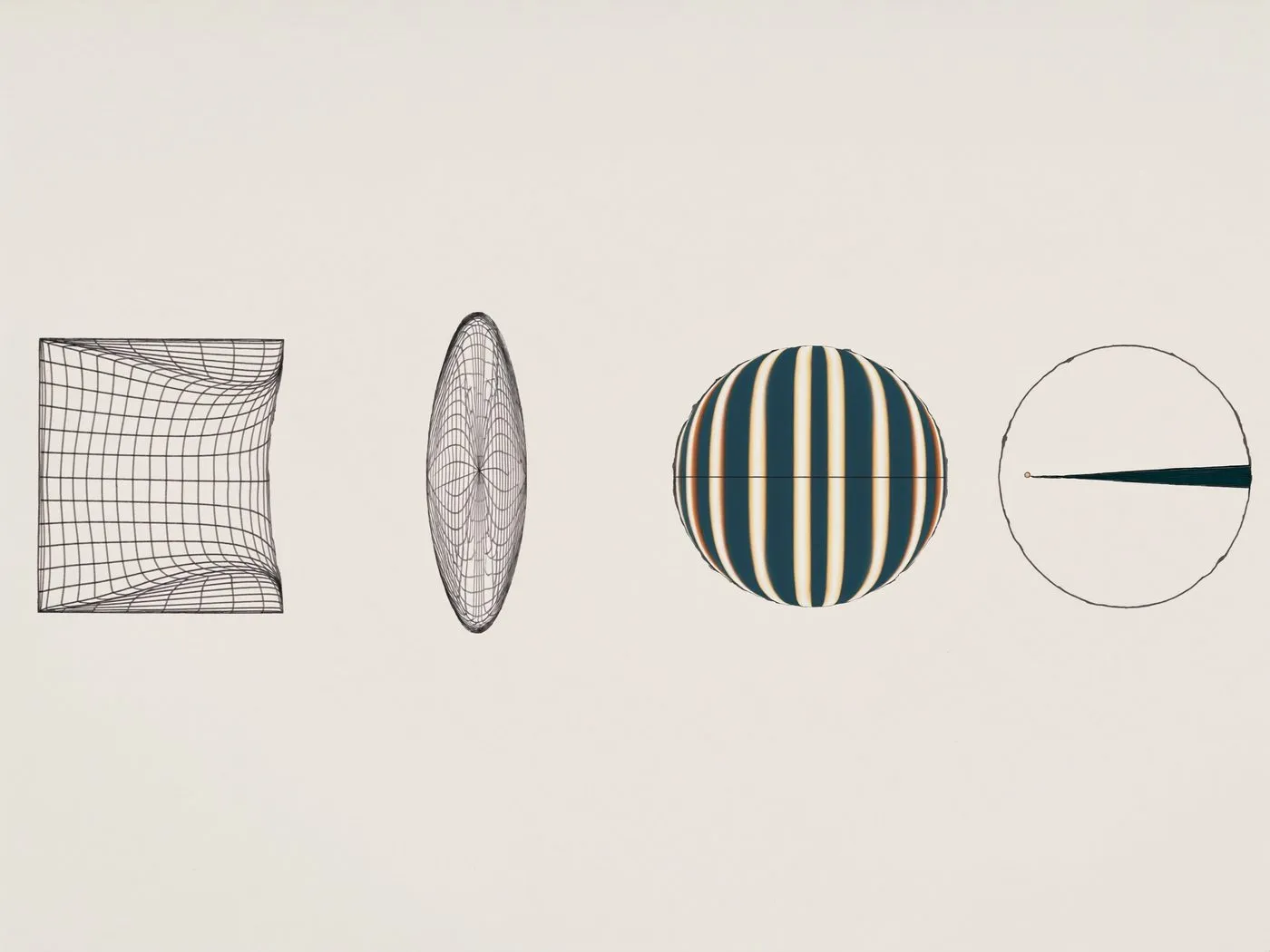
Distortion, coma and astigmatism
Quick answers
Why do old lenses show coloured reflections? Their single-layer coatings were tuned for green, so red and blue ends were reflected more.
Can I fix chromatic aberration by stopping down? It reduces the residual error but does not remove the cause; achromatic and apochromatic designs do.
Which lenses show barrel distortion? Wide-angle lenses, typically; telephotos tend toward pincushion.
Read next
- Lenses, Focal Length, Aperture and Depth of Field Explained for Filmmakers
- Reflection, Refraction, Dispersion, Interference and Diffraction
- Camera Filters: ND, Diffusion, Polarizing and Colour-Conversion Filters
Related on this site
- The Virtual Camera: a practical CGI guide
- How to check an image: a beginner’s method for visual evidence
This article is part of the free handbook Technical Foundation. Filmmaking: The Cinematographer’s Handbook by Semen Klenov, an independent researcher of light and visual perception. Cite the handbook as: Klenov, S. (2026). Technical Foundation. Filmmaking: The Cinematographer’s Handbook. Zenodo. https://doi.org/10.5281/zenodo.24326083.