Home / Journal / Cinematography
Reflection, Refraction, Dispersion, Interference and Diffraction
How light bends at a boundary, splits into colours, interferes in thin films and diffracts at an aperture, and why this limits lens sharpness.
A lens works because light changes direction at a boundary. Colour fringes, soap-bubble rainbows and the softness of a very small aperture follow from the same wave behaviour. This article walks through the five effects a cinematographer meets again and again: reflection, refraction, dispersion, interference and diffraction.
Key points
- The refractive index n is the ratio of the speed of light in vacuum to its speed in the medium. It is always greater than 1.
- Entering a denser medium, light bends toward the normal: the angle of refraction is smaller than the angle of incidence. Going the other way, beyond the critical angle the light cannot cross the boundary and is totally reflected.
- Dispersion splits white light because the refractive index depends on wavelength. Violet is deviated most, red least.
- Constructive interference needs a path difference of whole wavelengths (Δ = kλ); destructive interference needs an odd number of half-wavelengths (Δ = (2k + 1)λ / 2).
- A small aperture does not cast a sharp geometric shadow. It produces an Airy pattern, a bright core ringed by dark and bright rings, which sets the diffraction limit.
Reflection and refraction
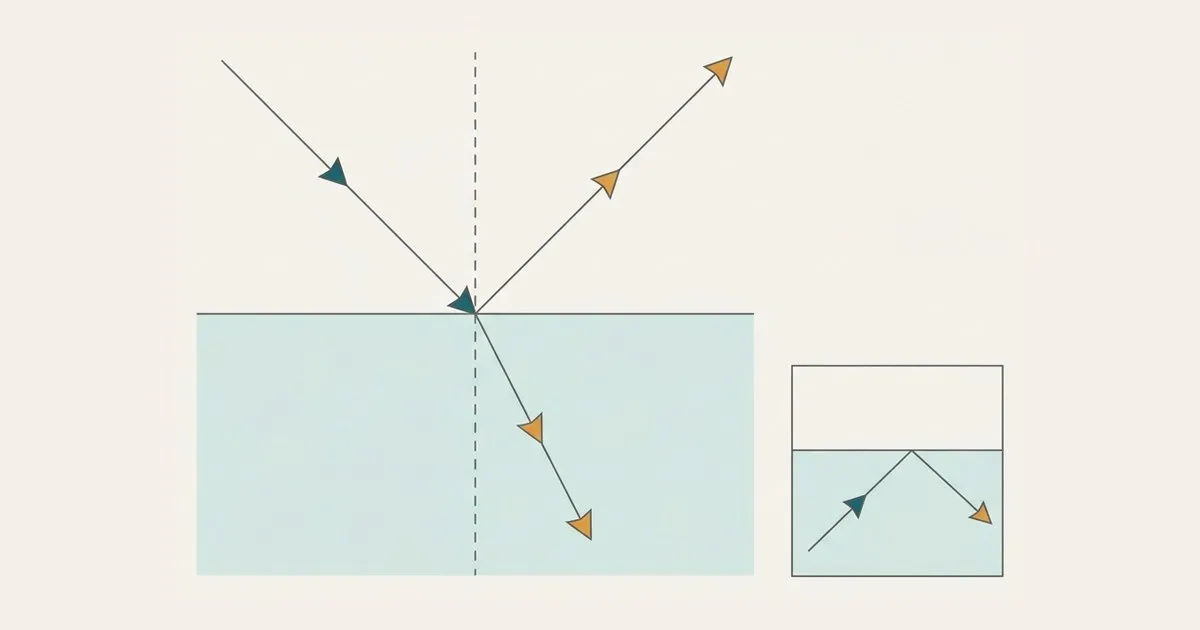
At a boundary part of the light is reflected and part crosses into the second medium. The reflected wave stays in the same medium, so its speed does not change. The transmitted wave travels at a different speed, and that is why its direction changes: this is refraction. The frequency stays the same, the wavelength changes.
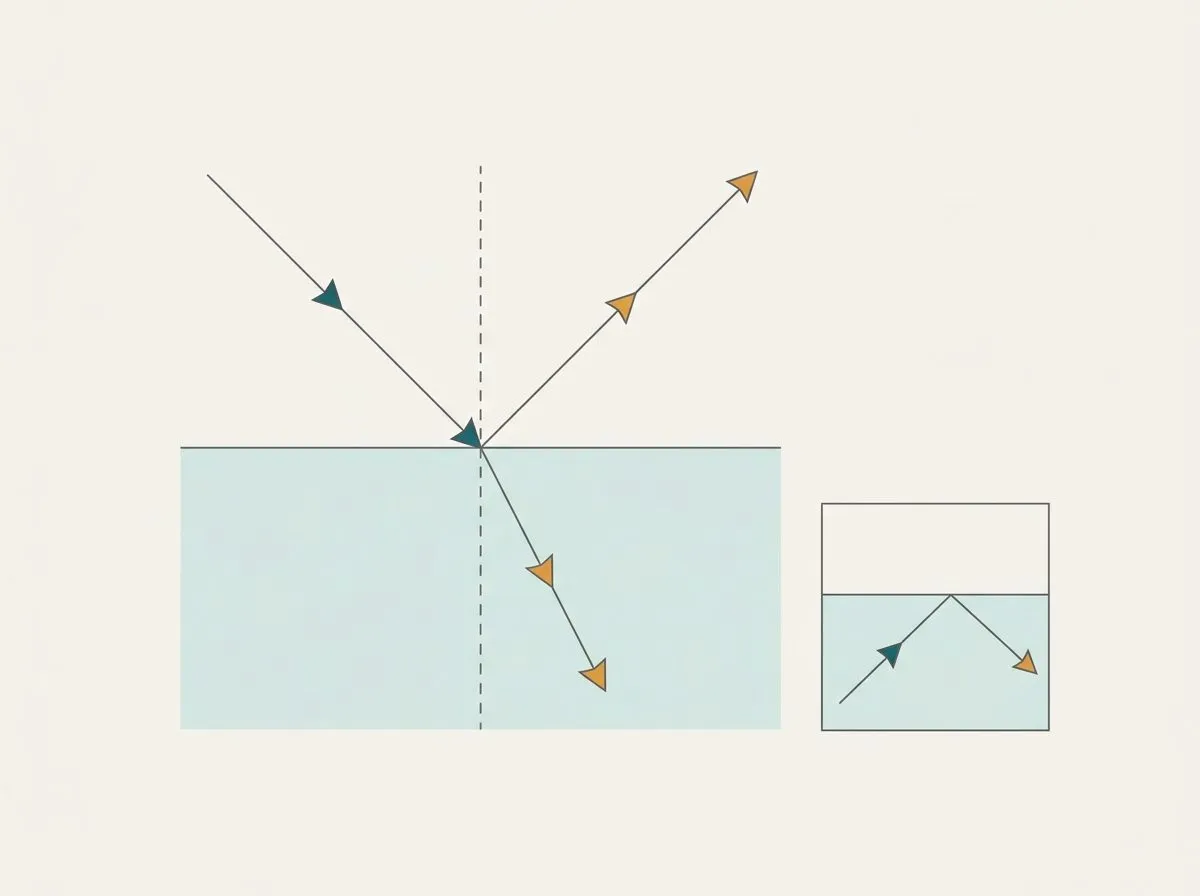
Reflection, refraction and total internal reflection
As the angle of incidence grows, a larger share of the energy is reflected. Inside a medium part of the light is also absorbed and part is scattered, which is why even clear glass is never perfectly transparent.
Dispersion
Because the refractive index depends on frequency, each wavelength is bent by a slightly different amount. A narrow beam of white light that passes through a prism fans out into a continuous spectrum. Violet, the shortest wavelength, is deviated the most; red, the longest, the least.
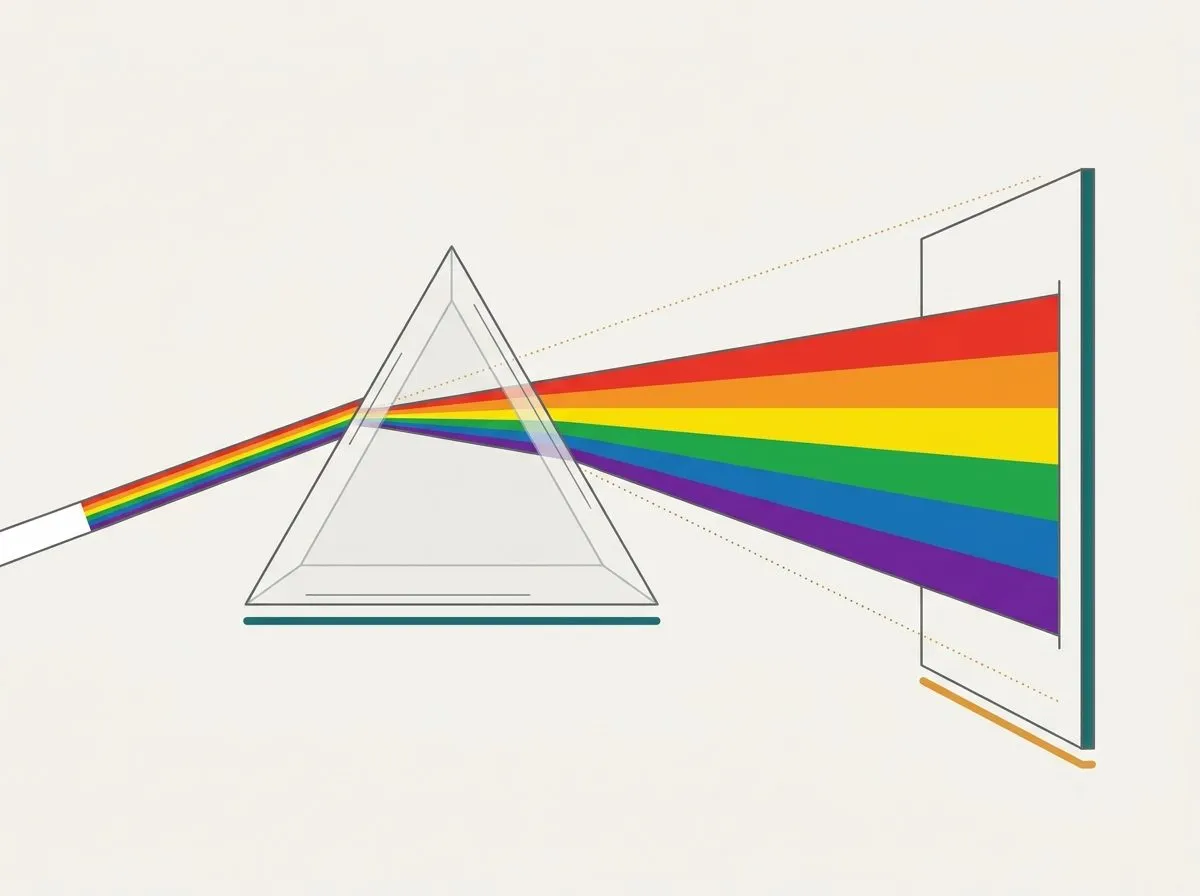
Dispersion of white light in a prism
The same dependence causes selective scattering in the air. Particles that are comparable to or smaller than the wavelength scatter short waves much more than long ones. Red and orange pass through fine haze with little loss, while blue and violet are scattered away. Humid air and aerosols therefore produce the blue haze that lowers contrast in distant landscapes.
Interference
When two coherent waves meet, they add. Where the crests coincide the amplitude grows (constructive interference); where a crest meets a trough it is cancelled (destructive interference). Coherent waves have the same frequency and a constant phase difference.
A thin transparent film shows this clearly. Light reflected from its upper and lower surfaces travels along the same axis but over different path lengths, so some wavelengths reinforce and others cancel. That is why a soap bubble or an oil slick shows vivid colours although the liquid itself is colourless. As the bubble drains, its thickness changes and so do the colours.
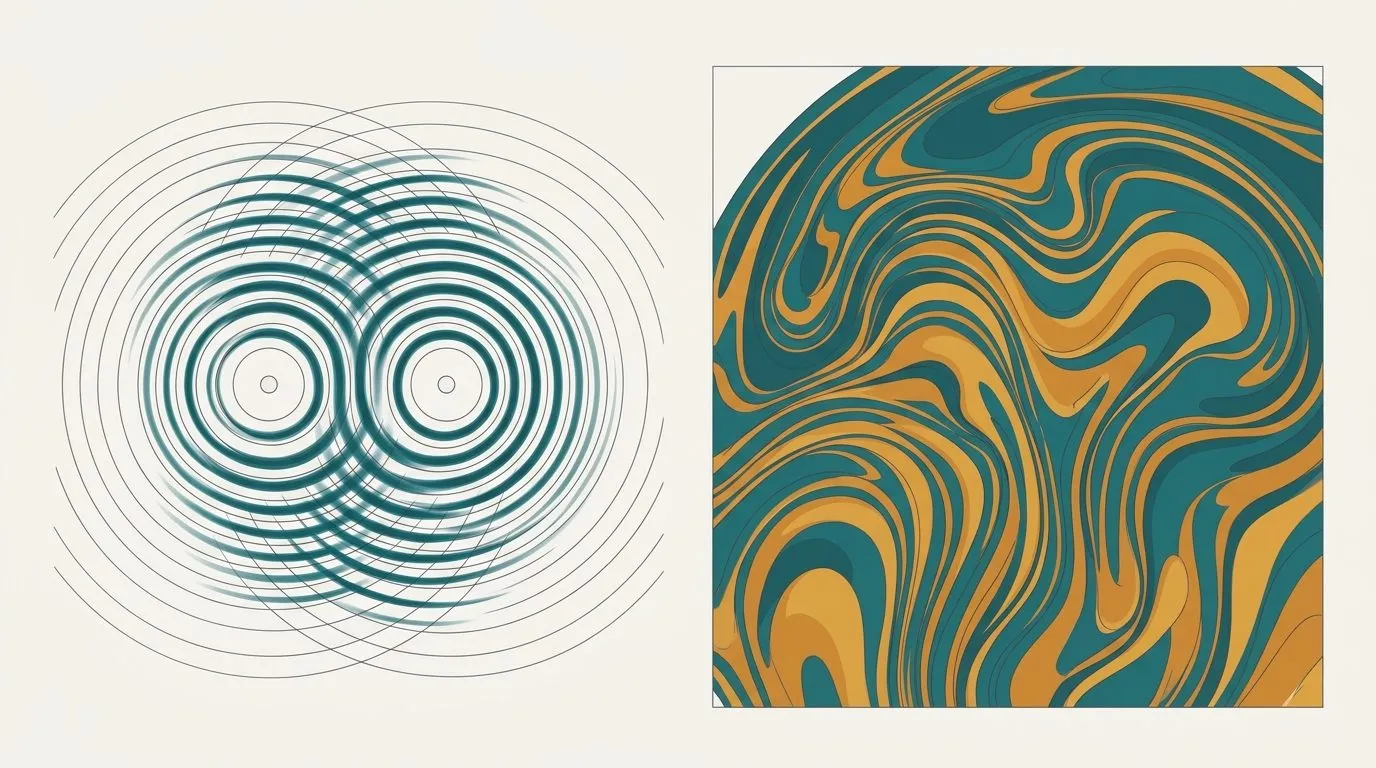
Wave interference: two coherent sources and thin-film colors
Diffraction
Diffraction is the departure of light from straight-line travel at edges, narrow slits and small obstacles. The smaller the opening, the wider the light spreads, and the effect is strongest when the opening is comparable to the wavelength. In a camera the wavelets leaving the aperture interfere at the sensor plane and form concentric rings, the Airy pattern. The bright centre surrounded by rings marks the diffraction limit of the aperture and softens fine detail.
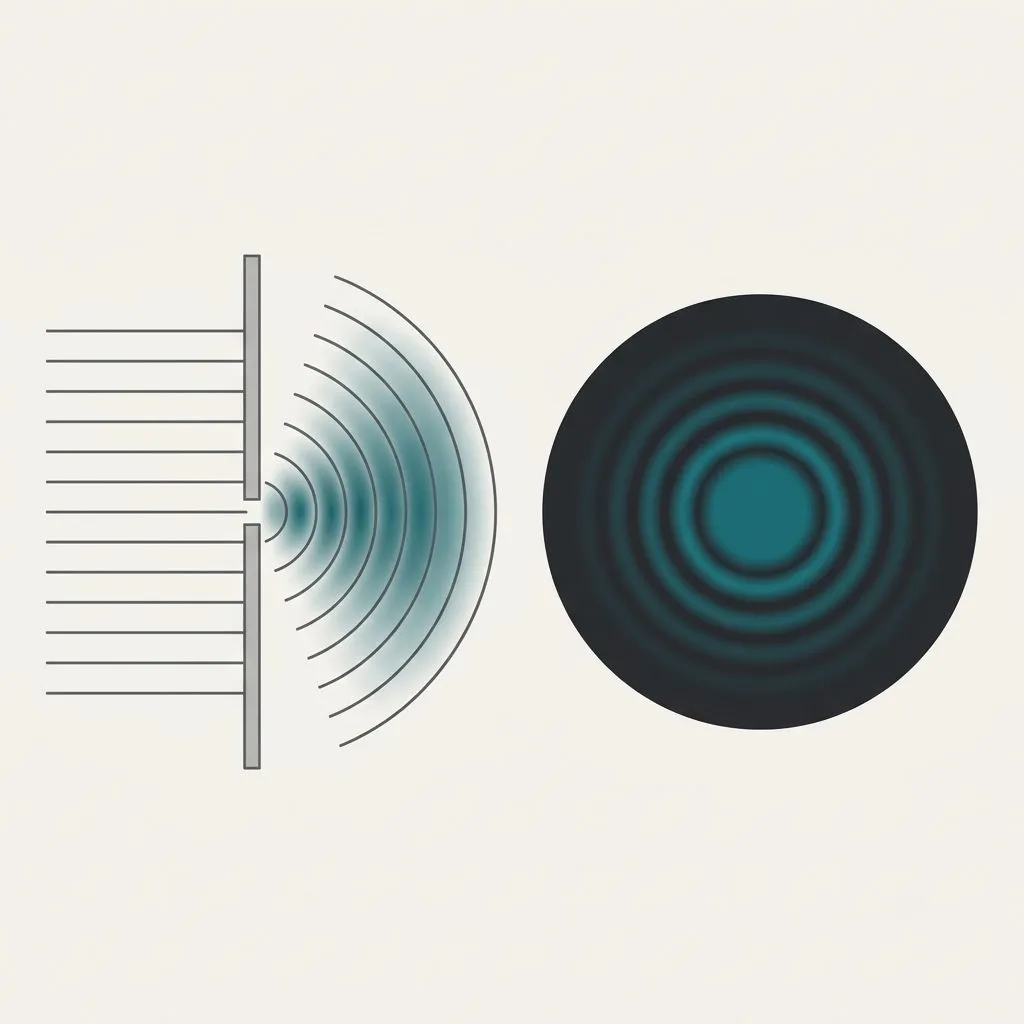
Diffraction at an aperture and the Airy pattern
Resolving power
The resolving power of a lens is its ability to show two close details as separate. It is expressed in line pairs per millimetre (lp/mm) on a high-contrast test chart. In typical photographic systems the centre resolves on average 55–65 lp/mm, and the periphery 25–40 lp/mm. A result of 40–60 lines per millimetre is generally considered good. Final sharpness depends on three things together: the lens, the diffraction at the chosen aperture, and the recording medium, whether film grain or a digital sensor.
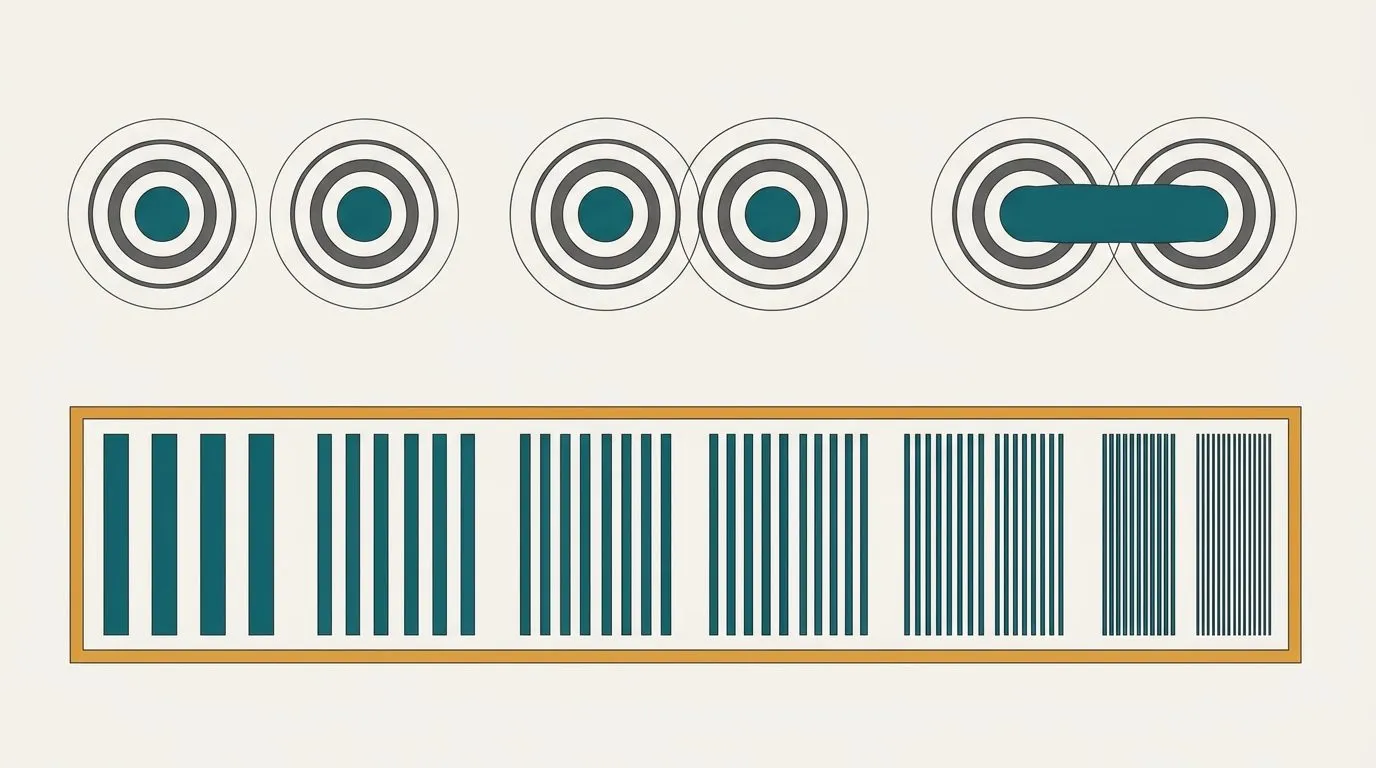
Resolving power: separated vs. merged points and a line-pair test chart
Quick answers
Why does a prism show colours? Each wavelength has a different refractive index, so each is bent by a different angle.
Why is the sky hazy in the distance? Fine particles scatter blue and violet far more than red, which lowers contrast with distance.
Can stopping down always improve sharpness? No. A very small aperture increases diffraction, so the Airy pattern grows and softens the image.
Read next
- What Is Light? Waves, Photons and the Electromagnetic Spectrum
- Polarization of Light and the Polarizing Filter in Cinematography
- Lenses, Focal Length, Aperture and Depth of Field Explained for Filmmakers
Related on this site
- Colour for beginners: why pixel values are not amounts of light
- How Rendering Works: a practical CGI guide
This article is part of the free handbook Technical Foundation. Filmmaking: The Cinematographer’s Handbook by Semen Klenov, an independent researcher of light and visual perception. Cite the handbook as: Klenov, S. (2026). Technical Foundation. Filmmaking: The Cinematographer’s Handbook. Zenodo. https://doi.org/10.5281/zenodo.24326083.