Home / Journal / Cinematography
What Is Light? Waves, Photons and the Electromagnetic Spectrum
Light is a transverse electromagnetic wave that also arrives as photons. Wavelength, frequency, wavefronts and the Huygens–Fresnel principle for filmmakers.
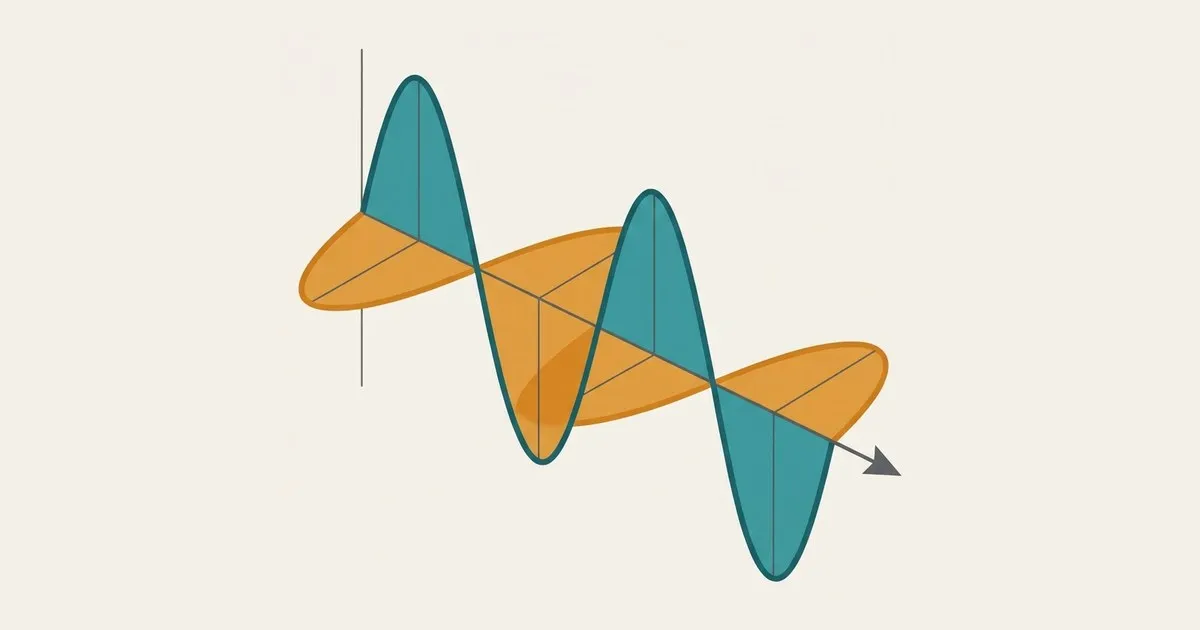
Every lamp, lens and sensor on a film set deals with the same thing: light, an electromagnetic wave that also behaves as a stream of photons. This article collects the physics a cinematographer meets first: oscillation, wavelength, frequency, the two models of light and the Huygens–Fresnel principle.
Key points
- Light is a transverse electromagnetic wave: its electric and magnetic fields oscillate at right angles to the direction of travel. It needs no medium and crosses a vacuum.
- Wavelength and frequency are linked by λ = v / f. The source sets the frequency, and it stays the same in every medium; the wavelength changes with the speed of the wave.
- Wavelength is measured in nanometres: 1 nm = 10 Å = 10⁻⁹ m.
- Two models complement each other: Maxwell’s wave theory explains colour, interference and polarization; Einstein’s photons explain how energy is exchanged with a sensor.
- Most optical radiation comes from thermal excitation. The hotter the body, the higher the frequency at which its spectrum peaks.
From oscillation to wave
An oscillation is a repeated motion around an equilibrium position. Four quantities describe it. The period T is the time of one full cycle. The frequency f = 1 / T counts cycles per second and is measured in hertz. The amplitude is the largest displacement from equilibrium. The phase says where in the cycle the system is at a given moment.
A wave is an oscillation travelling through a medium or a field. Its wavelength is the distance between two neighbouring points that oscillate in the same phase: λ = v · T = v / f. In a transverse wave the displacement is perpendicular to the direction of travel; in a longitudinal wave, such as sound, it is parallel. Mechanical waves need a solid, liquid or gas to travel through. Electromagnetic waves do not.
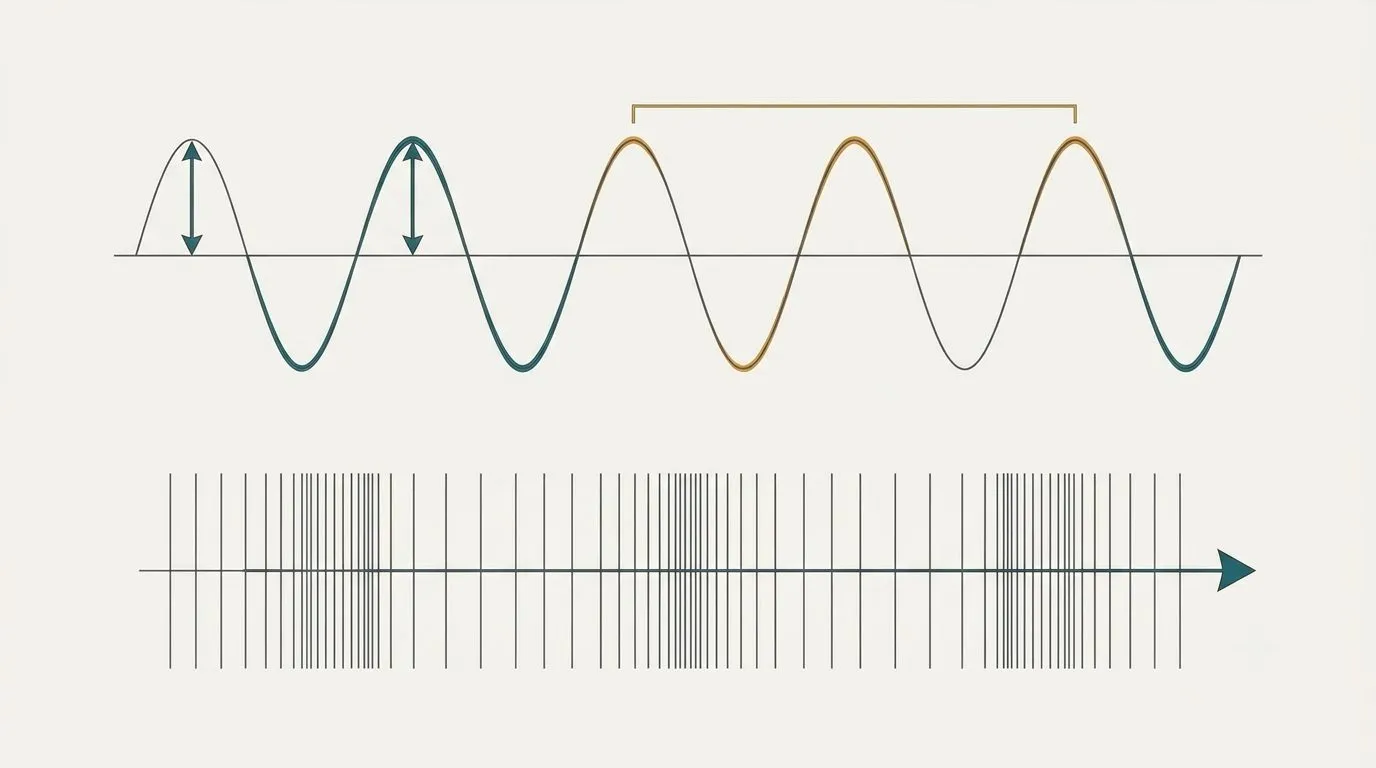
Transverse and longitudinal waves; amplitude, wavelength and period
What light is
Light is a changing electromagnetic field, produced when electric charges accelerate. For practical work it is described by rays, geometric lines that show the direction in which optical energy travels. In a homogeneous medium rays are straight (rectilinear propagation), and beams cross each other without disturbing each other’s paths. A wavefront is the set of all points that share the same phase; a point source in a uniform medium sends wavefronts out evenly in every direction.
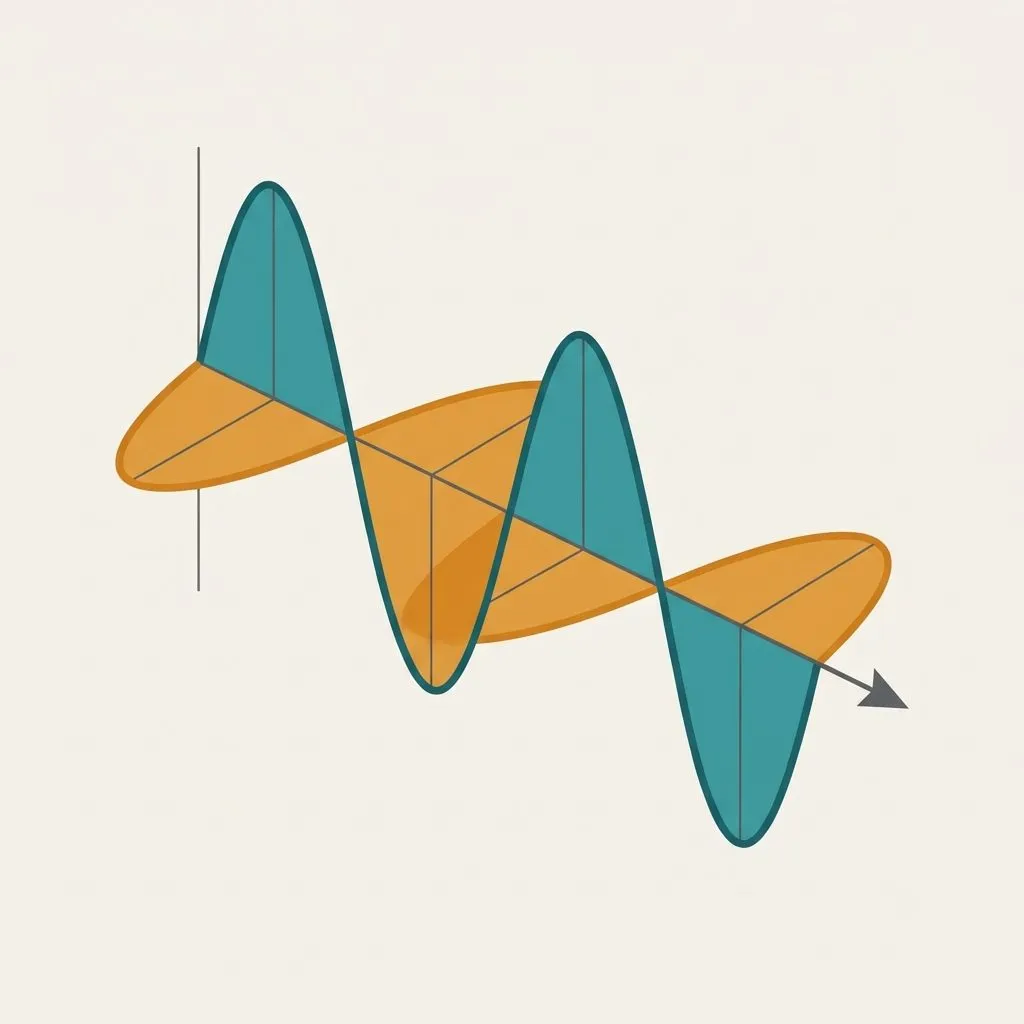
Light as a transverse electromagnetic wave
Wave and particle
Optics uses two complementary pictures. In Maxwell’s wave theory, radiant energy travels as coupled electric and magnetic fields described by frequency, wavelength and polarization. In quantum theory, energy is emitted, absorbed and handed over in discrete packets, the photons, and this is how a film grain or a sensor pixel registers light. Neither picture replaces the other. A cinematographer needs the wave picture for colour, filters and lens sharpness, and the photon picture for exposure and noise.
The electromagnetic spectrum
Visible light is a narrow band of the electromagnetic spectrum, roughly 400–750 nm. Shorter waves are ultraviolet, longer ones infrared; the physics is the same, only the frequency differs. When coherent waves meet they superpose and form stable interference patterns, and when a wave passes the edge of an obstacle it bends around it, which is diffraction. Dielectrics such as glass reflect only a fraction of the energy that hits them, while polished metals reflect almost all of it.
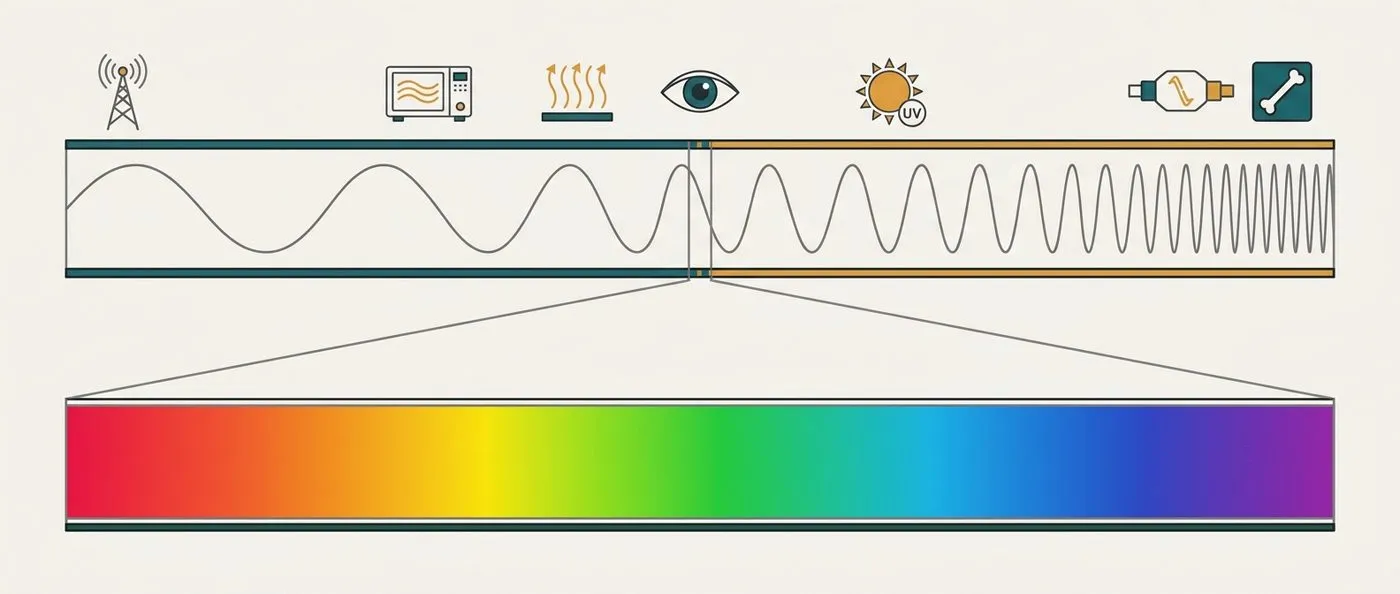
The electromagnetic spectrum with the visible band enlarged
The Huygens–Fresnel principle
In 1690 Huygens proposed that every point of a wavefront can be treated as a source of small spherical wavelets, and that the envelope of these wavelets forms the wavefront a moment later. Fresnel added interference: the light at any point in space is the sum of all the wavelets reaching it. This explains why light seems to travel in straight lines past a wide opening. Wavelets from different parts of the opening reinforce each other in the forward direction and cancel to the sides.
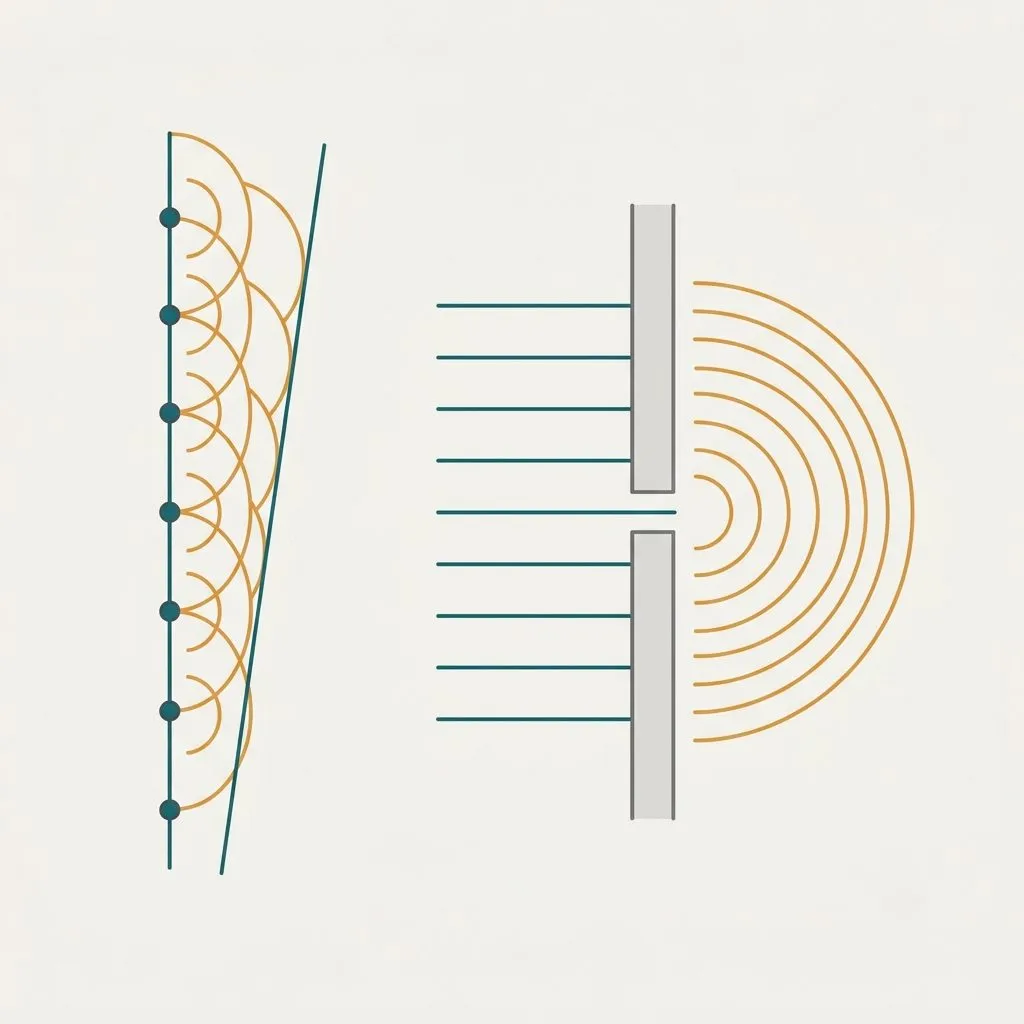
Huygens–Fresnel principle: secondary wavelets form a new wavefront
Quick answers
Does light need a medium? No. Electromagnetic waves travel through a vacuum; sound and water waves do not.
Does colour change when light enters glass? The frequency stays constant, but the wave slows down, so the wavelength shortens.
Is light a wave or a particle? Both descriptions are needed. The wave model covers how light travels and interferes; the photon model covers how it is absorbed.
Read next
- Reflection, Refraction, Dispersion, Interference and Diffraction
- Polarization of Light and the Polarizing Filter in Cinematography
Related on this site
- One light, two worlds: physical units from the film set to the render engine
- Colour for beginners: why pixel values are not amounts of light
This article is part of the free handbook Technical Foundation. Filmmaking: The Cinematographer’s Handbook by Semen Klenov, an independent researcher of light and visual perception. Cite the handbook as: Klenov, S. (2026). Technical Foundation. Filmmaking: The Cinematographer’s Handbook. Zenodo. https://doi.org/10.5281/zenodo.24326083.