Home / Journal / Cinematography
Polarization of Light and the Polarizing Filter in Cinematography
What polarized light is, how reflections and the blue sky polarize it, and how a polarizing filter removes glare and darkens the sky on camera.
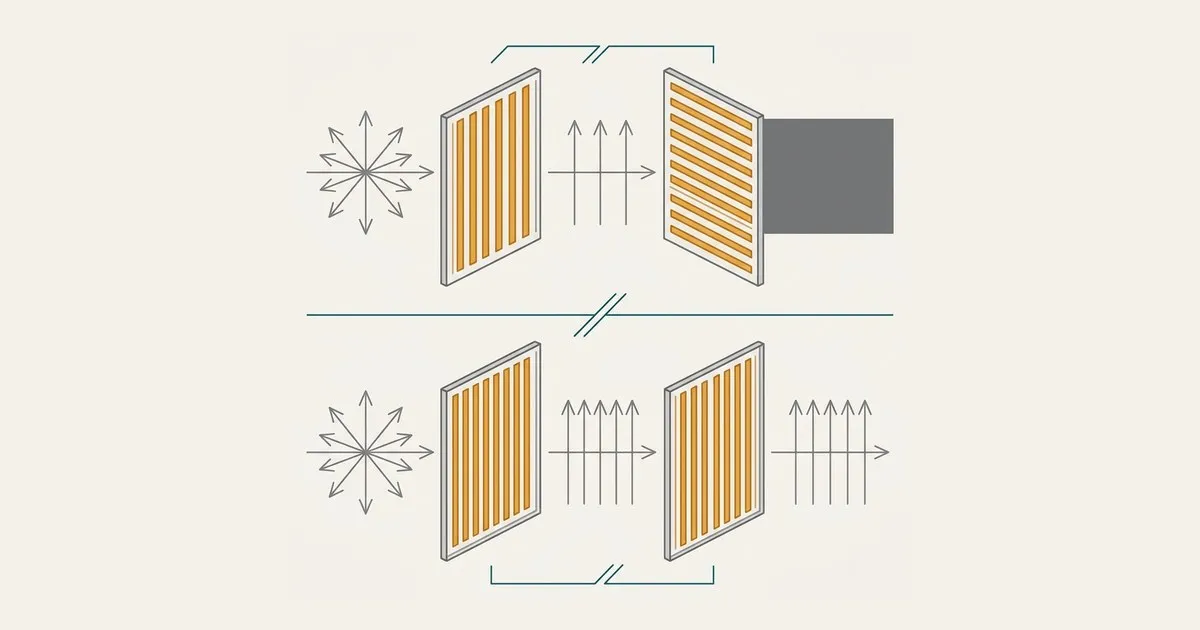
Polarization is the one property of light that proves it is a transverse wave. For a cinematographer it turns into a practical tool: a polarizing filter can remove reflections from glass and water and deepen a blue sky. This article explains what polarized light is, where it occurs naturally, and how to use it.
Key points
- Polarization confines the oscillations of light to a single plane. Natural light is unpolarized: its oscillations occur in all planes perpendicular to the direction of travel.
- Reflection from smooth non-metallic surfaces polarizes light. Matte surfaces scatter it and depolarize it.
- Brewster’s angle is the angle of incidence at which light reflected from a dielectric is completely polarized; for optical glass it is typically 53°–57°.
- The clear sky polarizes strongest at 90° from the sun and hardly at all along the sun’s axis.
- Two polarizers with axes turned by 90° block the light completely.
Kinds of polarized light
A linearly polarized wave oscillates in one plane. Partially polarized light has an unequal distribution of oscillations between planes; the degree of polarization is the ratio between the maximum and the minimum intensity passed by a rotating polarizer. In circularly polarized light the electric vector turns in a circle along the axis of travel, clockwise or counter-clockwise. Pure linear polarization is an idealization. The light met on location is almost always partially polarized.
A polarizer passes the oscillations along its transmission axis and absorbs or deflects the rest. A crystal such as Iceland spar goes further and splits a beam into two orthogonally polarized beams that take different paths.
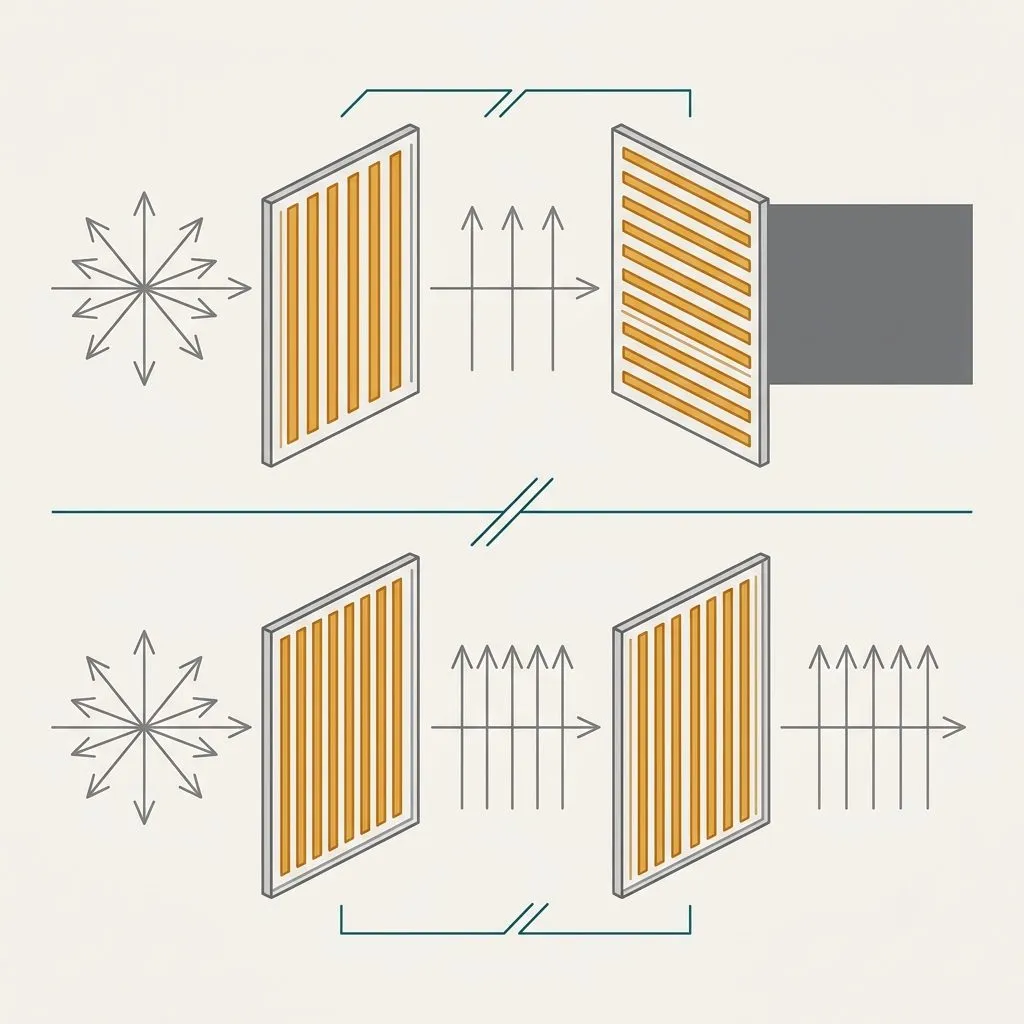
Unpolarized light passing through a polarizer and crossed polarizers
Where polarized light comes from
Two sources matter on location. The first is reflection. Specular reflection from glass, water and other dielectrics polarizes light, most strongly near Brewster’s angle. Light reflected from matte or rough surfaces is completely unpolarized. The second is the sky. Molecules of nitrogen and oxygen scatter sunlight, and a clear blue sky is the main natural polarized source outdoors. Looking at 90° to the solar axis gives the highest degree of polarization. With the sun high, the strongest band lies near the horizon; with the sun low, it arcs directly overhead.
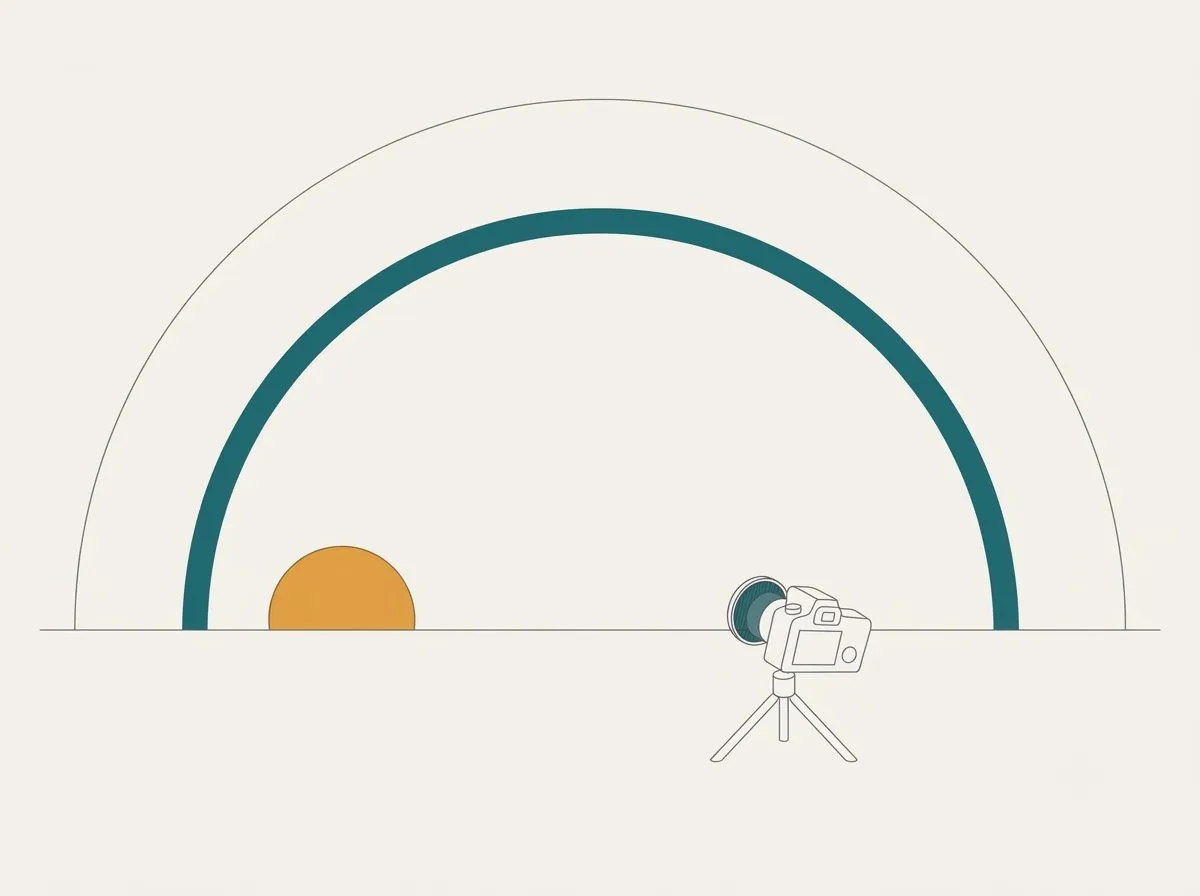
Band of maximum sky polarization at 90° from the sun
Using a polarizing filter
- Remove reflections. Rotating the filter against polarized glare from a window, a car or a water surface can reduce or remove it, because the reflected light is polarized in a known plane.
- Darken the sky. Aimed at the band of strongest polarization, the filter makes a blue sky denser.
- Cut atmospheric haze. Because scattered skylight is polarized, the filter lowers haze in the distance.
The filter itself, with the other camera filters, is covered in the article on ND, diffusion and colour-conversion filters; this article gives the physics behind it.
A caution for moving shots
Avoid a polarizing filter on a continuous wide-angle pan, for example when tracking an aircraft across the sky. The degree of polarization changes across the frame, so the density of the sky varies from one side of the image to the other and shows up as an unnatural gradient.
Quick answers
Why does a polarizer remove reflections? Reflected light is polarized in one plane, and the filter can be turned to block exactly that plane.
When is the sky polarized the most? At 90° from the sun. Along the line toward the sun it is almost unpolarized.
Can a polarizer be used with a matte surface? There is nothing to remove: light from a matte or rough surface is unpolarized.
Read next
- What Is Light? Waves, Photons and the Electromagnetic Spectrum
- Camera Filters: ND, Diffusion, Polarizing and Colour-Conversion Filters
- Reflection, Refraction, Dispersion, Interference and Diffraction
Related on this site
- One light, two worlds: physical units from the film set to the render engine
- How Rendering Works: a practical CGI guide
This article is part of the free handbook Technical Foundation. Filmmaking: The Cinematographer’s Handbook by Semen Klenov, an independent researcher of light and visual perception. Cite the handbook as: Klenov, S. (2026). Technical Foundation. Filmmaking: The Cinematographer’s Handbook. Zenodo. https://doi.org/10.5281/zenodo.24326083.