Home / Journal / Technical research
Making a game project: from idea to vertical slice
The stages studios use, from concept and ugly prototype to vertical slice and release, the MDA framework and rules for keeping a first game small enough to finish.
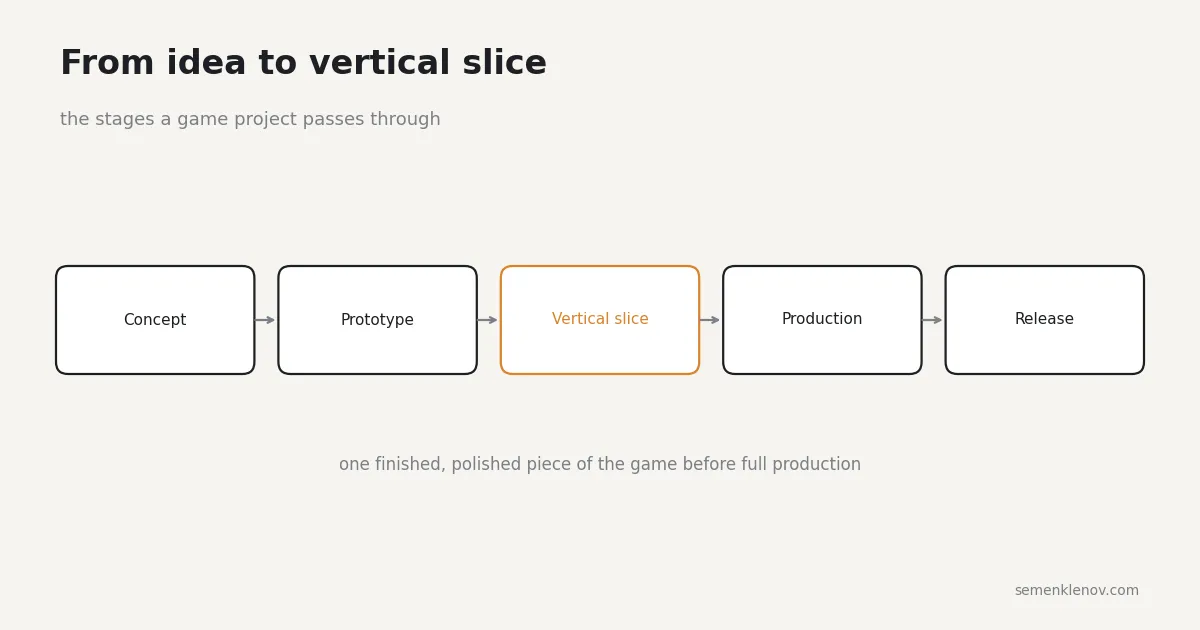
Many beginners start a game by opening an engine and building the world they dream of. A few months later the project is too big to finish. Studios avoid this with a fairly standard sequence of stages, each ending in a decision. I am preparing my own portfolio for game studios and working on game-related ideas such as NPC behaviour learned from human movement. In this article I lay out that sequence as I understand it from the literature and from production practice, so that a beginner can plan a project that actually ships.
Think in systems first: the MDA framework
Hunicke, LeBlanc and Zubek (2004) proposed a simple lens that I find useful at every stage:
- Mechanics: the rules and data (jump height, damage, cooldowns).
- Dynamics: the behaviour that emerges when players use those rules (rushing, hiding, trading).
- Aesthetics: the emotional experience the player has (tension, discovery, fellowship).
Designers build mechanics, but players feel aesthetics. So the first question for any project is not “what features?” but “what should the player feel?” Every mechanic must serve that answer.
The stages of a game project
| Stage | Main question | What you produce | Decision at the end |
|---|---|---|---|
| Concept | Is the idea worth exploring? | One-page pitch, mood board, target feeling | Prototype it or drop it |
| Prototype | Is the core loop fun? | Ugly, playable test of the main mechanic | Keep, change or kill |
| Pre-production | Can we build it, and how? | Design document, art style tests, tech plan, schedule | Go into production |
| Vertical slice | Can we make one part at final quality? | A short playable section with final art, sound and polish | Approve budget and scope |
| Production | Build all content | Levels, assets, systems | Content complete |
| Alpha / beta | Is it complete and stable? | All features in, then bug fixing and balancing | Release candidate |
| Release and live | Does it work for real players? | Launch, patches, updates | Continue, expand or end |
Two stages deserve special attention from beginners.
The prototype must be ugly on purpose. Grey boxes and placeholder sounds let you test whether the core loop (the action the player repeats most) is fun, without spending weeks on art. If it is not fun in grey boxes, beautiful art will not save it.
The vertical slice is the opposite. It is a small section, often just minutes of play, at final quality. It proves that the team can reach the target look and feel. It also gives a realistic estimate of how long the whole game will take: if one level took two months, twenty levels will not take two weeks.
Scope: the main killer of first projects
Jesse Schell’s The Art of Game Design (2019) treats design as a cycle of testing and iteration, not a single act of invention. For a first project I would apply three rules:
- One core mechanic, one setting, one session length. Add more only after the core works.
- Cut by cost, not by love. List features with their cost in days, and cut from the bottom.
- Ship something small. A finished 10-minute game teaches more, and looks better in a portfolio, than an unfinished open world.
Roles in a game team
Even small teams cover the same roles: game design, programming, art (concept, 3D, environment, characters), technical art (the bridge between art and code), animation, sound, production and QA testing. Technical art is the role I find closest to my own profile. It connects 3D, lighting, tools and performance, and it suits people who enjoy both pictures and systems.
What this means for my work
My game-related ideas follow this sequence. The NPC behaviour project, which explores learning movement from VR recordings, is still at the concept stage, and I keep it there until a prototype question is clear. My Houdini building generator is a tool rather than a game. It is exactly the kind of technical-art asset that speeds up the production stage, and I build it step by step in public.
If you are just starting
- Write a one-page pitch: target feeling, core loop, player, session length.
- Prototype the core loop in grey boxes within one or two weeks.
- Make a vertical slice of your best idea for your portfolio. Studios look for finished, polished work.
- Join a game jam: a 48-hour deadline teaches scope faster than any book.
References
- Hunicke, R., LeBlanc, M., & Zubek, R. (2004). MDA: A formal approach to game design and game research. Proceedings of the AAAI Workshop on Challenges in Game AI.
- Schell, J. (2019). The Art of Game Design: A Book of Lenses (3rd ed.). CRC Press.
SEMEN KLENOV · 3D and games for beginners. Drafted with AI assistance; reviewed by the author.