Hair, Fur and Crowds: a practical CGI guide
A human head has about 100,000–150,000 hairs; a few hundred to a few thousand guides drive them.
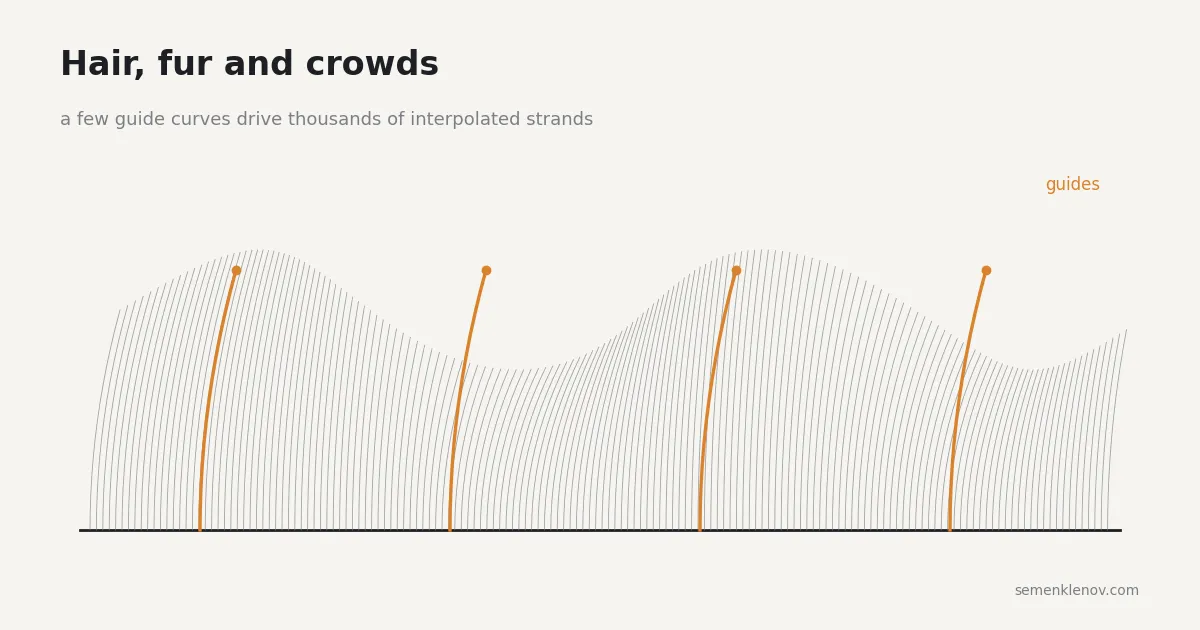
Hair, fur and large groups of people are three of the most specialized departments in a studio. Most advertising artists will not build a full groom or a stadium crowd, but they must recognize the problem, plan the budget and brief a specialist — or do a simple version themselves. this article is an overview of how these systems work.
Key points
- A human head has about 100,000–150,000 hairs; a few hundred to a few thousand guides drive them.
- Hair shading has a white reflection, a colored second highlight and a glow from transmission.
- Crowds use agents with clips of motion and simple rules.
- Know when to hire a specialist and how to brief one.
Hair and Fur
- Hair in numbers: a human head has about 100,000–150,000 hairs, each 0.05–0.1 mm thick. A groom does not simulate them one by one: a few hundred to a few thousand guide curves drive the rest.
- Strands: Hair is a large set of thin curves, often tens of thousands to millions.
- Guides: A small set of hand-shaped guide curves that control the style; the system interpolates the rest.
- Grooming: Shaping the hair with comb, cut, clump, frizz and noise tools; the style comes from reference.
- Distribution: Density maps and masks control where hair grows and how thick (eyebrows, a beard, a fur coat).
- Hair cards: Flat textured strips that imitate hair in real-time; cheap but limited.
- Fur and short hair: Millions of tiny strands, rendered with special fur shaders and level-of-detail.
- Brands and ads: Hair care, cosmetics, pet food and fashion spots demand exceptional hair quality; most agencies hire a specialist.
Shading and Simulation of Hair
- Hair shading: A hair strand is a thin cylinder with layers: the cuticle reflects light (a primary highlight), light enters, tints and exits (a second, colored highlight), and some transmits (a glow when backlit).
- Parameters: Melanin or color, roughness, specular shift, radial roughness and coat.
- Rendering cost: Hair is among the slowest geometry to render; control strand count and use adaptive sampling.
- Simulation: Strands move by simulation of guide curves: stiffness, damping, gravity and collisions with the head, body and clothes.
- Wind and motion: Hair follows the character with overlap and drag; add a little constant secondary motion so it is never perfectly still.
- Wet hair: Clumped, darker and glossier; usually a separate groom or modifier.
Crowds
- Agent: A character (rig plus mesh) that can move and make simple decisions.
- Motion clips: A library of animations (walk, idle, run, react) the agents play and blend.
- Behaviors: Rules: follow a path, avoid others, face a target, react to an event.
- Variation: Random body shapes, clothes, colors and timing offsets prevent a “clone army”.
- Level of detail: Distant agents use simplified geometry and rigs.
- Simulation vs. instancing: Background figures can be instanced, pre-animated clips; foreground crowd needs unique animation.
- Use in advertising: Stadiums, streets, concerts, audience reactions — usually from stock footage and compositing, or a small crowd system for hero shots.
Other Specialties: When You Need a Specialist
- Creature FX: Muscles, skin sliding and fat jiggle (character effects, CFX).
- Cloth for characters: Production-quality clothing needs a pattern workflow and a cloth artist.
- Facial animation at film quality: Facial rigs, capture and performance retargeting.
- Digital humans: Scanned faces, skin shading and eyes — the hardest area of CG; the “uncanny valley” lies here.
- Scale: Deliver stylized or non-human characters when the budget cannot afford a believable digital human.
- Decision rule: If an element will be on screen for more than two seconds in close-up and needs film-level realism, hire or partner with a specialist.
In the tools
- Blender: Hair Curves (Curves objects) with Geometry Nodes groom assets, Particle Hair (older system), Hair BSDF / Principled Hair in Cycles; crowds with Geometry Nodes and action instancing; Agent add-ons for crowds.
- Houdini: Guide Groom, Guide Process, Hair Generate, Hair Clump; Vellum Hair for simulation; Crowd tools (Agent, Crowd Source, Crowd Solver) in DOPs; Karma hair/curves rendering.
- Studio tools: XGen (Maya), Ornatrix, Yeti, Golaem and Massive for large productions.
Common mistakes
- Too many strands for the budget.
- Perfectly straight hair: no noise, no clumping.
- Hair shaders based on a plastic material.
- A crowd with identical agents moving in sync.
- Trying to make a believable digital human with no specialist.