Motion Design: a practical CGI guide
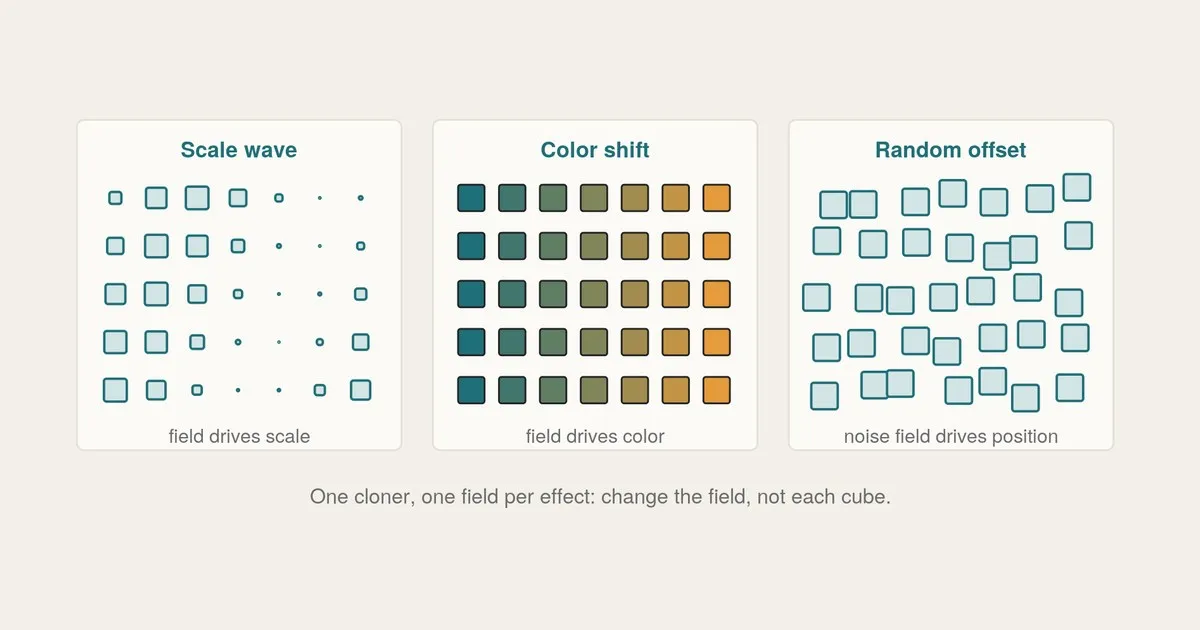
Motion design uses clones and effectors: one rule moves many objects.
Motion design is the language of titles, interfaces, abstract brand films and many product spots. It values rhythm, shape and typography as much as realism. It also trains a skill every CG artist needs: making many things move together in time with music.
Key points
- Motion design uses clones and effectors: one rule moves many objects.
- Frames per beat = fps × 60 ÷ BPM. At 120 BPM: 12 frames at 24 fps, 12.5 at 25 fps.
- Music is built in phrases of 4, 8 and 16 beats; cut at phrase boundaries.
- 3D type must stay legible at the smallest delivery size.
Cloners, Effectors and Procedural Motion
- Cloner: Creates many copies of an object in a pattern (grid, radial, along a spline).
- Effector / field: A control object that changes properties of clones depending on distance or position: scale, rotation, position, color. Move the field to animate thousands of items with one key.
- Delay and offset: The same animation, shifted slightly in time per clone, produces waves and cascades.
- Random and noise: A seed or noise adds variation; a time-animated noise adds life.
- Tools by program: Cinema 4D MoGraph (the original), Blender Geometry Nodes with fields, Houdini attributes and copy-to-points. The idea is identical.
3D Typography
- Type as geometry: Convert a font to curves, extrude, bevel.
- Font choice: Respect the brand font; check its license for use in a video and for converting to 3D.
- Legibility first: Contrast with the background, clear spacing, enough time on screen.
- Reveal styles: Letters rise, scale up, rotate in, pass through a light sweep or are built from particles. Offset per letter.
- Kerning and tracking: Check spacing manually after extrusion.
- Foreign scripts: Cyrillic, Thai, Arabic and CJK need fonts that contain the glyphs; test the actual text early.
Rhythm and Music Sync
- BPM to frames: Frames per beat =
fps × 60 ÷ BPM. At 120 BPM and 25 fps there are 12.5 frames per beat; at 24 fps, exactly 12. - Hits: Key actions land on strong beats; secondary motion on off-beats or sub-beats.
- Phrase structure: Music works in 4-, 8- and 16-beat phrases; change scenes at phrase boundaries.
- Audio visualization: Drive parameters from the audio amplitude or frequency band for reactive visuals.
- Sound design: Add whooshes, clicks and impacts that match visual events.
- Licensing: Use licensed or original music only.
Abstract Form and Style
- Shape language: Limit yourself: one or two primitives, a tight palette.
- Materials: Clean glossy, matte clay, glass, holographic and flat toon — each has a mood.
- Backgrounds: Gradient, infinite white, dark void; the product or form remains the hero.
- Simulation as motion design: Soft bodies, cloth and particles drive graceful abstract motion.
- Look: Add grain, depth of field, bloom and glow for polish.
- Style frames: Design two or three key frames before animating.
Motion Design Workflow
- Boards and style frames → animatic with timing and music → build assets → animate → render in passes → composite (glow, depth, grain) → edit and sound.
- 2D/3D mix: After Effects for text, shapes and finishing; a 3D program for depth and lighting; compositing joins them.
- Template building: Make the system parameter-driven so the client can change text, color or timing quickly.
In the tools
- Blender: Geometry Nodes (Instance on Points + fields), Text object with Extrude/Bevel, audio Sound Strip in the Sequencer, Bake Sound to F-Curves.
- Houdini: Copy to Points, Attribute Randomize, Noise, Time Shift, CHOPs Audio for reactive motion; Font SOP for text.
- Cinema 4D: MoGraph (Cloner, Fracture, Effectors, Fields), MoText; widely used in broadcast and advertising.
- After Effects: For 2D motion and final polish; Cineware/Live link with 3D.
- Unreal Engine 5: Niagara for particle motion, the Text 3D actor, and the newer Motion Design toolset for broadcast-style graphics.
Common mistakes
- Everything moving all the time with no hierarchy.
- Type that is unreadable on a phone.
- Animation not locked to the music.
- Over-complicated effects that hide the message.
- Fonts used without checking the license.