Home / Journal / Technical research
Provenance over detection: what C2PA Content Credentials can and cannot prove
Detectors guess an image's history; provenance records it. What a signed C2PA credential proves, what it does not, and how both belong in one honest report.
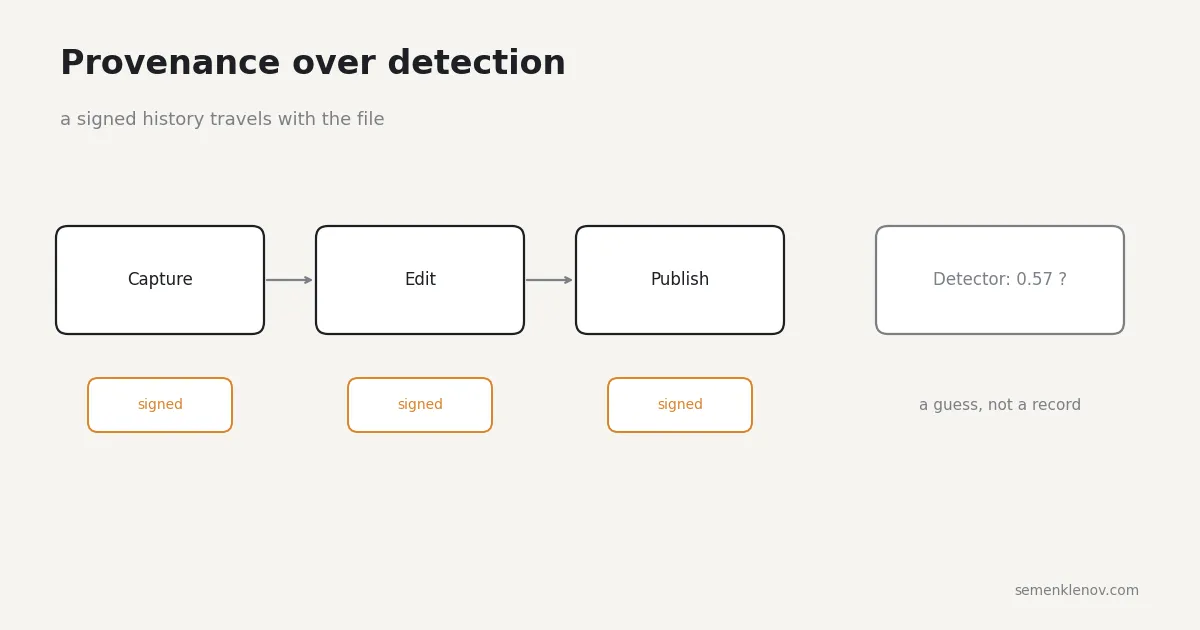
Most public debate about fake images asks one question: can software tell if a picture is real? I think it is the wrong first question. A more answerable one is: where did this file come from, and what happened to it on the way? That is the question behind content provenance and the C2PA standard. In this article I explain what the standard can prove, what it cannot, and how I plan to use it next to pixel analysis in SMART ONE.
Detection vs provenance
Detection looks at the pixels and tries to infer their history: compression traces, sensor noise, lighting inconsistencies. It works without any cooperation from the author, but its answers are probabilistic. Every detector has error rates, and the best fakes are made to beat the detectors of their day. (My notes on double JPEG compression show how narrow a single pixel-level clue really is.)
Provenance works the other way round. The camera, editing software or publisher attaches a signed record of origin and edits at the moment of creation. Later, anyone can check that record. It does not need to guess, but it only exists if somebody created it.
What C2PA is
The Coalition for Content Provenance and Authenticity (C2PA) publishes an open technical specification for “Content Credentials”. The current versions are 2.2 (2025) and 2.3 (dated 5 January 2026). In short:
- A manifest travels with the asset (embedded or stored externally).
- The manifest holds assertions: statements such as “captured by this device”, “edited with this tool”, “these actions were applied”, “this is the original ingredient”.
- A claim gathers the assertions and is cryptographically signed by the tool or organisation that produced it.
- A hard binding (a hash of the content) ties the manifest to the exact bytes. If the pixels change without a new signed step, validation fails.
- Edits form a chain: an edited file can reference earlier manifests as ingredients, so the history can be followed step by step.
Open-source tooling exists. The c2pa-python library, maintained by the Content Authenticity Initiative, can read and validate manifests, and also sign new ones (Python 3.10+).
What a valid credential proves, and what it does not
| A valid C2PA credential shows | It does not show |
|---|---|
| Who signed the record (a certificate) | That the scene in front of the camera was real or staged |
| That the bytes have not changed since signing | That the signer is honest or the certificate trustworthy, unless it is on a trust list you accept |
| Which edits the signing tools declared | Edits made outside C2PA-aware tools before signing |
| A chain of ingredients | Anything about files whose credentials were stripped |
Two points are easy to miss.
- Absence is not evidence of fakery. Many platforms and messengers strip metadata. Only some cameras and apps sign their output at all. An image without credentials is simply unverified.
- A signature is about the file, not the world. A staged photo, signed by a real camera, carries a perfectly valid credential.
Why the two approaches need each other
Provenance answers where from with certainty, when the record exists. Detection answers what does the file itself show, always, but with uncertainty. An honest analysis report uses both and keeps them apart:
- Provenance: present / absent / invalid, signer, declared edits.
- Measured file properties: compression history, noise, resampling, each with known innocent causes.
- Interpretation: what is supported, and what remains uncertain.
What this means for my work
SMART ONE organises visual evidence: it measures properties of an image and reports which statements the evidence supports and which stay uncertain. A planned addition is to read and validate C2PA manifests with c2pa-python and show the result as its own block, separate from the pixel indicators. Then a user sees at a glance whether the file claims a history, whether that claim holds, and what the pixels add. This report structure is more honest than a single “real / fake” score, and it keeps working as generators improve.
If you are just starting
- Learn to read metadata: EXIF in any photo viewer, Content Credentials at contentcredentials.org/verify.
- A missing credential means ‘unverified’, never ‘fake’.
- If you publish visual work, consider signing it: it protects your authorship.
References
- C2PA. (2025). Content Credentials: C2PA Technical Specification, version 2.2. https://spec.c2pa.org/specifications/specifications/2.2/specs/C2PA_Specification
- C2PA. (2026). Content Credentials: C2PA Technical Specification, version 2.3 (2026-01-05).
- Content Authenticity Initiative. c2pa-python (Python library for reading, validating and signing C2PA manifests). https://github.com/contentauth/c2pa-python
- Farid, H. (2009). Exposing digital forgeries from JPEG ghosts. IEEE Transactions on Information Forensics and Security, 4(1), 154–160.
SEMEN KLENOV · Research notes on visual data. Drafted with AI assistance; reviewed by the author.