From Brief to Treatment: a practical CGI guide
A good idea can be told in one sentence and in ten seconds.
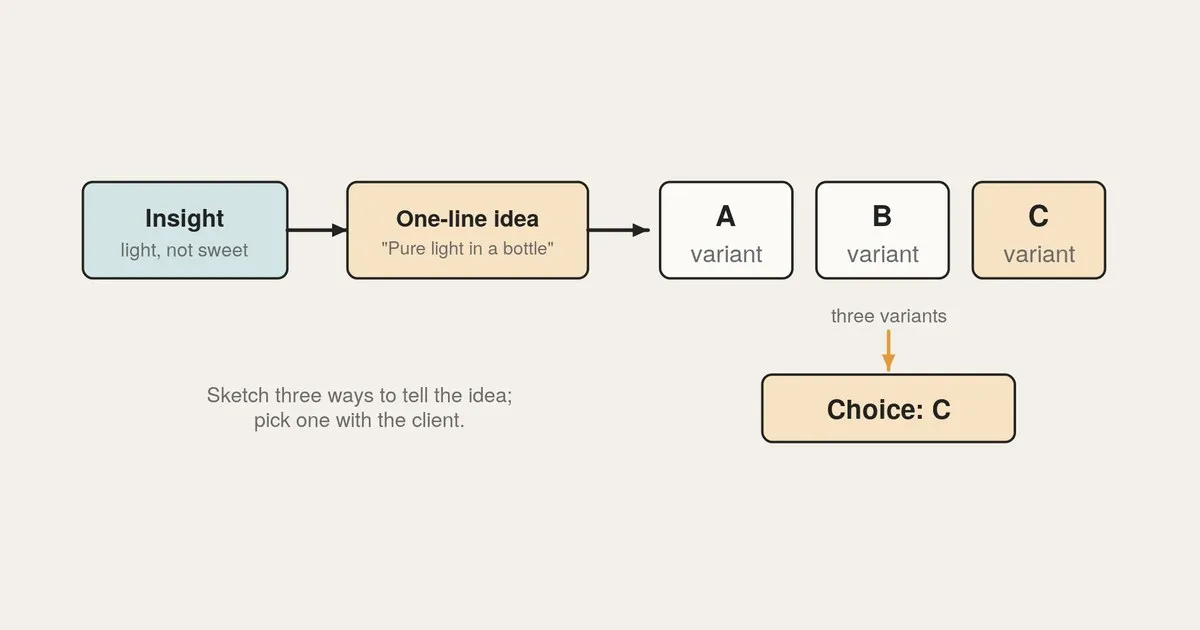
Before anyone pays for shots, they pay for an idea they can see in their heads. The treatment, style frames, storyboard and animatic are the tools that make a film visible before it is made. They win pitches, align a team, and protect you from the worst sentence in production: “that’s not what I imagined”.
Key points
- A good idea can be told in one sentence and in ten seconds.
- A treatment (3–10 pages) sells the film with words and images.
- Style frames show the final look before production starts.
- Storyboard, animatic and previs test the film cheaply.
Idea and Concept
- Insight: A truth about the product or the audience that makes the idea inevitable.
- One-line idea: A sentence that explains the film: “A single drop of juice builds a whole orchard around the bottle.”
- Variants: Develop three different directions; the client chooses with a clear contrast between them.
- Feasibility: Check each idea against time, budget and skill.
- The product is the hero: The concept must show the product clearly and in a way that serves the message.
- Test: Explain the film in 10 seconds without images; if you cannot, it is not ready.
The Treatment
A treatment is a short document (3–10 pages) that sells the film:
- Cover and title.
- Concept: The idea and why it fits the brief.
- Story and beats: What happens, shot by shot or beat by beat, in plain words.
- Look and feel: Lighting, materials, color palette, camera style, with references.
- Style frames: Two or three still images that show the look (below).
- Camera and motion: The grammar of the film.
- Music and sound: Direction and references.
- Technical approach: How it will be made: CG, simulation, live action; what is real and what is not.
- Deliverables and schedule.
- Budget: Often a separate document.
- Voice: Clear, concrete, confident; no jargon the client does not need.
- Length: Short. A client reads the first three pages.
Style Frames
- What: Finished-looking images (not the whole film) that fix the look: lighting, color, material, composition.
- How: Render one or two key frames in the final engine, or paint over a render; use the real product model if available.
- Number: Three is typical: the hero, a detail and a wide/environment.
- Honesty: A style frame must be achievable in the schedule. Do not promise what you cannot deliver.
- Style frames in the pitch: Spending time here has a direct effect on winning; but do not overspend on unpaid work (see below).
Storyboard, Animatic and Previs
- Storyboard: A sequence of drawings or frames showing each shot with camera, action and timing notes. Simple sketches are enough.
- Animatic: The storyboard edited with timing, music and rough sound; the first version of the film. Approve it before building.
- Previs: A rough 3D version (low-poly models, simple lights) used to test camera, timing and staging in space.
- Shot list: A table of shots with number, description, duration, camera, assets needed and complexity.
- Locking: Lock the animatic before final modeling and animation; changes after this stage are costly.
- Feedback: Show the animatic in context (with sound), never as separate stills.
- Tools: Pen and paper, Procreate, Blender Grease Pencil, Storyboarder, Premiere/Resolve for the animatic, a 3D viewport for previs.
Pitching
- Pitch: A presentation to win a project, often in competition with other studios.
- Structure: The client’s problem → your idea → how it looks → how you will make it → the price and schedule.
- Visuals first: Open with the best style frame.
- Be specific: A confident, precise plan wins over a long list of possibilities.
- Spec work: Unpaid creative work done to win a job. Decide in advance how much you will invest; ask for a pitch fee or limit your effort to a short deck and one style frame.
- Rights in pitches: Your pitch ideas and visuals remain yours unless the contract says otherwise; mark documents with your name and date, and agree on confidentiality before showing unfinished ideas.
- After the pitch: Ask for feedback even if you lose; it is the cheapest training available.
In the tools
- Documents: A deck in Keynote, Google Slides or a PDF; keep a master template.
- Boards and frames: Photoshop, Procreate or a render; keep layered files.
- Animatic: Resolve/Premiere with music and temporary sound.
- Previs: Blender or Unreal with low-quality settings.
Common mistakes
- A treatment that explains the technique instead of the idea.
- Style frames that cannot be reproduced in the schedule.
- Starting production before the animatic is locked.
- Giving away too much unpaid work.
- No confidentiality or ownership terms in a pitch.