Home / Journal / Cinematography
Grammar of the Frame: Coverage, Eyelines, the 180° Rule and Camera Movement
Rules for covering a scene: dialogue types, over-the-shoulder coverage, eyelines, stopping movement for dialogue, the 180° rule, camera moves.
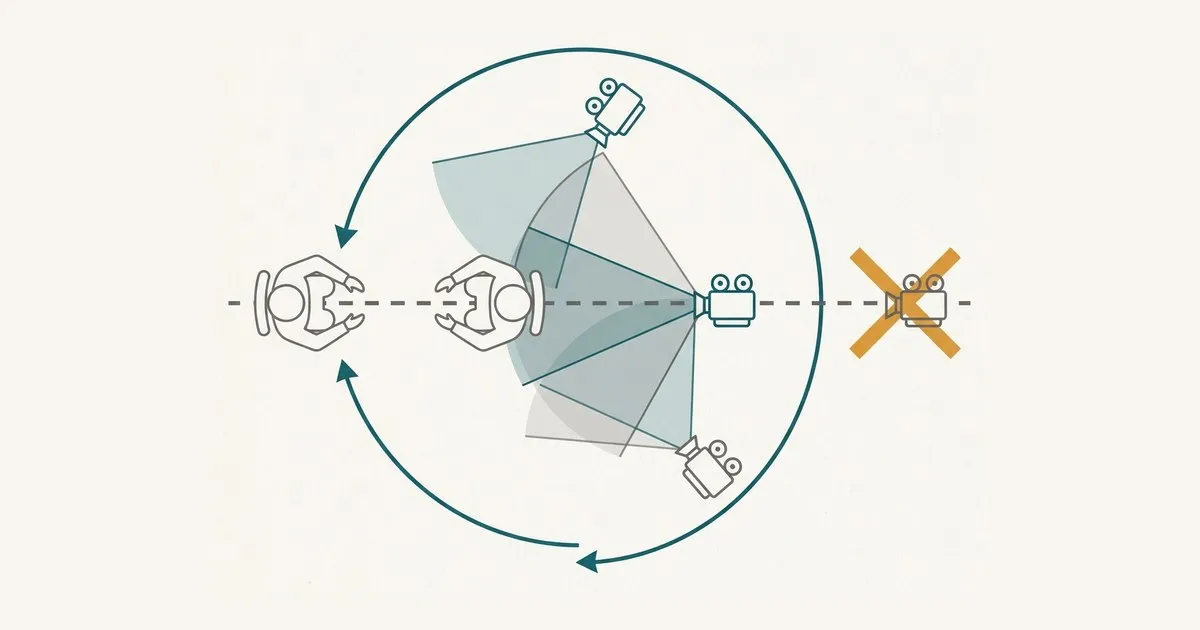
Coverage is how a scene is shot so that it can be cut: where cameras stand, who is looked at, and when the camera moves. This article gathers the grammar rules that keep a sequence clear and the movement motivated.
Key points
- Drama rests on action and the characters’ reactions to it. The listening actor is often the audience’s emotional anchor.
- Keep all cameras on the same side of the line of action (the 180° rule), and keep eyelines consistent across cuts.
- A move has three parts: a static hold, smooth movement, a clean static hold.
- Match tracking speed to the actor’s pace; let the actor start slightly before the camera, and the camera settle just before the actor stops.
- Do not move the camera across lines of dialogue unless the move is planned around the pauses.
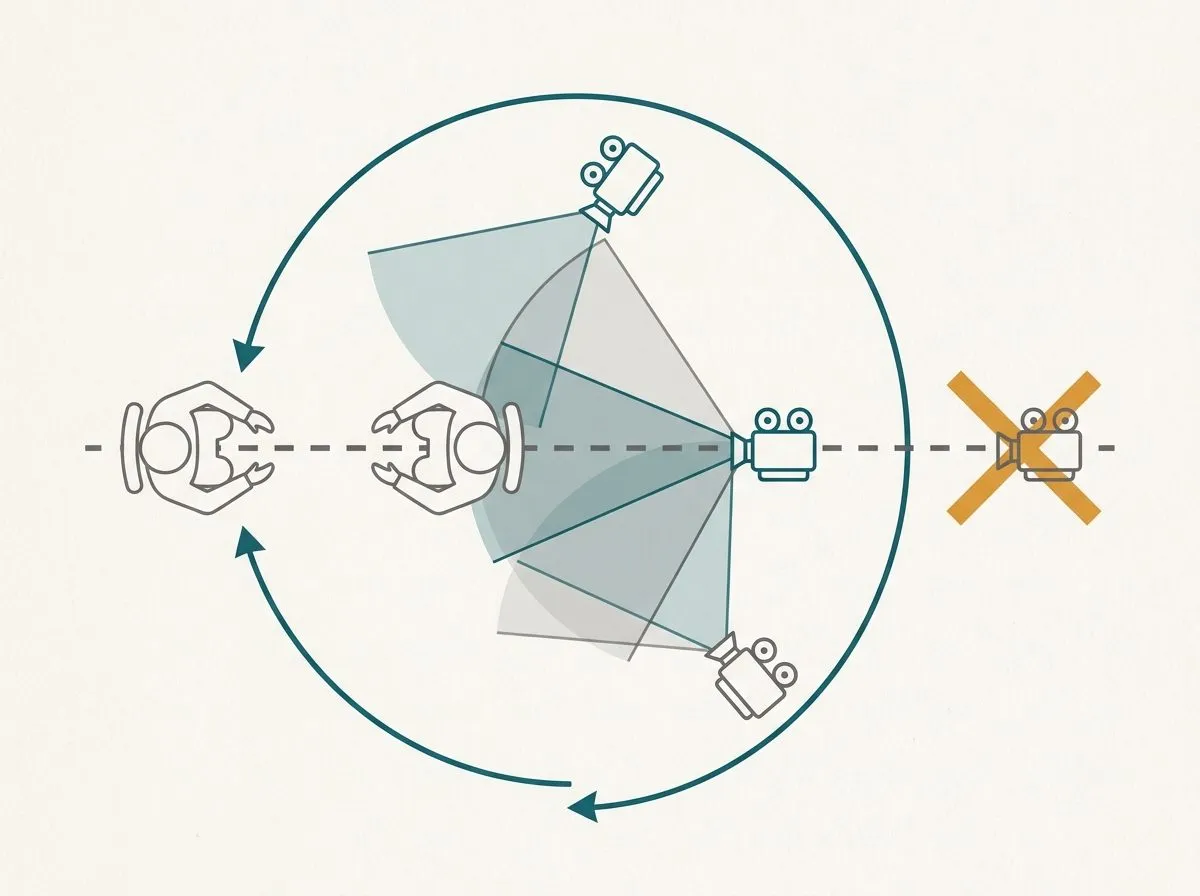
The 180-degree rule and coverage triangle
Scenes and screen space
Parallel editing, or cross-cutting, alternates between simultaneous lines of action and balances tight beats with wider atmospheric shots. When the audience learns what a character does not know, the result is dramatic irony and suspense. Three basic scene types exist: static dialogue, dynamic dialogue (dialogue integrated with movement) and pure action. A speaking character usually occupies roughly two thirds of the visual space, with the remaining third giving breathing room and context. While foreground actors stay still, movement in the background keeps the frame alive.
For over-the-shoulder coverage (shot and reverse shot), keep the foreground shoulder underexposed so that the fully lit face of the speaker across the axis is the focus.
Eyelines and staging
The actor’s eyeline decides where the camera goes within the coverage triangle. Acting to a real scene partner is more natural than to an empty mark behind the lens, and looking into the lens breaks immersion unless it is used deliberately. Match camera height to the actors’ eye level unless an elevated or lowered angle is needed to say something about status. Avoid sudden vertical crane moves during dialogue unless the drama motivates them. Keep eyelines consistent through cuts, especially in telephone conversations, where opposing look directions sell the connection.
For group dialogue, use a central anchor character to link spatial angles across cuts, balance standing characters against seated ones, and keep the spatial orientation of background characters consistent when you change coverage, to avoid disorientation.
Six ways to stop movement for dialogue
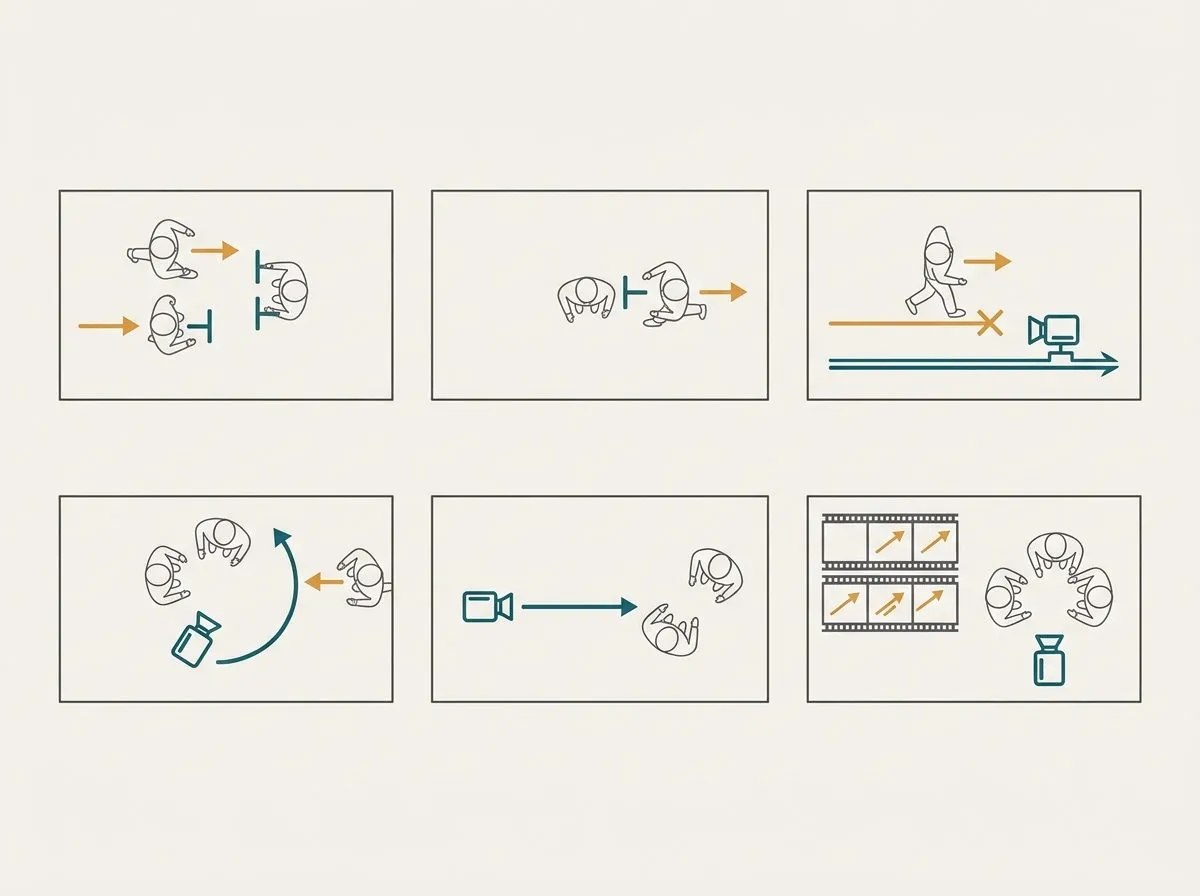
Six ways to bring movement to a stop
- Two characters enter, walk toward the camera and stop together before speaking.
- Character A is already in place; B walks in, stops beside them and begins.
- The camera tracks with a moving character to a natural mark, where actor and camera settle into a static frame.
- The camera pans with a moving character until a third enters, settling into a three-shot.
- The camera tracks away from an empty area to reveal the characters already in position.
- Moving coverage cuts into a static setup as the conversation starts.
Cutting and continuity
When several cameras cover continuous action, keep them all on the same side of the line of action. Cutting on action hides the edit by using the subject’s movement to bridge two angles. Always show a change of distance or perspective across a cut to avoid a jump cut. Screen motion is either toward or away from the camera, or lateral. Break complex tracking shots into spatial beats, and widen the frame slightly before an actor reaches the mark to anticipate arrival.
Rules for camera movement
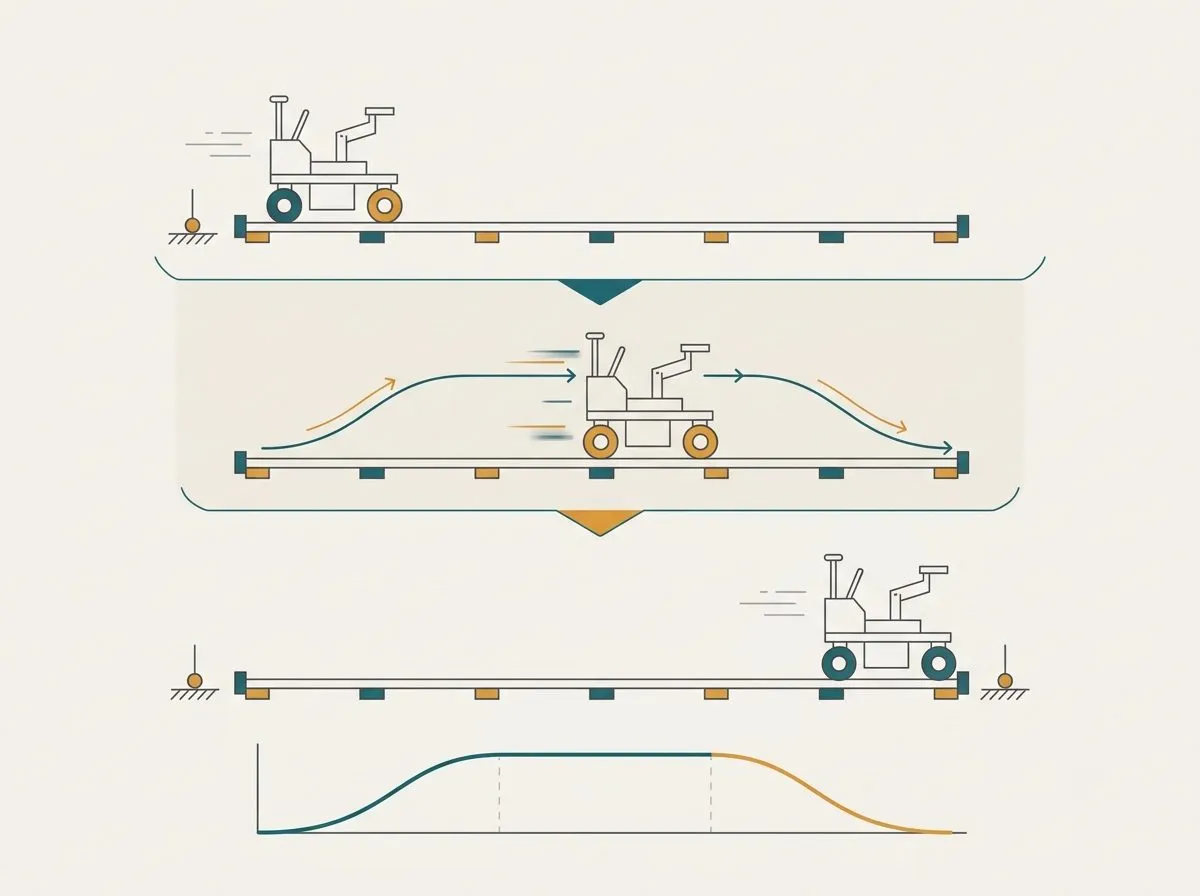
Three-part structure of a camera move
- A moving camera lets the audience share in the character’s movement through space.
- A subjective camera acts as the character’s eyes and draws the viewer into their emotional state.
- Pans and tracking shots can be objective, to establish, or subjective, to reveal what a character sees.
- Moves should build anticipation and end on an expected reveal or a deliberate surprise.
- Ending a moving shot on a sharp cut re-anchors attention on the next setup.
- Time entrances and exits to the start and end of moves.
- Structure every move as hold, movement, hold.
- When tracking a moving subject, keep them in the same part of the frame.
- Match tracking speed to the actor’s pace.
- Let the actor move slightly before the camera follows, and let the camera settle just before the actor stops. This preserves a natural sense of weight.
- Keep camera paths clean and geometrically simple; leave complex choreography to the actors.
- Use subtle moves to rebalance the composition as actors shift position.
- Moving backgrounds behind a stationary actor can simulate a vehicle or disorientation.
- Sweeping directional light across an actor simulates passing streetlights or travel.
- Coordinate moves with pauses in dialogue; moving across lines can muddy delivery.
- Accelerate and decelerate smoothly; abrupt speed changes look sloppy.
Further practical points: do not end a tracking shot with an obstruction against the lens; let an actor walk entirely out of frame before cutting to a static setup; shoot winding or erratic walking paths with smooth straight tracks; slow smooth push-ins heighten emotional focus; when tracking vehicles, start slightly wider and let the vehicle accelerate into position; circular moves isolate characters and emphasize intense emotion or romance; and an objective camera observes without favouring one character’s viewpoint.
Quick answers
What does the 180° rule protect? Screen direction: characters keep their left-right relationship across cuts.
Why start the actor before the camera? It gives the move a natural sense of weight and motivation.
How do I cover a long static dialogue? Break it with purposeful moves or cutaways so the visual rhythm stays alive.
Read next
- Composition in Film: Rules, Visual Weight, Shapes, Lines and Camera Angle
- Advice for the Cinematographer: Craft, Discipline and the Viewer’s Eye
- Colour, Geometry, Symmetry and Movement in the Film Frame
Related on this site
This article is part of the free handbook Technical Foundation. Filmmaking: The Cinematographer’s Handbook by Semen Klenov, an independent researcher of light and visual perception. Cite the handbook as: Klenov, S. (2026). Technical Foundation. Filmmaking: The Cinematographer’s Handbook. Zenodo. https://doi.org/10.5281/zenodo.24326083.