Personal Brand: a practical CGI guide
Your position fits in one sentence: what you do, for whom, with what edge.
In a field full of skilled people, the ones who are found, trusted and remembered get the better work. A personal brand is not a logo; it is the consistent answer to the question “who is this person and why should I care?” — built from a body of public work over years.
Key points
- Your position fits in one sentence: what you do, for whom, with what edge.
- Your own site is the hub; platforms link back to it.
- Use the same name, photo and style everywhere.
- Choose licenses before publishing; publish steadily, not in bursts.
What a Personal Brand Is
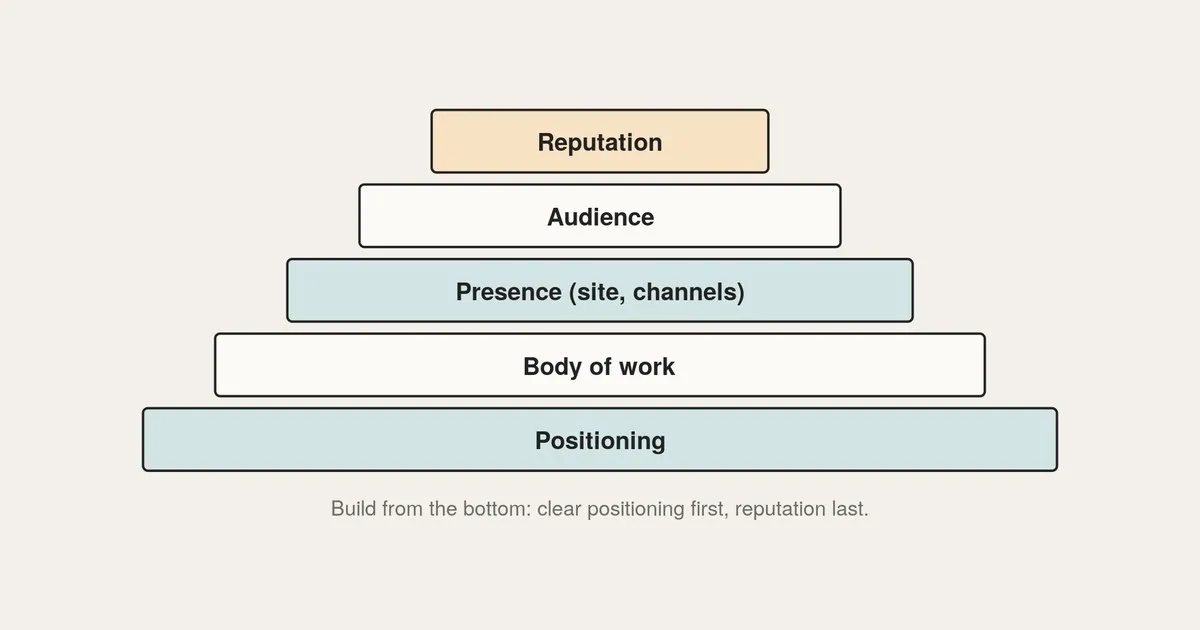
- Positioning: One clear sentence: what you do, for whom, with what edge (“procedural product CGI for beverage brands”).
- Body of work: The projects, tools, articles and teaching that prove the positioning.
- Presence: A website and a few channels where you are active and reachable.
- Audience: Clients, peers, employers and students who follow your work.
- Reputation: What others say about you when you are not in the room: reliability, taste, honesty.
- Consistency: Same name, same style of communication, same quality; reputation grows by repeated evidence.
- Authenticity: Real work and honest credit; invented achievements are found out.
The Foundation: Site and Identity
- Domain and site: A personal domain with your name; a fast, simple site with reel, projects, about, services and contact.
- Handles: The same name across platforms; short and spellable.
- Visual identity: A small system: logo or wordmark, typeface, palette; applied consistently to the site, reel title cards and documents.
- About page: Who you are, what you believe about the craft, what you are looking for; add a clear photo.
- Structured data and search: Good titles and descriptions, alt text for images, a sitemap so your work can be found.
- Ownership: Your site and mailing list belong to you; platforms change their rules and reach.
- Contact: A professional email on your domain, and a contact form or direct address.
Creating Public Work
- Breakdowns and process posts: Show how a shot was made; they teach, prove skill and attract the right clients.
- Writing: Articles, notes and tutorials explain your thinking; they build search visibility and authority.
- Video: Short clips and longer tutorials on YouTube and social platforms; consistent format and quality.
- Open-source tools and assets: Share a script, an HDA or a small asset pack with a clear license.
- Books and guides: A long text consolidates your knowledge and signals depth; publish a free edition with a version and a DOI to make it citable.
- Teaching: Workshops, lectures and mentoring; they sharpen your knowledge and widen your network.
- Competitions and festivals: Public recognition for excellence; choose those relevant to your field.
- Speaking and community: Local meet-ups, online communities, conferences.
- Cadence: A sustainable rhythm (for example, one meaningful post a week or two) beats bursts followed by silence.
- Quality filter: Publish only what you would be proud to have found in five years.
Distribution and Measurement
- Own the hub: Post the full piece on your site first, then adapt it for each platform with a link back.
- Platform fit: Short vertical video for discovery, longer video for depth, articles for search, professional networks for hiring.
- Newsletter or channel: A direct line to your audience that does not depend on an algorithm.
- Metrics: Track visits, plays, subscribers and, above all, inquiries and jobs; vanity numbers do not pay.
- Experiments: Try a format for a month, check the result, keep or drop.
- Licenses matter: open knowledge projects such as Wikimedia Commons accept only free licenses; a work under a non-commercial or no-derivatives license cannot be uploaded there, and AI-made images are often removed. Decide the license before publishing, and keep a separate set of assets under an open license if you want them reused.
- Notability: an encyclopedic entry about yourself needs independent sources (press or third-party publications), not your own pages; start by correcting facts in topics you know well.
- Ethics and honesty: Disclose sponsored content and AI-assisted work as required; do not copy others; credit sources.
- Privacy: Share work, not private details; separate personal and professional accounts where needed.
- Automation: Tools that publish one piece to several channels can save time; keep a human review before posting.
Case: The Author’s Public Base
- A home site: the author keeps one personal website with a portfolio page, a journal, a travel section, a research page and a book page. Everything else links back to it.
- Filmmaking* is a free electronic edition with a DOI on Zenodo (all-versions DOI 10.5281/zenodo.24325834, license CC BY-NC-ND 4.0), a page on the site (semenklenov.com/book) and a submission to Google Play Books as a free title.
- Channels: a video profile on Vimeo, a YouTube channel (@semenklenov), a Telegram channel (@klenovworld) and a professional profile on LinkedIn carry the same name and the same photo.
- Lesson: each publication links to the others; a citable DOI, a stable site and a free download form a base that others can reference.
- Next: Technical Foundation. CGI is built the same way: free, versioned, documented, and linked back to the site.
Note for the final edition: check the current status of each channel and platform listing before printing this section.
Long-Term Strategy
- One year: A reel, a site, three published breakdowns, first paid work.
- Three years: A recognized specialty, steady clients, a few public projects, a growing audience.
- Five years: A studio or a senior position, teaching or writing, a body of work that is cited and shared.
- Diversify income: Services, products (assets, tools, courses), education and, if appropriate, licensing and royalties.
- Reinvest: Time for learning and experimentation, money for hardware and software.
- Review: Once a quarter, look at work done, income, energy and direction.
- Sustainability: Rest, health and relationships support a long career.
- Give back: Teach, share and mentor; a field grows when its members help each other.
In the tools
- Site: A static site or a portfolio platform with a custom domain.
- Publishing: Markdown for articles, a video editor for clips, scheduling tools for posts; analytics on your own site.
- Archive: Keep source files, a log of publications and a list of sources.
- Identity assets: A folder with logos, fonts, bio texts and photos ready for requests.
Common mistakes
- Several different names and styles across platforms.
- Posting only finished glamour shots, never process.
- Chasing followers rather than clients and peers.
- Stopping after a month.
- Giving all content to platforms and keeping no site or list.