Freelance and Studio: a practical CGI guide
Rate = (desired income + business costs) ÷ (1 − tax rate) ÷ billable hours.
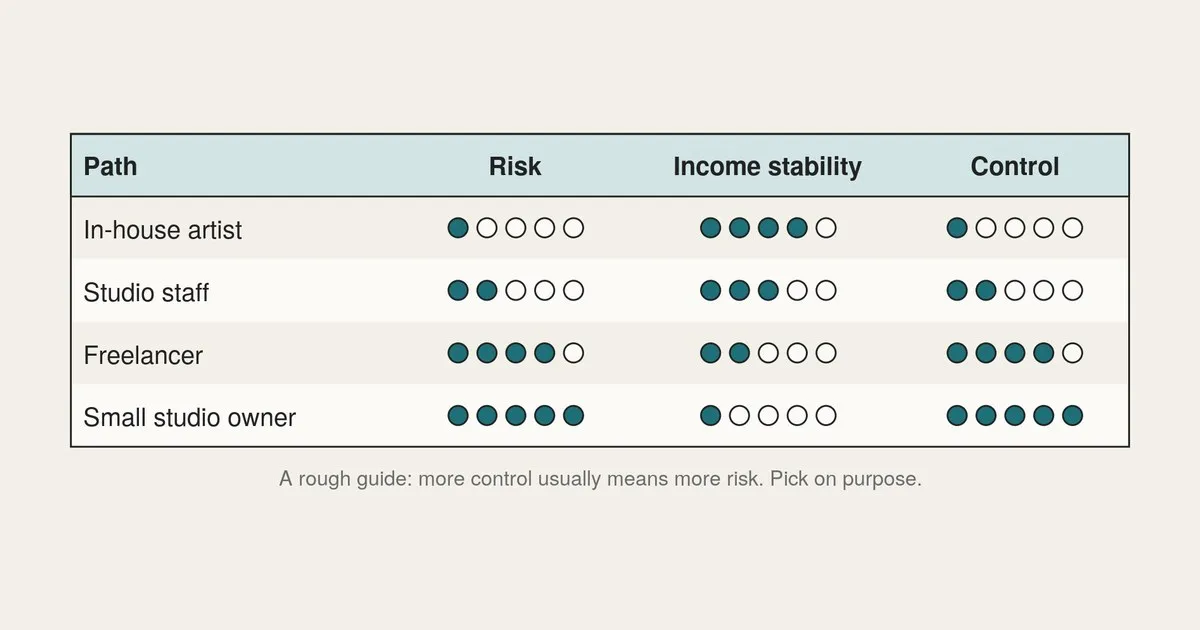
Many CG artists work independently for part or all of their careers, and some start a studio. Both require something the craft never taught: how to price, find clients, get paid, protect your time and decide who you work for. The numbers matter because a price that is too low can destroy a career slowly and silently.
Key points
- Rate = (desired income + business costs) ÷ (1 − tax rate) ÷ billable hours.
- Only about 50–60 % of working time is billable.
- Trade scope, not price; never start without a contract and a deposit.
- Raise rates as skills grow.
The Paths
- In-house (brand or agency): Stable salary, one type of work, limited variety.
- Studio staff: Large pipelines and specialization, mentorship, credit on big projects.
- Freelancer: Control and variety; income and work are uncertain; you do the business yourself.
- Small studio: A name, a team and bigger projects; more responsibility, overhead and risk.
- Hybrid: Staff or study plus freelance on the side, remote employment for foreign companies; an effective way to build a reel and savings.
- Choose by situation: Savings, location, family, goals and tolerance for uncertainty; paths can change.
Pricing: How to Calculate a Rate
- Idea: Your rate must cover your living income, business costs, taxes and unpaid time (finding clients, admin, learning, vacations, sick days).
- Formula:
rate = (desired net income + business costs) ÷ (1 − tax rate) ÷ billable hours. - Billable hours: Only about 50–60 % of working time is billable.
- Illustrative example (numbers are invented for demonstration; use your own currency and local tax rules):
- Desired net income: 36,000 per year; business costs (hardware, software, internet, accountant): 6,000.
- Tax rate: 20 %.
- Gross needed:
(36,000 + 6,000) ÷ (1 − 0.20) = 52,500. - Billable hours: 48 weeks × 40 h × 55 % = 1,056 h.
- Rate:
52,500 ÷ 1,056 ≈ 49.7per hour.
- Day rate: Often 6–8 billable hours; used in production and studio work.
- Project price: Estimated hours × rate + render and license costs + contingency. Quote projects when you can estimate; hourly or daily when scope is unknown.
- Value: Prices also reflect the value to the client: a hero film for a global launch is worth more than the same hours of an internal presentation.
- Different rates: Rush work, complex work, usage rights and exclusivity cost more.
- Raise rates: Review prices every year or after each major skill gain; new clients pay the new rate.
Finding and Keeping Clients
- Portfolio and reel come first.
- Sources of work: Direct outreach to brands, agencies and producers; referrals from past clients; platforms and job boards; communities; studios that need overflow help; open-source and educational content that attracts clients.
- Outreach: A short email with one relevant piece of work and a clear offer; follow up once.
- Qualify: Ask about deliverables, budget, timeline and decision makers; skip clients who will not pay or will not decide.
- Retention: Deliver on time, communicate clearly, offer improvements, and keep in touch between projects.
- Recurring work: Packshot libraries, content series and retainers give stable income.
- Referrals: Ask satisfied clients to recommend you; give clear descriptions of the work you want.
- Say no: To projects with unclear scope, unpaid “tests”, or ratios that destroy your schedule.
Negotiation
- Know your walk-away point before talking.
- Trade, don’t discount: Change scope, rounds, schedule or usage rights rather than just lowering the price.
- Anchor: Quote the full value first; options help (basic, standard, premium packages).
- Listen: Find out what matters to them (speed, quality, risk).
- Written confirmation: Summarize agreements by email.
- Handling a low budget: Offer a reduced scope or a simpler look; do not offer the same work for less.
- Late changes: State the impact on price and time; use a change order.
Working with International Clients and Remote Teams
- Time zones: Agree on overlapping hours and response times.
- Language and communication: Clear written updates with images; a short call for complex feedback; summaries after calls.
- Contracts and payments: Agree on the currency, who pays the fees, payment method and deadlines; use deposits and milestones.
- Security: Protect client files; use strong passwords, two-factor authentication, encrypted backups, and delete data as agreed.
- Cultural differences: Style of feedback, decision speed and formality differ; ask and adapt.
- Location: Local tax and registration rules matter for foreign income and for hiring from abroad; consult an accountant familiar with international work.
Running a Small Studio
- Identity: A name, a website, a reel, a simple brand.
- Structure: The legal form depends on the country; consider liability, taxes and contracts.
- Team: A core of one or two people plus trusted freelancers; clear rules for roles, credit and pay.
- Pipeline and templates: The same folder structure, naming, versions and publish steps for every project.
- Finance: Separate business and personal accounts; track income and expenses; invoice promptly; set aside money for taxes; keep a reserve of several months.
- Equipment and software: Plan upgrades, licenses and render costs.
- Insurance: Equipment, professional liability and health coverage, as appropriate to the country.
- Growth: Add people only when there is steady work; grow by specialty, not by taking all work.
- Health: Avoid permanent crunch, rest between projects, and treat sustainability as part of the business model.
In the tools
- Documents: Contract and invoice templates, a pricing sheet, a project tracker.
- Finance: A spreadsheet or accounting software for invoices, expenses and taxes.
- CRM: A simple list or board of leads, clients and follow-ups.
- Security: Password manager, backups and encrypted storage.
Common mistakes
- Pricing by the hour you work, not the hours you need to live.
- Working without a contract or deposit.
- Discounting without changing the scope.
- Never raising prices.
- Mixing business and personal finances.