Cloth and Soft Bodies: a practical CGI guide
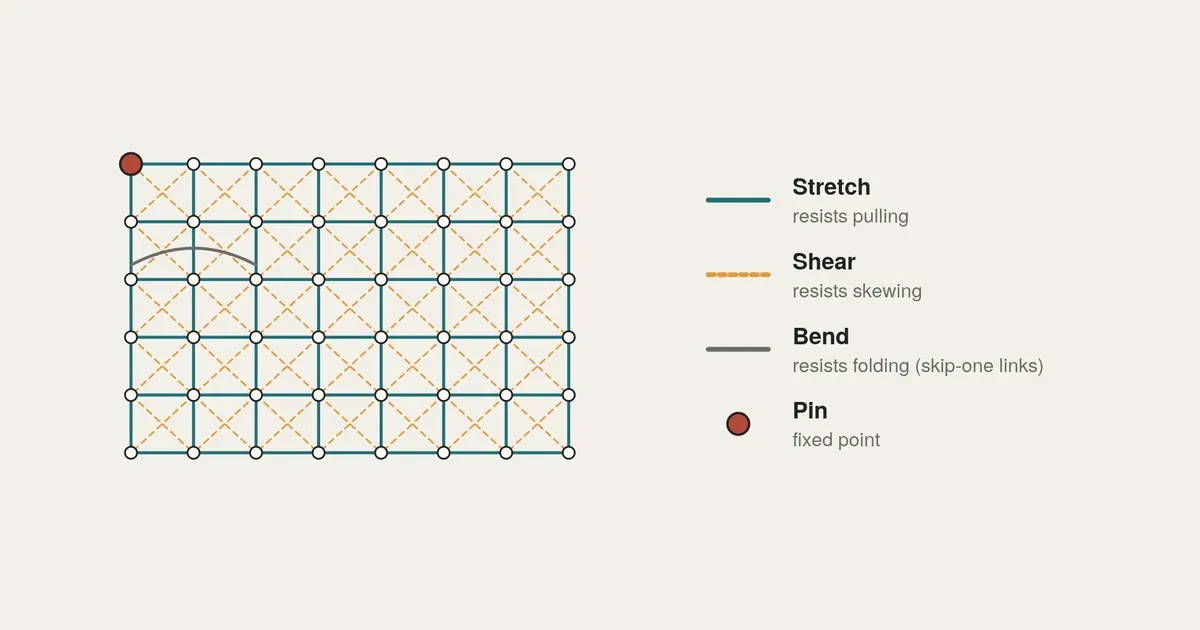
Cloth and soft bodies are points held together by constraints (distance, bend, pressure).
Silk behind a perfume bottle, a ribbon unfurling, a balloon-like pillow, gummy candies bouncing, a pile of cereal: advertising loves soft things because they signal softness, indulgence and comfort. They are also hard to animate by hand. A constraint-based solver handles them all with one idea.
Key points
- Cloth and soft bodies are points held together by constraints (distance, bend, pressure).
- Fabric weight in g/m² guides mass and stiffness: silk 20–60, cotton shirt 100–150, denim 300–450.
- Start without intersections and with the cloth slightly above the collider.
- Stability comes from substeps and constraint iterations, not from luck.
The Constraint Idea
- Particles and constraints: A soft object is a set of points connected by constraints that hold distances or angles.
- Cloth constraints: Stretch (distance along edges), bend (angle across edges), shear (diagonal).
- Solver iterations and substeps: How many times constraints are solved per step. More iterations = stiffer, more stable, slower.
- Mass and density: Heavier cloth hangs and drapes; light fabric floats.
- Damping: Removes unwanted jitter; too much makes motion look underwater.
- Gravity and wind: Force fields shape the move.
- Real scale: A shirt is ~0.5 m wide, not 50; fabric stiffness and mass are scale-dependent.
Vellum (Houdini)
- Vellum: A unified soft-body solver in Houdini that handles cloth, hair, rope, balloons, grains and tearing with the same engine.
- Configure nodes: Vellum Configure Cloth, Hair, Balloon, Grains, Strut — they add the proper constraints.
- Typical uses:
- Cloth: Silk, flags, towels, dresses, curtains.
- Pressure (balloon): Inflated shapes, soft packaging, pillows, bags of chips.
- Grains: Sand, sugar, rice, cereal and spilled pills as colliding spheres.
- Strut/hair: Ribbons, strings, cables, rope, strands.
- Glue and tear: Breakable seams, torn paper, ripped fabric.
- Pin constraints: Hold points to a collider or animated geometry (a flag fixed to a pole).
- Collision settings: Thickness (the distance at which collisions occur) and friction control slipping and stuck cloth.
- Meshing: For rendering, grains are often replaced by instanced geometry.
Blender Equivalents
- Cloth physics: Physics → Cloth with presets (silk, cotton, leather); Pin Group for fixed areas; Quality Steps for stability; Collision settings on colliders.
- Soft Body: Elastic deformation for jelly-like objects; Goal and Edges settings.
- Pressure: Cloth → Pressure for inflatables.
- Geometry Nodes simulation zones: Custom soft-body and grain systems.
- Third-party tools: Add-ons exist for advanced grains and fluid-like effects; check quality before relying on them.
- Limits: Complex multi-layer cloth and tearing are easier in Houdini.
Setup and Stability
- Resolution: Enough points that folds read; too many is slow and unstable. Remesh uniformly.
- Start from a clean state: No intersecting geometry at frame 1; start the cloth above the product and let it fall.
- Pre-roll: Run the simulation before the shot starts to settle, then start the render when it is calm.
- Colliders: Use a simplified, slightly inflated proxy for the product; avoid sharp edges that catch cloth.
- Pin and animate: Drive the cloth with animated pinned points (a hand pulling a cloth off a bottle).
- Art direction: Cloth needs shape: choose where folds occur by the initial pose, pins and wind direction.
- Common failures: Explosion (too-large timestep), jitter (not enough iterations), cloth passing through the collider (thin collider or fast move), over-stiff “plastic” look (wrong bend values).
Fabric in numbers. Cloth is described by its weight per square meter, which helps you choose mass and stiffness: light silk 20–60 g/m², shirt cotton 100–150 g/m², heavy cotton or linen 200–300 g/m², denim 300–450 g/m². Thin, light fabrics fold into many small wrinkles; heavy ones into a few large folds.
Soft Products in Advertising
- Fabric reveal: Silk pulled away to reveal the product.
- Ribbons and gift wrap: Struts and cloth with animated pins.
- Pillows, bags and inflatables: Pressure solver with a slight mesh smoothing.
- Food and confectionery: Gummy candies (soft bodies), cereal (grains), powder and sprinkles.
- Hair and fur: A specialized topic.
- Lookdev: Cloth shading needs sheen and weave scale.
In the tools
- Houdini: Vellum Configure, Vellum Constraints, Vellum Solver, Vellum Pin to Target, Vellum Post-Process, File Cache after the solver, and Remesh before it.
- Blender: Cloth modifier and cache bake (Bake button), Collision modifier, Pressure, Shrinkwrap to settle on a surface.
- Cache: Bake to disk; never render from a live simulation.
Common mistakes
- Too few iterations: stretchy, rubbery cloth.
- Cloth starting inside the collider.
- Simulating at the wrong scale.
- No pre-roll: the first seconds twitch.
- Rendering without a cache.