Home / Journal / Cinematography
Building a Lighting Setup: Fill, Backlight, Kicker, Eye Light, Background
How to build a lighting setup after the key: fill ratios, backlight and rim, silhouettes, kickers, eye lights, background light, side light and cross lighting.
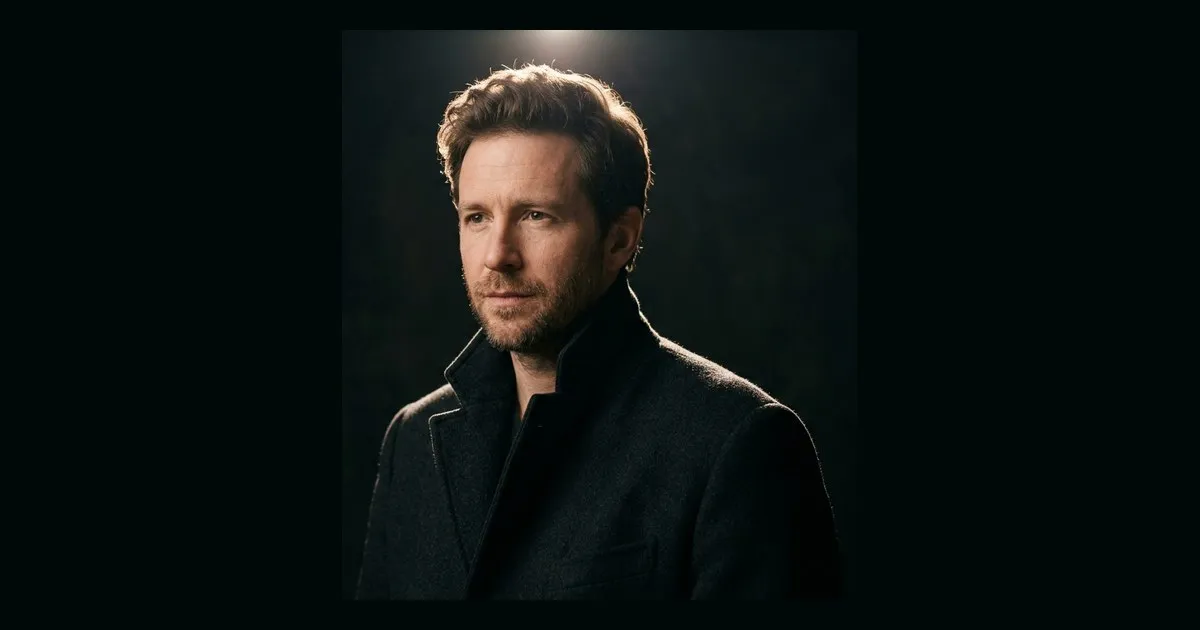
Once the key is set, the rest of the setup decides depth, separation and mood. This article goes through each added light in the order a crew would build it: fill, backlight, kicker, eye light and background, then the arrangements of side light, cross lighting and bounce.
Key points
- Fill opens shadow detail without competing with the key. Key-to-fill ratios run from about 1.5:1 (low contrast) to 4:1 (dramatic).
- Backlight and rim light separate the subject from the background. It should cover the actor’s path so the rim does not flicker on and off.
- A kicker, behind the subject at three-quarters, skims the cheek and jaw.
- The Obie light, designed by Lucien Ballard in the 1930s for Merle Oberon, is a small light near the lens that puts a catchlight in the eyes.
- Background luminance should sit slightly below the key exposure on the face, so that talent stays distinct from the set.
Fill
Fill raises the base exposure in shadow areas without creating a second shadow. It should be non-directional, feather into the key shadows and stay below the key in intensity. A fill as strong as the key creates ugly double nose shadows, and unbalanced frontal light flattens the volume. Fill goes near the camera axis, where it lights the shadows the lens can see, and it must stay subordinate to the motivated source so that window or practical light remains believable. The ratio is checked with an incident meter. A soft fill, bounced or diffused, lifts shadows with no visible edge. Big HMIs bounced into overhead frames give natural fill for deep exterior shadows in bright sun, and a slight blue-cyan tint imitates cool sky fill.
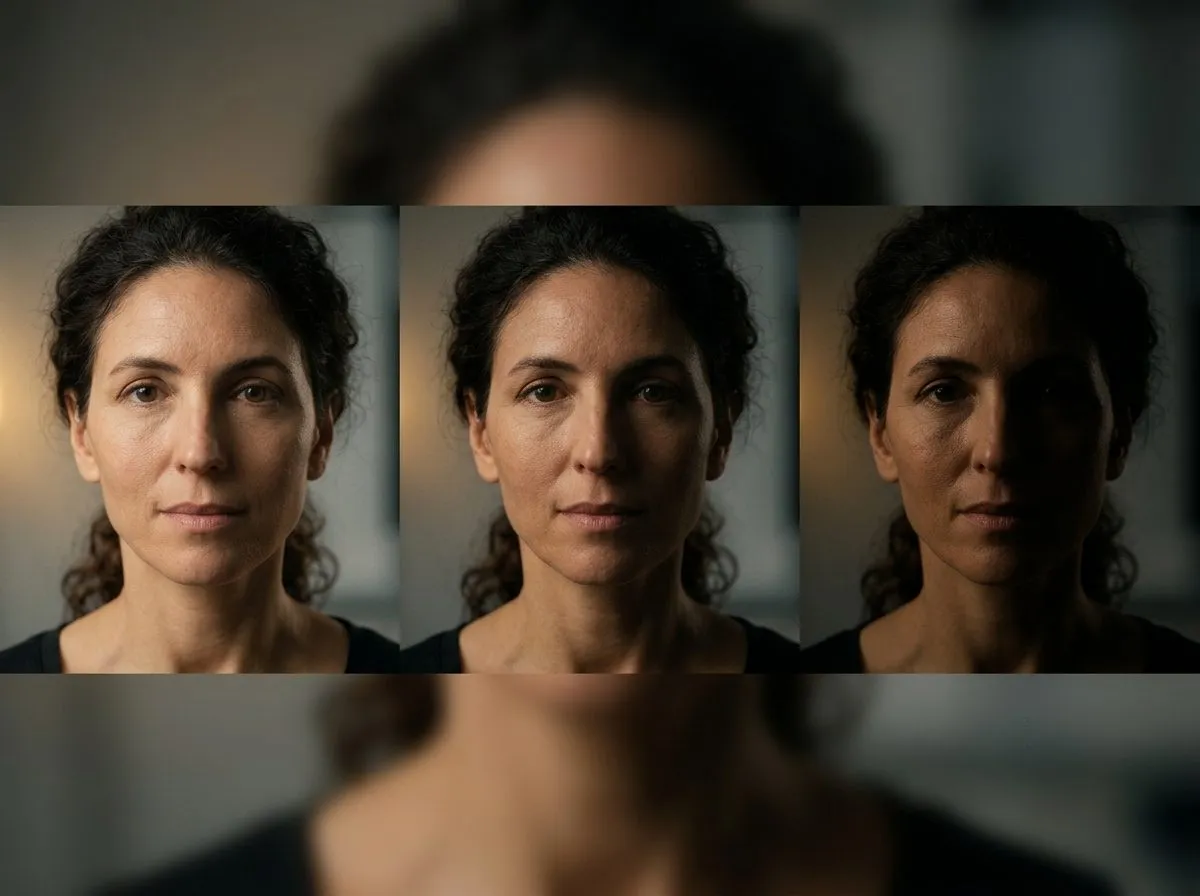
Key-to-fill ratios
Backlight, rim light and silhouettes
A backlight traces hair and shoulders with a thin edge of light, separating talent from a dark background. It sits high and behind the actor, aimed at the camera, and it is measured alone with the key off to avoid false readings. A rim light is brighter than the background behind it, adds the feel of depth and separates similar tones. Outdoors, the sun is often the natural backlight.
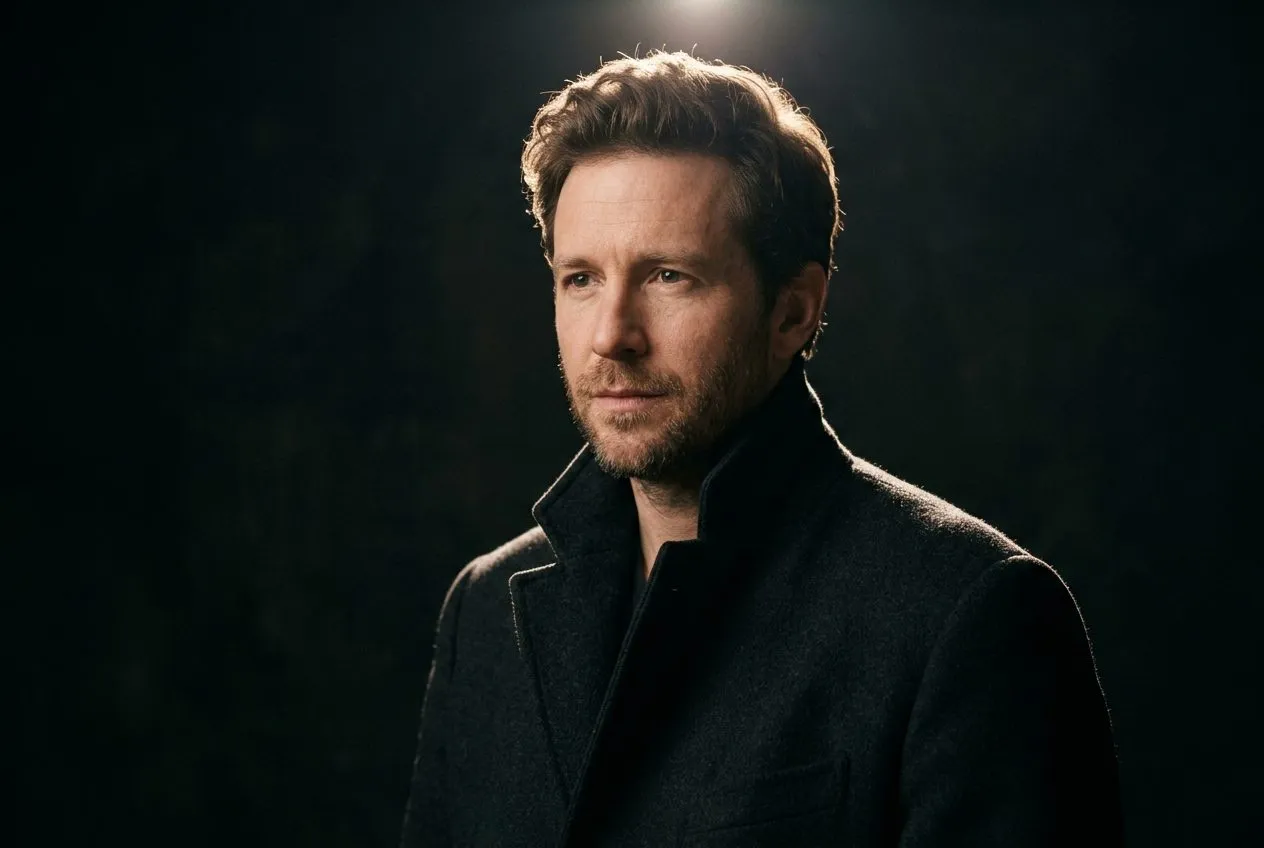
Backlight separating the subject
Practical points: cover the actor’s whole path; if they step between unlinked pools, the rim flickers; if they step out into the dark, separation vanishes abruptly. Adjust power to hair colour and wardrobe, more for dark hair and less for blonde. If a backlight is stronger than the frontal key, form shadows spill toward the camera, and a high backlight can throw a chin shadow on the chest. Keep the light from striking the front element of the lens.
A silhouette is made by turning off all frontal light and washing the background evenly. It suggests danger, mystery or anonymity.
Kicker and eye light
The kicker stands behind the subject at three-quarters and skims the cheekbone. A snoot or barn doors keep spill off the nose. It can be on the key side or the shadow side, and hair must be dressed so it does not block the light. Hard kickers convey toughness and tension, soft kickers romance and gentleness.
The eye light is a compact, low-power fixture near the lens axis that makes a reflection in the pupils. The Obie smooths facial imperfections and gives radiant catchlights. Outdoors, a small fill or a silver bounce card makes catchlights in deep shade. A micro-fixture such as a Dedolight with a snoot can light the eyes only, and it helps actors with deep-set eyes.
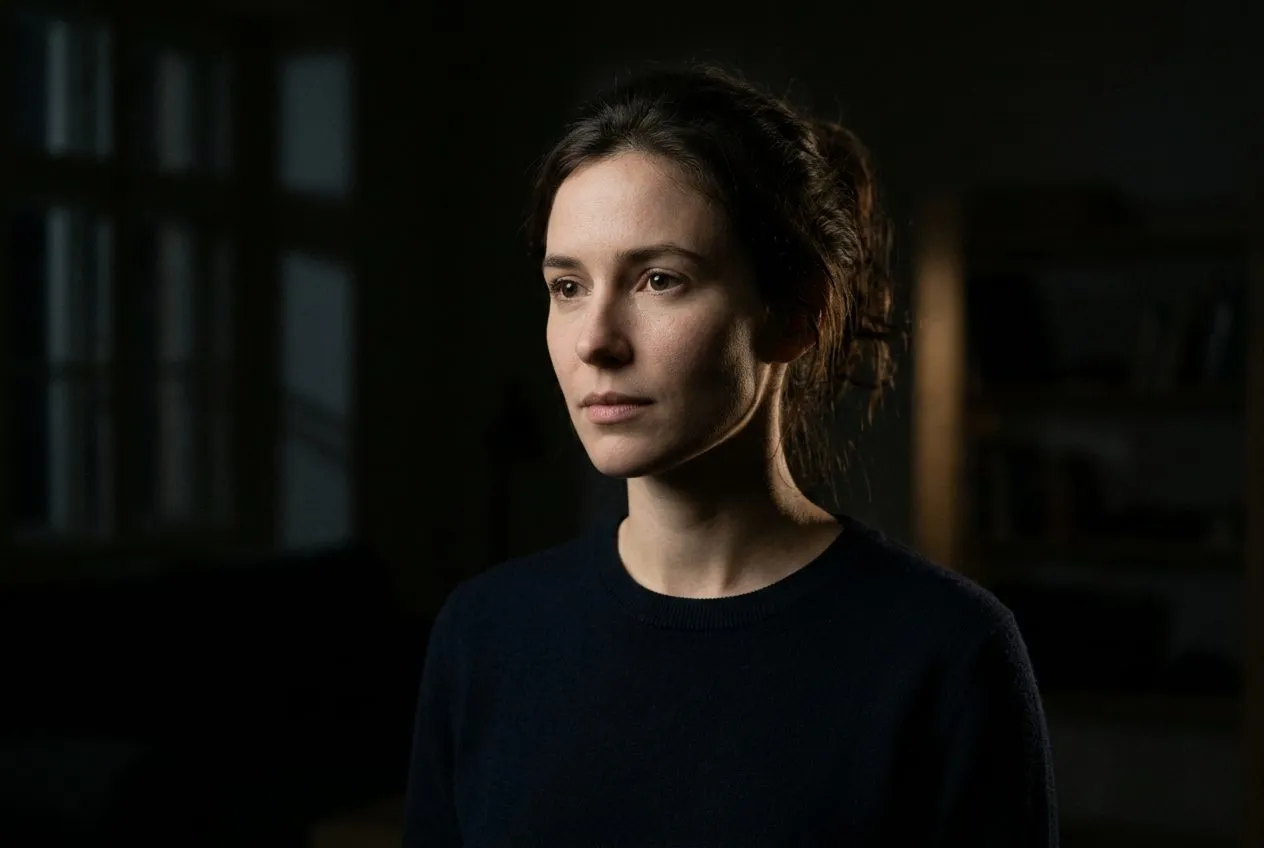
Kicker sculpting the cheek and jaw
Background light
Background light is mounted overhead or hidden on the floor and aimed across the set at walls and architecture. Wall light should follow the direction of the scene’s motivated source and stay consistent across coverage angles. In night scenes it is often kept low to concentrate attention on foreground characters, and changes in its level or colour can signal the time of day. Break up flat washes with cookies, branches or window frames. Tint backgrounds slightly cool or warm for depth, and use edge silhouettes to peel subjects off a monochrome wall. Outdoors the lamps must be strong enough to balance daylight.
Side light, cross lighting and tonal lighting
Side light comes at 90° to the lens axis and emphasizes texture and shape, while frontal light flattens. In a long corridor, side light through doors and windows at different heights creates rhythmic pools of light. Cross-quarter lighting, front-diagonal and rear-diagonal, sculpts faces. Tonal lighting is low-contrast, with smooth gradations: soft key near the lens axis, light wardrobe and a softly lit bright background.
Cross lighting uses two opposing side lights, each keying one actor and rimming the other, which suits over-the-shoulder dialogue. Soften the light on the faces and net down the foreground shoulder.
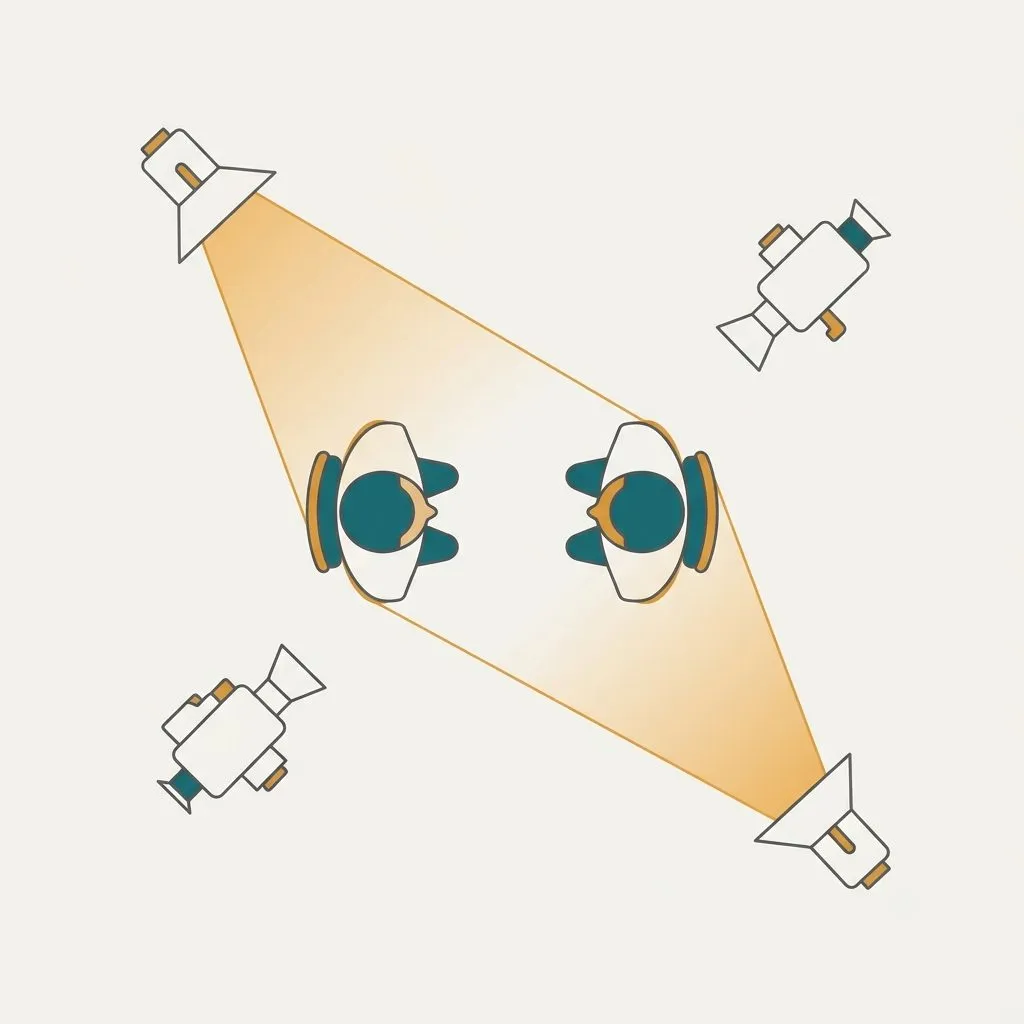
Cross lighting two actors in dialogue
Bounce, motivated and effect light
Bounce from foamcore, beadboard, muslin or umbrellas gives soft, shadowless wrap. Two large white surfaces on both sides of talent flatter mature skin. Motivated light appears to come from a visible source, with intensity and colour matched to it. Effect light is stylized, for dramatic rather than naturalistic purposes. Bounce from a coloured wall without context can look like an exposure error.
Quick answers
How strong should fill be? Weaker than the key. A typical key-to-fill ratio is between 1.5:1 and 4:1.
What is a rim light for? To separate the subject from the background with a bright edge.
What does a catchlight do? It gives the eyes a spark of life and keeps deep-set eyes from falling into shadow.
Read next
- Key Light Principles: Hard vs Soft, High-Key vs Low-Key Lighting
- Lighting Faces: Rembrandt, Short and Broad Light, Fresnel vs Softbox
- Lighting Exteriors and Interiors: Daylight, Windows, Shadows and Texture
Related on this site
This article is part of the free handbook Technical Foundation. Filmmaking: The Cinematographer’s Handbook by Semen Klenov, an independent researcher of light and visual perception. Cite the handbook as: Klenov, S. (2026). Technical Foundation. Filmmaking: The Cinematographer’s Handbook. Zenodo. https://doi.org/10.5281/zenodo.24326083.