Home / Journal / Cinematography
Lighting Exteriors and Interiors: Daylight, Windows, Shadows and Texture
Sun angles, changing daylight, balancing window light with interior lamps, shooting through doorways and how shadows, highlights and raking light shape texture.
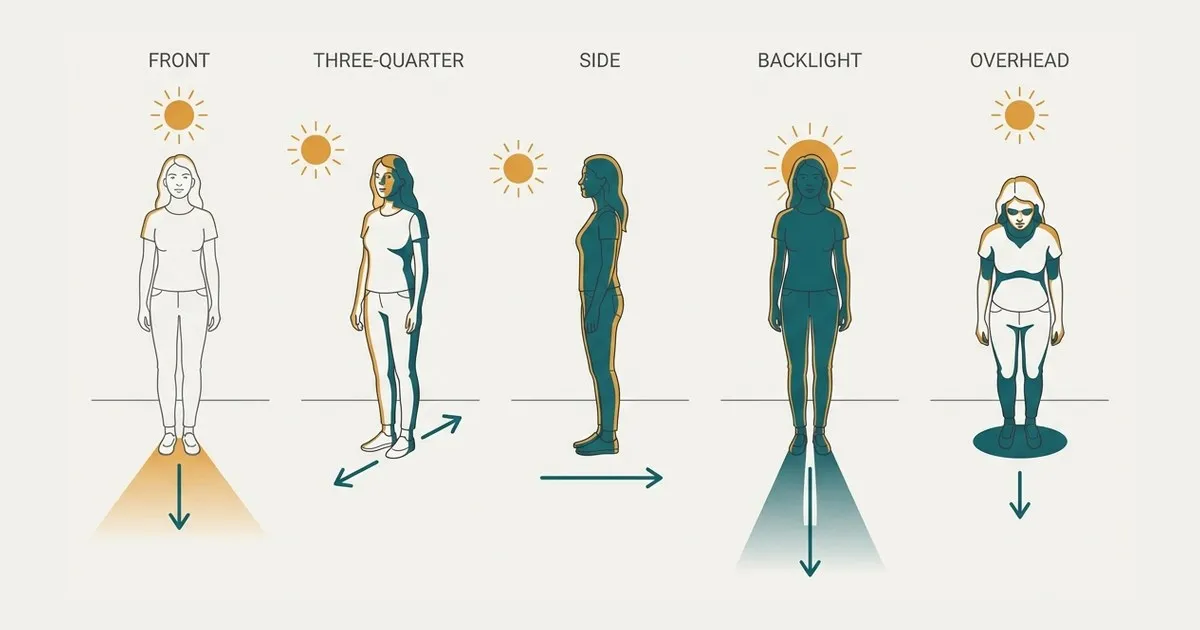
Daylight is the largest light on any exterior and the biggest problem on any interior with a window. This article describes the angles of the sun, the way daylight changes, how to balance windows against room lamps, and how shadows, highlights and texture respond to the direction of light.
Key points
- Sunlit scenes have two components: hard direct sunlight and soft skylight that fills the shadows.
- Frontal sun flattens; three-quarter sun sculpts; backlit sun rims the hair and leaves the face in open shade, a standard for exterior dialogue; overhead sun puts shadows in the eye sockets.
- Gel windows with CTO (full, ½ or ¼) to warm daylight to the room, or gel the room lamps with CTB to match daylight.
- Seen through a doorway, the adjacent room’s wall is set at the foreground level for day scenes and 1–2 stops lower for night.
- Grazing, low-angle hard light brings out texture; frontal light erases it.
Sun angles
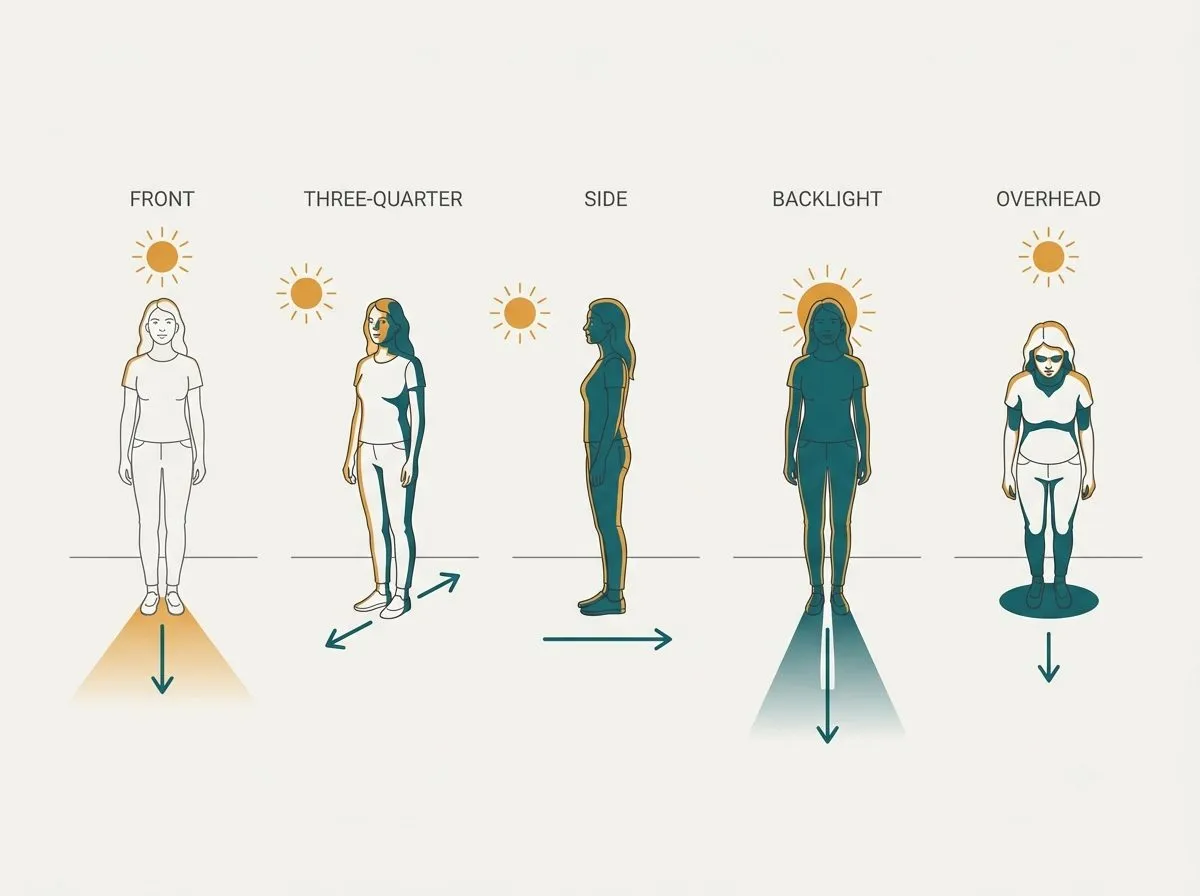
Sun angles and their effect
Frontal sun flattens facial contours and gives a low-contrast, two-dimensional look. Diagonal (three-quarter) sun sculpts faces and landscapes. Side sun lights half the subject and throws long shadows, good for landscape and harsh for portraits. Backlit sun outlines hair and shoulders and leaves the face in smooth shade. Overhead sun at midday casts shadows into the eye sockets and under the nose. A low sun at dawn and dusk gives long raking shadows, warm colour and rich texture. At high noon, contrast can exceed the camera’s dynamic range. At twilight, directional light fades and leaves cool soft skylight.
Changing daylight
Shadows receive only skylight and ground bounce, so on a clear day they take a cool blue cast, while under heavy overcast they turn soft, neutral grey. A low sun lengthens the atmospheric path and shifts the direct beam to orange and red. Thin high cirrus acts as a giant diffusion frame: it softens the sun but keeps its direction. Broken cumulus adds fill through horizontal bounce. Light haze scatters the beam and softens contrast. Dense cloud lowers both illuminance and contrast. Intensity, angle and colour move all day, so a long exterior scene needs continual checking.
Shadows and highlights
Form shadows belong to the object and define its volume. Cast shadows fall on other surfaces, and their length and sharpness tell the viewer where the source is, how far and how large. Outdoors, open shadows lit by the full dome of sky are soft and cool; semi-enclosed shadows, in alleys and courtyards, get only overhead skylight and are deeper; deep shadows, under arches or in basements, are almost dark.
Highlights reveal polish and material. Polished wood, chrome and wet surfaces give specular highlights that take the colour of the light source. Too much glare hides texture and form, while perfectly flat light robs surfaces of sheen. To tame highlights, change the camera angle or light position, feather the light or diffuse it, or use a polarizing filter on non-metallic surfaces.
Texture
To bring out coarse texture, stone, masonry, weathered skin or rough cloth, skim the surface with hard light from a low grazing angle. It casts micro-shadows behind each irregularity. Frontal light fills them in and washes out detail. For glossy surfaces use broad diffused sources instead of bare bulbs. A mirror is shown clearly by lighting the objects in front of it, so that their reflection defines the glass.
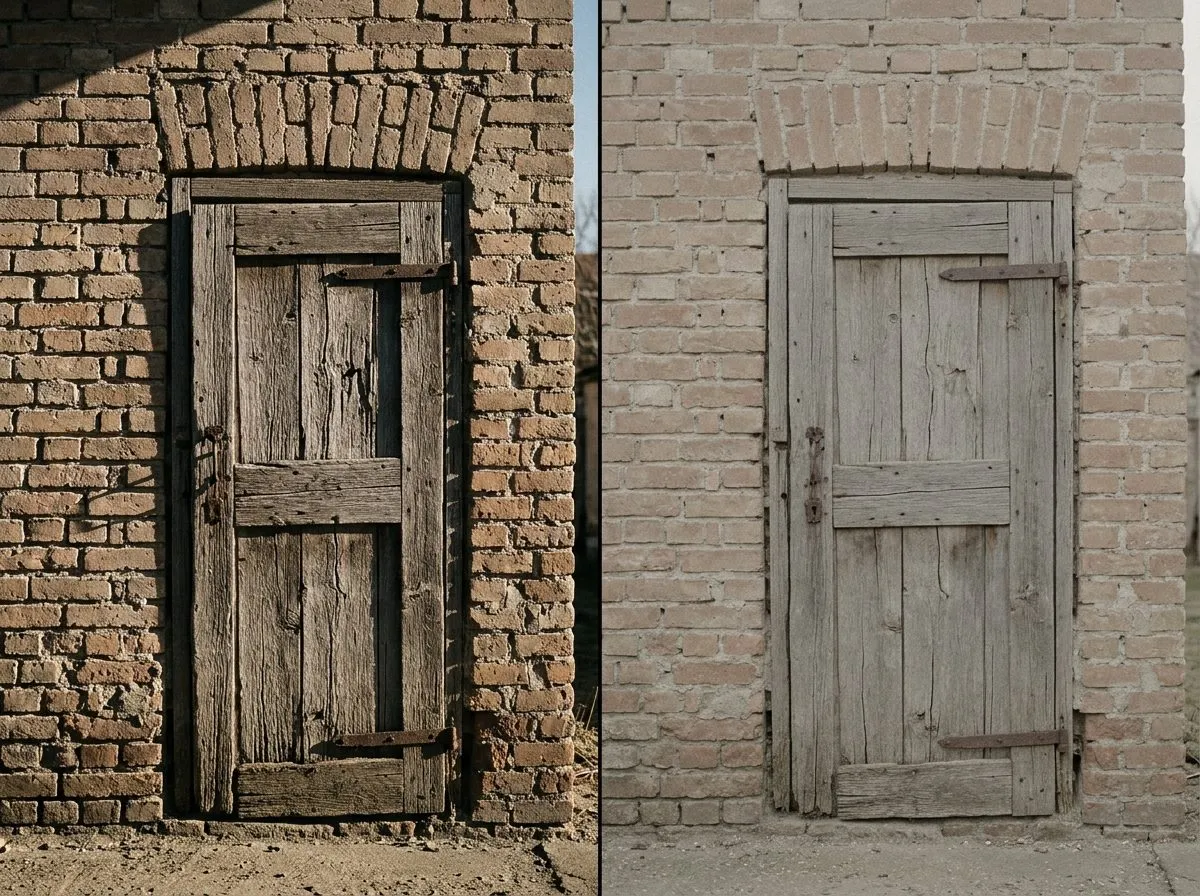
Raking light vs. frontal light on texture
Interiors
The aim is to keep the natural tonal and colour atmosphere of the location. In a typical room, highlights and midtones are warmer than outdoor daylight, and shadows pick up room reflections, often around 3200–4000 K. There are three ways to balance mixed lighting: gel practical lamps with CTB to match the daylight, gel production fixtures to match the room, or filter the lens and gel the windows to set one colour baseline. Pick one dominant colour temperature for the key source to avoid muddy colour casts.
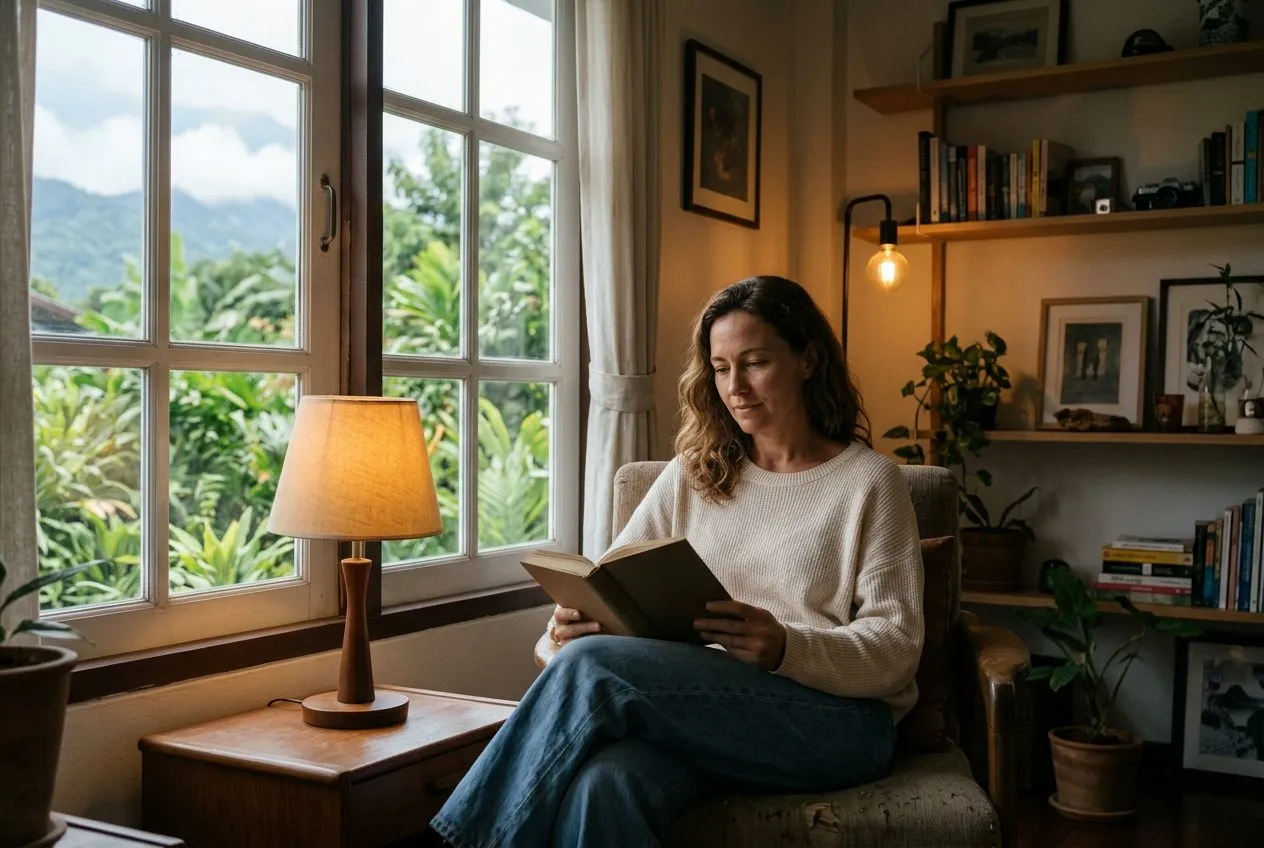
Balancing interior and window light
Diffused fixtures such as softboxes and Kino Flos give a flattering base. Daylight-balanced HMIs bounced through diffusion simulate window spill. Natural light falls off rapidly with distance from a window, following the inverse-square law. White muslin or grid cloth rigged to a wall gives broad bounce. Warm foreground accents such as table lamps and wood against cooler background walls add a sense of depth.
Windows and doorways
An actor against a bright, uncorrected window becomes a silhouette unless interior fill is strong or ND gel is on the glass. To balance, put ND sheets on the windows to lower daylight or bring strong HMI or LED units inside. When staging through open architecture, keep the wall with the door or window slightly darker than the room beside it, and expose the view outside to the same base as the foreground. Painted backdrops (translights) should be lit to match or slightly exceed the interior key, with plants or mullions between window and backdrop to build depth.
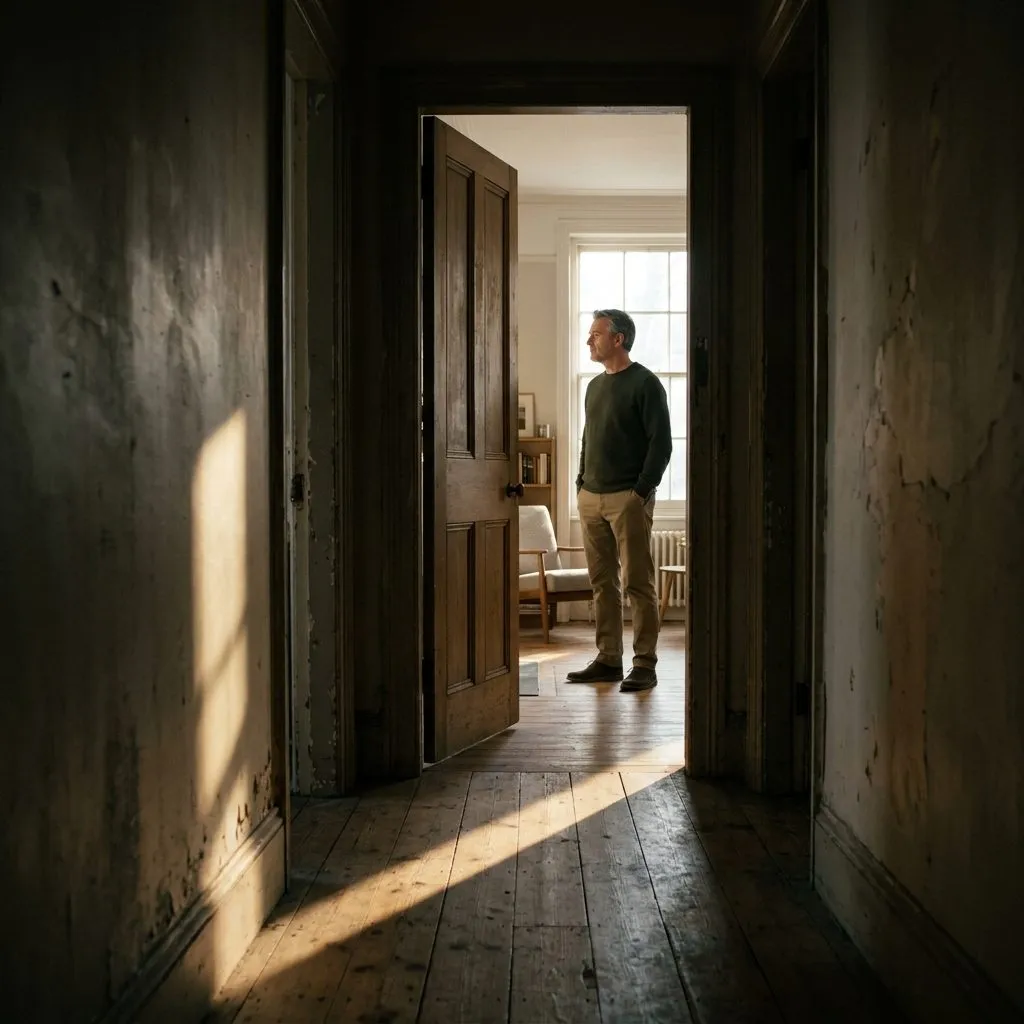
Shooting through a doorway
Quick answers
Which sun angle is best for faces? Three-quarter sun sculpts; backlit sun with open-shade fill is the standard for exterior dialogue.
How do I stop a window from burning out? Add ND gel to the glass or raise interior light with HMI or LED fixtures.
Why does raking light show texture? It casts tiny shadows behind every bump, which makes depth visible.
Read next
- Building a Lighting Setup: Fill, Backlight, Kicker, Eye Light, Background
- Color Temperature, Mireds and CRI Explained for Cinematographers
- Flags, Nets, Diffusion and Gels: Shaping and Controlling Light on Set
Related on this site
- Colour for beginners: why pixel values are not amounts of light
- One light, two worlds: physical units from the film set to the render engine
This article is part of the free handbook Technical Foundation. Filmmaking: The Cinematographer’s Handbook by Semen Klenov, an independent researcher of light and visual perception. Cite the handbook as: Klenov, S. (2026). Technical Foundation. Filmmaking: The Cinematographer’s Handbook. Zenodo. https://doi.org/10.5281/zenodo.24326083.