Home / Journal / Cinematography
Perspective, Depth and Gestalt: How the Eye Reads a Film Frame
Linear and aerial perspective, techniques for enhancing depth, Gestalt laws of perception, figure and ground, and how the viewer's eye moves across a frame.

A film frame is flat, yet viewers read depth, groups, objects and meaning from it in a fraction of a second. This article describes the perceptual rules behind that reading and the practical techniques that use them.
Key points
- Linear perspective makes receding parallel lines converge at a vanishing point. Aerial perspective makes distant objects lower in contrast, softer and bluer.
- Wide-angle lenses expand the perceived distance between planes; telephotos compress it.
- The Gestalt laws, proximity, similarity, closure, simplicity, common fate, continuity and figure-ground, describe how viewers group what they see.
- Bright shapes advance and dark shapes recede.
- The eye tends to enter a frame from the left, scan to the centre and then the right, so elements on the right often act as the punchline.
Perspective and depth

Linear and aerial perspective
Linear perspective converts three-dimensional space into depth on a two-dimensional screen. Atmospheric perspective adds the effect of the air: distant objects lose contrast, soften and shift to cooler blue-grey. Large bright foreground objects can break this illusion if their contrast is not managed. Lens choice changes the impression: a wide angle expands the apparent distance between planes, a telephoto squeezes foreground and background together.
Techniques that enhance depth:
- Choose elevated or deep camera positions that look down long receding vistas.
- Use a wide lens close to foreground elements to exaggerate separation.
- Put warm-coloured objects in the foreground against cool backgrounds.
- Give foreground subjects a punchy key and keep the background softly lit.
- Include repeating elements of known size, such as fence posts, columns or figures, receding into the distance.
- Use shallow depth of field to separate sharp subject from soft background.
- Use haze, dust or smoke to strengthen aerial perspective.
- Use cross-light to cast shadows that stretch across the ground and connect planes.
Gestalt principles
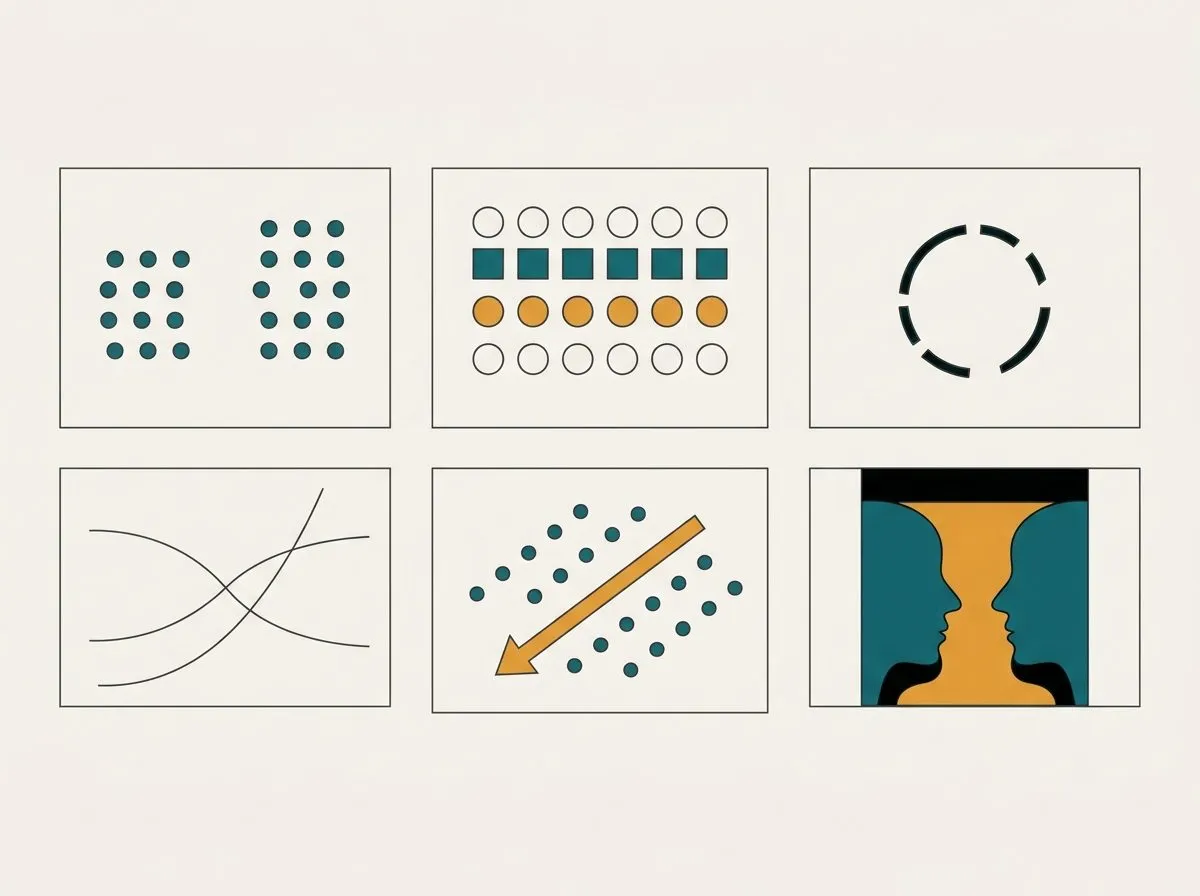
Gestalt principles
Viewers see organized wholes, not fragments.
- Proximity: objects close together are seen as one group.
- Similarity: objects sharing colour, shape or size are grouped.
- Closure: the brain completes an incomplete shape.
- Simplicity (Prägnanz): scenes are interpreted in the simplest, most stable forms.
- Common fate: elements moving in the same direction and speed read as one unit.
- Continuity: the eye follows continuous lines and curves past their endpoints.
- Figure and ground: the subject separates from its background field. High contrast and edge sharpness pull the figure forward.
Visual perception
Viewers see abstractly, as geometry, tonal masses and colour fields, and rationally, recognizing objects, space and dramatic context. The contour defines forms and silhouettes. Because of irradiation, a black shape on white looks slightly smaller than a white shape of the same size on black, and bright shapes advance while dark ones recede. The background is usually less defined and simpler than the figure, and reads as a continuous surface behind it. In the frame, an object’s real dimensions are translated into angular and relative scale.
Some reading habits are common, not universal. A figure in profile facing left often reads as open or communicative, facing right as departing or guarded. Shadows on the right of a form tend to read as convex, on the left as concave. Heavy masses at the top of the frame feel unstable.
Reading the frame
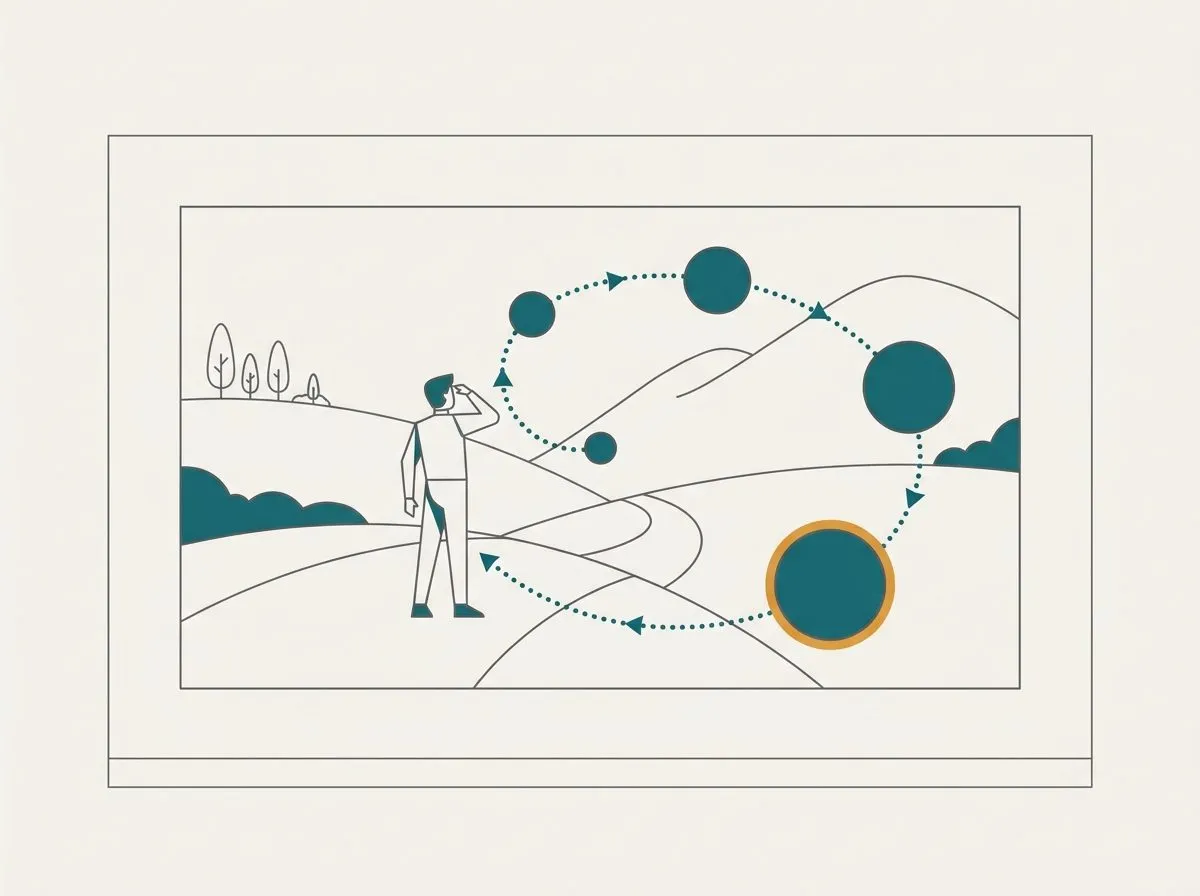
Typical eye path across a frame
The eye tends to enter from the left, find an anchor, and scan toward the centre and right. If the left and centre are dense with information, movement slows, and a secondary element on the right then works as a visual punchline. Central compositions are scanned in quick jumps, so a clean perimeter keeps attention on the centre. Viewers look for balance between the left and right halves, and strong images often combine overall symmetry with nuanced internal asymmetry. A main subject pushed to the far left can leave the rest of the frame feeling empty and pull the eye restlessly into the background. A foreground figure seen from behind, a repoussoir, frames the scene and pushes the viewer into depth. Similarity of scale connects objects more strongly than matching shape or colour.
Aligning leading lines with the frame edges pulls the eye smoothly inward. Weight in the lower half feels physically stable. Open negative space gives a frame room to breathe, and a wide panorama encourages slow scanning across the horizon.
Quick answers
How do I make a flat set look deep? Add foreground, a wider lens, repeating elements receding, haze, and warm foreground against cool background.
What is figure-ground? The separation of the subject from its background; contrast and sharp edges push the figure forward.
Why does the right side of the frame matter? Because many viewers scan left to right, a detail on the right often lands as a conclusion.
Read next
- Composition in Film: Rules, Visual Weight, Shapes, Lines and Camera Angle
- Visual Balance, Rhythm and Contrast in the Film Frame
- Lenses, Focal Length, Aperture and Depth of Field Explained for Filmmakers
Related on this site
- Design and Composition: a practical CGI guide
- A digital photo is not reality: what your camera really records
- How to check an image: a beginner’s method for visual evidence
This article is part of the free handbook Technical Foundation. Filmmaking: The Cinematographer’s Handbook by Semen Klenov, an independent researcher of light and visual perception. Cite the handbook as: Klenov, S. (2026). Technical Foundation. Filmmaking: The Cinematographer’s Handbook. Zenodo. https://doi.org/10.5281/zenodo.24326083.