Delivery and Law: a practical CGI guide
Deliver every frame and duration the platforms need: 16:9, 1:1, 4:5, 9:16; 6, 15 and 30 seconds.
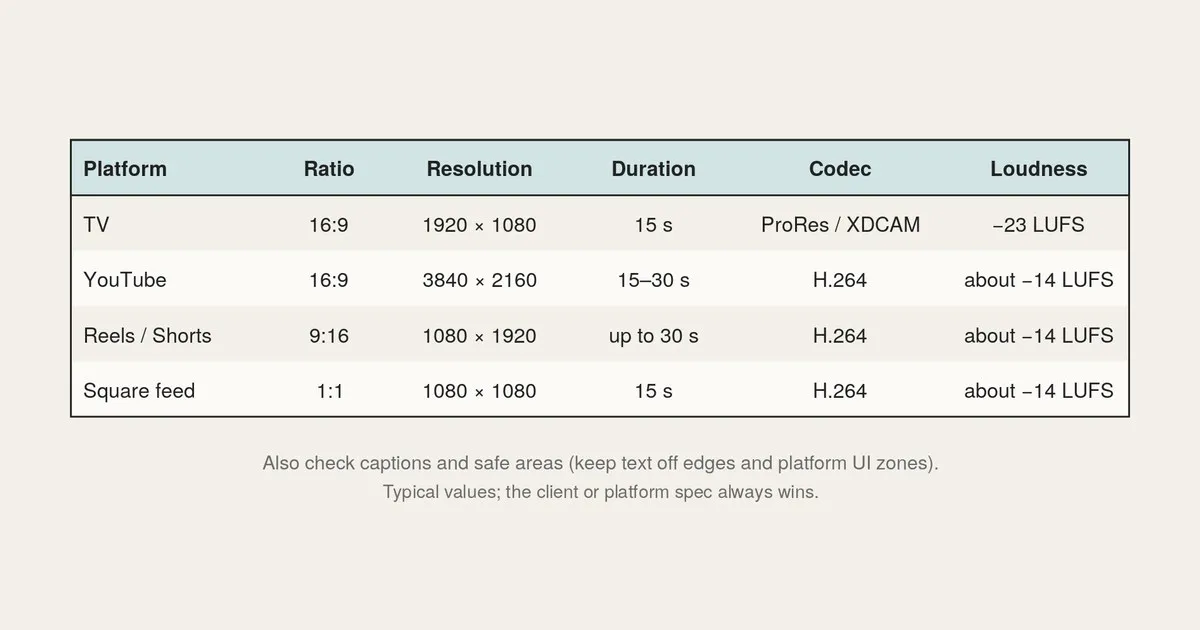
A film is finished only when the client has what they need to run it, and you have been paid for work you are allowed to deliver. The most expensive mistakes in this business are not artistic: a wrong frame size on a platform, an unlicensed song, a logo used without permission, or a contract that says nothing about who owns what. this article is a practical guide, not legal advice; laws differ by country, and large projects need a qualified lawyer.
Key points
- Deliver every frame and duration the platforms need: 16:9, 1:1, 4:5, 9:16; 6, 15 and 30 seconds.
- A contract defines scope, rounds, payment, rights and credit.
- Usage rights depend on media, territory and term.
- Check licenses for every font, model, texture, song and software tool. This is not legal advice: ask a lawyer for real cases.
Platforms, Formats and Specs
- Ratios and uses: 16:9 for TV, YouTube and cinema-style; 1:1 and 4:5 for feeds; 9:16 for Stories, Reels, Shorts and TikTok.
- Durations: Cutdowns of 6, 15 and 30 seconds are common; platforms have their own limits and optimal lengths.
- Resolution and frame rate: 1920 × 1080 or 3840 × 2160 at 24/25/30 fps (or 50/60 for some broadcast); keep the frame rate consistent.
- Codecs: H.264 or H.265 (HEVC) for online delivery; ProRes or DNxHR for broadcast and masters.
- Color and range: Rec.709 for HD, sRGB for web, HDR where requested; check tags and legal levels.
- Audio: Stereo (sometimes 5.1) with loudness targets of the platform; separate stems on request.
- Captions and subtitles: Burned-in or sidecar files (SRT); sound-off viewing makes them essential for social media.
- Safe areas: Keep text and logos away from interface overlays.
- Check the current spec: Always request the platform’s or broadcaster’s delivery specification in writing; they change often.
Delivery Package
- Contents:
- Masters: The highest-quality files.
- Platform versions: Each format and duration, named clearly.
- Stills and key art: The hero frame and promotional images.
- Audio: Mixed audio and stems.
- Captions: Subtitle files per language.
- Documentation: A README with versions, specs and color notes.
- Rights sheet: All third-party assets and their licenses.
- QC: Watch each deliverable from start to finish on a clean player; check sync, levels, text, legal lines, and the first and last frames.
- Transfer: Use a reliable method (client portal, secure link); confirm receipt in writing.
- Archive: Keep project files, caches, sources and masters for the period in the contract; document software versions so the project can be reopened. Delete client confidential files when the contract requires.
Contracts
- A contract: A written agreement before work begins. Even a short one prevents most disputes.
- Key clauses:
- Parties and project description.
- Scope and deliverables: Formats, durations, shots.
- Schedule and milestones.
- Fees and payment terms: Deposit, milestone payments, due dates, late fees, currency.
- Revisions: Number of rounds; billing of extra work.
- Approvals: Who approves and how.
- Client obligations: Assets, feedback within a time, access.
- Intellectual property and usage rights: Who owns what (below).
- Credit: Whether you may show the work and be credited.
- Confidentiality (NDA).
- AI and third-party content: Whether generative tools or stock are allowed and who bears the risk.
- Termination and kill fee: What happens if the project stops.
- Liability and indemnity: Who is responsible for claims.
- Governing law and dispute resolution.
- Keep records: Signed contract, emails with approvals, change orders and invoices.
- Get advice: A lawyer or a professional association template for the first contracts, then adapt.
Rights: Ownership, Licenses and Usage
- Copyright basics: The creator usually owns the copyright in an original work unless it is transferred in writing or created as a work made for hire, which varies by country. Do not assume.
- Transfer vs. license: The client may buy ownership (assignment) or a license to use the work for a defined period, territory and media. Buyouts are priced higher than licenses.
- Usage terms: Media (TV, online, cinema, in-store), territory (country, worldwide), duration (one year, perpetual), exclusivity. Pricing depends on these.
- Showreel rights: Ask for permission to show the work in your portfolio; the contract can allow it after the release date.
- Moral rights and credit: Some countries protect the right to be credited and the integrity of the work.
- Client-supplied material: The client must own or license what they give you (logo, product designs, music); get this in writing.
- Product design and trade dress: The product’s shape can itself be protected; do not modify or imitate others’ products.
Licenses for Assets, Software and Content
- Stock assets (models, textures, HDRIs, sounds): Read the license: commercial use, redistribution of the raw file, whether the asset can be in a client’s product, per-project or per-seat limits.
- Fonts: Desktop, web and video-use licenses differ; a font used in a video usually needs a license for broadcast or digital use; check with the foundry.
- Music: Needs licenses for composition and recording; licensing differs by media and territory. Use libraries with clear commercial terms or commission original music.
- Software: Student, non-commercial and indie licenses limit income; commercial work requires a commercial license.
- Plug-ins and scans: Same rule: commercial use must be allowed.
- Open licenses: Creative Commons has several types; some prohibit commercial use or require attribution; verify which one.
- Rights log: Keep a sheet of every external asset with its license text and link.
Trademarks, People and Claims
- Logos and brands: Use them only with the owner’s permission; show a competitor’s product only after legal review.
- Likeness and releases: A recognizable person (actor, scan, voice) requires a signed release; so do locations and artworks with copyright.
- Claims in advertising: Statements about performance, health or price are regulated (alcohol, pharma, food, finance, children’s products); the client is responsible for approving claims, but you must not fabricate them.
- Misleading imagery: CG that shows a product doing something it cannot, or that hides how it was made where disclosure is required, can be illegal; follow advertising rules and platform disclosure.
- Data and privacy: Interactive projects that collect data must follow privacy law.
- Regulated markets: Rules differ by country; confirm with the agency or the client’s legal team.
Invoicing and Getting Paid
- Invoice details: Your legal details, client details, project, amount, taxes where applicable, due date and payment instructions.
- Deposits: A payment before work begins reduces risk, especially with new clients.
- Milestones: Payments tied to approvals.
- Late payment: State terms and follow up on time; stop delivery of final files until payment when the contract allows.
- Currency and banking: International clients: agree on currency, who pays transfer fees, and the payment method.
- Taxes: Local rules apply; consult an accountant.
In the tools
- Documents: Contract templates from professional associations, a rights sheet and an invoice template in your project folder.
- Delivery: Resolve/Premiere/Media Encoder with presets for each platform; FFmpeg for batch conversions; subtitle editors.
- Verification: MediaInfo or ffprobe to check codec, frame rate, resolution and color tags.
Common mistakes
- Starting without a written agreement.
- Using music or fonts with no commercial license.
- Delivering only one format.
- Not asking for permission to show the work.
- Vague terms for extra revisions.