How Advertising Is Made: a practical CGI guide
Advertising involves the brand, the agency, the production company and the CG studio, each with its own goal.
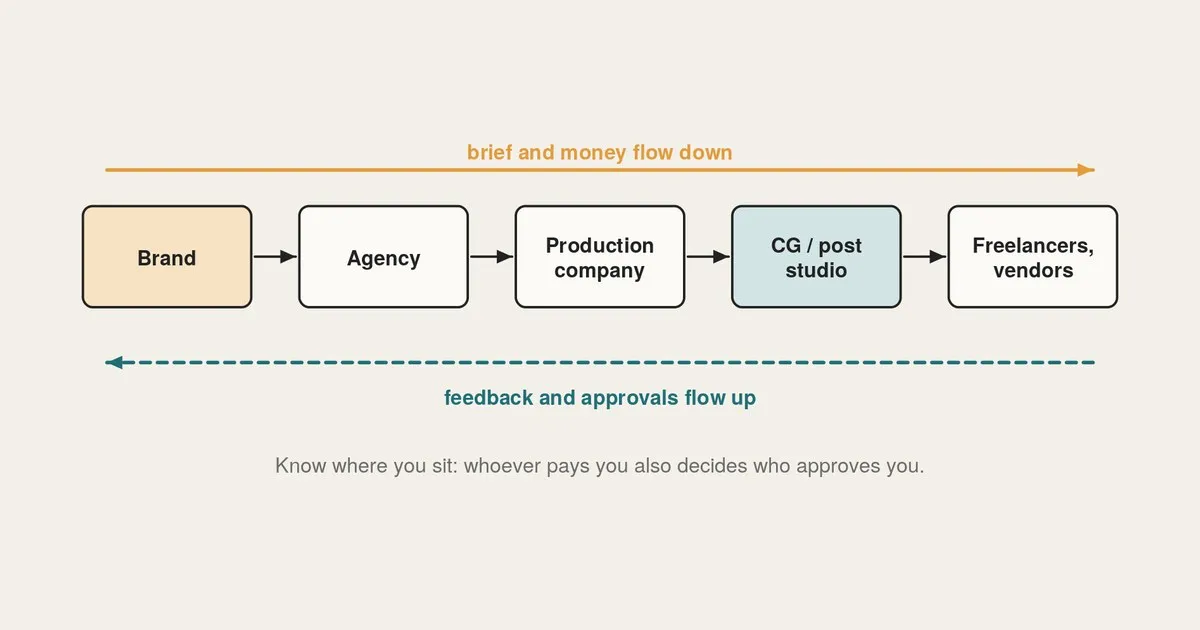
Most CG artists learn tools for years and never learn who they are working for. In advertising, the same shot can be a success or a failure depending on who asked for it, what they asked, and how the money and approvals flow. Knowing the industry saves weeks of confusion and is part of what makes a freelancer a professional.
Key points
- Advertising involves the brand, the agency, the production company and the CG studio, each with its own goal.
- A brief answers: goal, audience, message, deliverables, usage, budget and deadline.
- Ask questions before you start; most expensive mistakes come from an unclear brief.
The Players
- Brand (client, advertiser): The company whose product is advertised. The marketing team owns the budget and approves the work.
- Agency: Develops the idea: strategy, creative concept, copy and design. Large brands often work with an agency of record; smaller ones work directly with production.
- Production company: Produces the film: directs, shoots, hires crews and manages the budget.
- CG / VFX / post studio: Builds the CGI, animation, compositing and finishing, either for a production company or directly for the agency.
- Freelancers and specialists: Modelers, lookdev and lighting artists, FX artists, animators, compositors, colorists, editors, sound designers.
- Vendors: Render farms, stock libraries, music composers, voice-over studios, tools and licenses.
- Where you may sit: As a freelancer in a studio team; as a small studio serving agencies; or directly as a vendor to a brand.
Roles in a CGI Spot
| Role | What they decide |
|---|---|
| Account manager / producer (agency) | Budget, timeline and communication with the client |
| Creative director | The idea and its quality |
| Art director / copywriter | Look and words |
| Director | The film’s vision and shot design |
| Executive producer / producer (production) | Money, schedule, people |
| CG supervisor | Technical solutions, quality and pipeline |
| Lead artists (modeling, lookdev, lighting, FX, animation) | Their disciplines |
| Compositor / colorist / editor / sound designer | Finishing |
| Technical director (TD) | Tools, automation, problem-solving |
- Small teams: In small projects one person may do modeling, lookdev, lighting and comp. The roles remain even if the person is one.
- Decisions flow: Client → agency creative → director → CG supervisor → artists. Feedback travels the reverse way; keep it organized.
- Credits and responsibility: Know whose decision it is before you start a change.
The Brief
- What a brief is: A short document from the client or agency describing what is needed.
- Typical contents:
- Objective: What the film must achieve (launch, awareness, sales).
- Audience: Who will see it.
- Key message and tone.
- Mandatories: Logo, claims, legal lines, product accuracy, brand colors.
- Deliverables: Durations, formats, platforms, languages.
- Budget and timeline.
- References: Examples of the look desired.
- Bad briefs: “Make it premium” and “like Apple” without specifics. Your job is to turn this into precise questions.
Reading a Brief: Questions to Ask
- Deliverables: How many films, lengths, aspect ratios, languages, versions, stills?
- Product data: Real product available, CAD, colors, labels, measurements, packaging variants?
- Approvals: Who signs off, how many rounds, how long does the client need between rounds?
- Look: What is like the reference and what is not?
- Usage: Where will it run (broadcast, social, in-store screen, cinema)? For how long and in which countries?
- Assets provided: Music, voice, fonts, logo files.
- Constraints: Legal claims, regulated categories (alcohol, pharma, finance), restricted content.
- Budget: A range, or a fixed amount? Is it production only or does it include agency fees?
- Timeline: Final delivery date and milestones.
- Success measure: What does the client consider a good result?
- Rule: A question asked in week one costs nothing; the same question in week six costs a re-render.
Types of CGI Work
- Packshots and e-commerce: Hero images and turntables of products; high volume, repeatable.
- Beauty shots: Stylized hero images with dramatic light and effects.
- Product spots: 6–30 second films with story, animation and simulation.
- Motion graphics and social content: Short loops and series.
- Hybrid live-action and CG: Product or environment enhancement in a shot film.
- Interactive and real-time: Configurators and installations.
- Pitch visuals and previs: Quick work to win a project.
- Which to choose: Match your skills, equipment and price level; start with packshots and short loops to build a reel.
In the tools
- Briefing: A shared document or board with the brief, questions and answers, kept with the project.
- Tracking: Task and review tools (Notion, Trello, ShotGrid, ftrack, Kitsu) to track shots and decisions.
- Communication log: Keep a simple log of decisions and approvals by date and name.
Common mistakes
- Starting work from a vague brief without questions.
- Not knowing who approves.
- Ignoring the intended platforms and formats.
- Pricing before understanding deliverables.
- Mixing roles: the client’s marketing preferences against the agency’s creative direction.